
American millipede
Narceus americanus
Description
How to identify
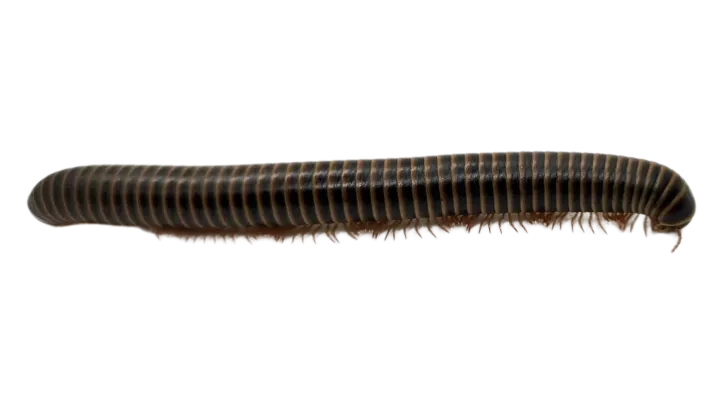
The American millipede (Narceus americanus) belongs to the class Diplopoda, family Spirobolidae. These organisms possess a cylindrical, elongated body composed of numerous segments, each typically bearing two pairs of legs, which is their hallmark feature.
Adults can grow up to 10 centimeters in length and exhibit a dark brown to black coloration, often accented by reddish or orange bands along the segments. They are renowned for their defensive behavior of curling into a tight spiral when disturbed.
Their biology is inextricably linked to high moisture and organic matter. They thrive in forest floors, compost piles, and damp soil, where they play a vital role as decomposers but can become problematic in agricultural environments.
The life cycle involves an egg stage, followed by several nymphal stages. As they grow, they undergo multiple molts, increasing their segment count and leg number with each cycle, which is a characteristic growth pattern for the species.
In suitable conditions, with abundant moisture and shelter, the population can expand rapidly. They are primarily nocturnal and shy away from bright light, spending daylight hours deep within the soil or under debris.
What it damages
American millipedes cause damage to a wide range of crops, showing a strong preference for tender seedlings and storage roots such as carrots, potatoes, and beets. They are particularly attracted to tissues that are already softening, but will readily feed on healthy, succulent roots.
They damage crops by gnawing tunnels into the flesh of roots and tubers. These excavations not only destroy the structural integrity of the vegetable but also introduce pathogens that lead to rot and decay, rendering the crop unmarketable.
Seedlings are highly vulnerable to attack. By feeding on the roots or the stem near the soil level, millipedes can cause rapid wilting and plant death, often resulting in significant gaps in planting rows or entire crop failure in severe cases.
Greenhouse environments are particularly susceptible to damage due to consistent humidity and the presence of organic potting mixes. In these conditions, millipedes can remain active throughout the entire growing season.
The overall impact on productivity is magnified by secondary infections. The wounds caused by the millipedes serve as entry points for various soil-borne bacteria and fungi, which often accelerate plant deterioration more quickly than the feeding activity itself.
Signs of infestation
The most common sign of infestation is the presence of characteristic crater-like lesions or small circular holes in root crops. These wounds are frequently darkened and surrounded by soft, rotting plant tissue.
Sudden, unexplained wilting of plants is a major red flag. When this occurs, inspecting the soil around the root zone often reveals the millipedes themselves, especially if the soil is kept consistently damp.
A distinctive odor can sometimes be detected during heavy infestations. Millipedes release defensive chemicals, including hydrocyanic acid derivatives, which have a pungent smell that can be noticeable in enclosed spaces like greenhouses.
Finding millipedes under boards, mulched areas, or piles of organic waste is a strong indicator that their population is present on your site and likely contributing to root damage in adjacent beds.
Surface feeding marks on leaves that touch the soil can also indicate their presence during periods of drought when the pests are forced to seek moisture from the aerial parts of the plant.
Control measures
Effective management begins with sanitation. Removing excessive mulch and plant debris significantly reduces the habitat and food sources that allow millipede populations to thrive near sensitive crops.
- Tilling the soil deeply in the autumn to expose overwintering stages to cold and predators.
- Using trap crops or potato traps (buried half-potatoes) to attract and manually collect the pests.
- Proper irrigation management to prevent the soil from remaining excessively waterlogged for long periods.
- Avoiding the application of uncomposted organic fertilizers which can attract breeding populations.
- Encouraging natural predators such as ground beetles, spiders, and birds on the property.
Chemical control is often difficult due to the millipede's hardened exoskeleton and subterranean lifestyle. If necessary, granular soil-applied insecticides should be used sparingly and strictly according to the product label.
Biological control methods, such as the use of entomopathogenic fungi, offer a sustainable alternative. These biological agents can suppress millipede populations over time without leaving harmful residues in the food supply.
Placing barriers of diatomaceous earth or wood ash around the base of plants can provide a temporary deterrent, as the desiccant and alkaline properties irritate the millipede's body and discourage them from crossing.
Taxonomy
- Latin name
- Narceus americanus
- Family
- Spirobolidae
- EPPO code
- NARCAM
Discussion
No discussions yet — be the first.