
Flathead borer
Myoplatypus
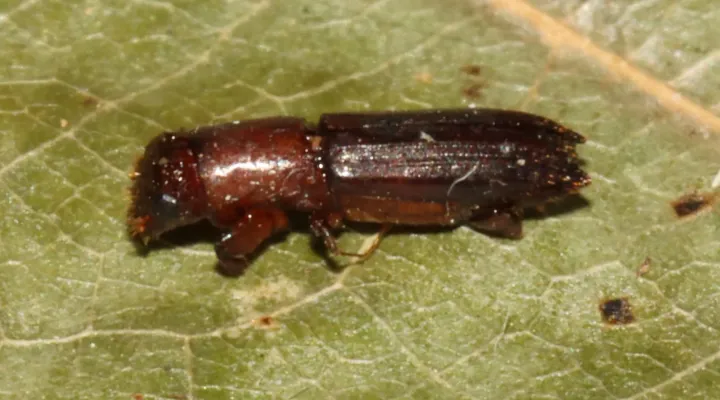
Description
How to identify
Flathead borers belong to a specific group of beetles known for their flattened body shape, which is a structural adaptation for navigating narrow galleries within tree trunks and branches.
The adults are typically characterized by a cylindrical but dorsoventrally flattened body. Their head is usually retracted into the prothorax, and their antennae end in a distinct club.
The coloration of these beetles is generally dark brown or black, often with a subtle sheen. These features help them camouflage effectively against the bark of host trees.
Larvae are legless, white, and fleshy, typical of many wood-boring species. They remain inside the wood throughout their entire larval development stage, protected by the tree tissues.
A fascinating biological feature is their association with symbiotic fungi. Females carry fungal spores in specialized organs, inoculating the tunnel walls to provide a food source for their larvae.
What it damages
These pests primarily target weakened or stressed trees, including orchard species like apple, pear, and plum, as well as various forest timber species.
Damage occurs when larvae create intricate tunnels in the sapwood and heartwood. This activity disrupts the transport of water and nutrients, often leading to canopy dieback.
The fungi introduced by the borers cause wood decay and tissue necrosis, which exacerbates the structural damage and significantly weakens the host tree's overall integrity.
In orchards, heavy infestations can result in the rapid death of young or poorly maintained trees, causing significant economic losses to the producer.
The presence of these pests reduces the timber value in forest stands, as the tunnels provide entry points for secondary pathogens and wood-rotting fungi.
When it appears
Adult flight usually begins in late spring, triggered by rising temperatures. The exact timing varies depending on the geographic location and the local climate.
During the summer months, adults are most active in searching for suitable host trees to initiate new galleries and oviposit their eggs into the bark crevices.
Larval development takes place throughout the summer and can extend into the autumn. They feed and expand their tunnels as they consume the wood and associated fungal growth.
Overwintering typically occurs within the tree galleries as mature larvae or young adults, protected from the harsh winter conditions by the wood itself.
Monitoring the activity of the pest is crucial during the peak flight season to implement timely protective measures before the infestation becomes widespread.
Signs of infestation
The most reliable sign of a flathead borer infestation is the presence of numerous small, circular exit or entrance holes on the surface of the bark, often just a few millimeters in diameter.
- Fine, sawdust-like frass accumulating in bark crevices or at the base of the tree.
- Patches of dead or discolored bark surrounding the gallery openings.
- Premature yellowing or shedding of leaves on affected branches during the growing season.
- Dieback of the crown or specific limbs, which often appears sudden.
- Exudation of sap or gum from the holes on certain fruit tree species.
If you suspect an infestation, inspecting the wood beneath the bark will reveal the characteristic branched tunnel system that indicates the presence of the larvae.
Control measures
The best defense against these borers is maintaining tree vigor. Proper irrigation, fertilization, and soil management help trees resist beetle attacks naturally.
Sanitation is a critical control method. Prune and remove infested limbs or entire trees immediately, ensuring all wood is destroyed to prevent the pests from spreading.
Trunk applications of appropriate insecticides can protect susceptible trees during the peak adult flight period, acting as a barrier against new infestation attempts.
Systemic insecticides, often applied via trunk injection, are highly effective as they target the larvae feeding within the wood, providing a direct treatment method.
Monitoring using pheromone traps can help track population levels, allowing for precise timing of chemical applications and reducing the need for broad-spectrum spraying.
Taxonomy
- Latin name
- Myoplatypus
- Order
- Coleoptera (beetles)
- Family
- Curculionidae
- EPPO code
- MPLTSP
Discussion
No discussions yet — be the first.