
Myllocerus undecimpunctulatus
Myllocerus undecimpunctulatus
Description
How to identify
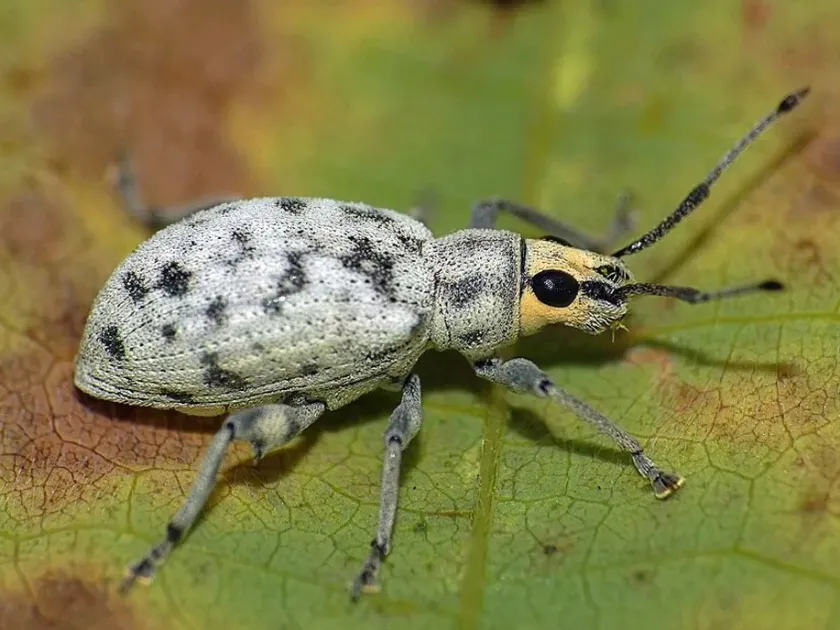
Myllocerus undecimpunctulatus is a species of snout beetle (Curculionidae) belonging to the order Coleoptera. Adult beetles are characterized by their small size and bodies covered in scales, which form a specific spotted pattern that provides effective camouflage.
The morphology of the beetle includes a distinct rostrum (snout) typical of the Curculionidae family. The larvae are soil-dwelling, legless, cream-colored, and curved in shape, which helps them move through the substrate and feed on roots.
This species is a polyphagous pest, meaning it adapts to various host plants, including legumes, cotton, and various horticultural crops. Beetles exhibit a defense mechanism known as thanatosis, where they feign death and drop to the ground when disturbed.
Reproduction involves laying eggs in the soil or near the root zone of host plants. This strategy ensures that the larvae have an immediate food source once they hatch, which is critical for their survival in the early stages of development.
The life cycle consists of egg, larva, pupa, and adult stages. Depending on local climatic conditions, the species may complete one or more generations per year, significantly impacting the population dynamics and pest pressure in agricultural areas.
What it damages
The pest attacks a wide range of agricultural crops, causing significant damage to both foliage and root systems. The polyphagous nature of the beetle allows it to survive on various weeds and crops, making it a persistent challenge for farmers.
Adult beetles feed on leaves, creating characteristic semicircular notches along the margins, often referred to as "leaf notching." Severe infestations can lead to complete defoliation, which reduces the plant's ability to photosynthesize and grow.
The larvae cause damage by feeding on young roots and root hairs. This root damage impairs the plant's uptake of water and essential nutrients, leading to stunted growth, wilting, and increased susceptibility to secondary infections.
When young seedlings are attacked, the combination of foliar damage and root pruning often leads to total plant death, causing significant yield losses and the need for field replanting in severe cases.
Mature plants may survive the attack but will show reduced vigor and lower productivity. The cumulative impact of larval and adult feeding can substantially decrease the economic viability of the affected crop.
Signs of infestation
The primary sign of infestation is the presence of serrated or notched leaf edges caused by adult beetles. Careful observation during the day might reveal the beetles hiding on the undersides of leaves or within dense foliage.
Sudden wilting of plants in the absence of water stress indicates potential root damage caused by larval activity in the soil. Checking the rhizosphere of affected plants often reveals the larvae.
Uneven patches in the field, characterized by stunted or chlorotic plants, often indicate areas of higher pest concentration. These "hotspots" should be the first areas monitored for population spikes.
Increased bird activity in the field can be an indirect sign of a high larval population in the topsoil, as birds often forage for these insects in disturbed soil.
On young fruit trees, damage to budding leaves or young buds during the spring growth phase is a key indicator that the population has emerged and begun active feeding.
Control measures
Cultural control measures, such as deep autumn plowing, are highly effective in disrupting the pupal stage of the pest in the soil. This practice significantly reduces the overwintering population.
Crop rotation is essential to break the pest's life cycle by removing the host plants on which it depends. Maintaining weed-free borders and fields further limits the habitat available for adult beetles.
Chemical control involves the application of systemic or contact insecticides during peak beetle emergence. Strategic timing is critical, ensuring treatments are applied before the females lay their eggs.
Biological control, including the use of entomopathogenic fungi or nematodes, can be used to target the soil-dwelling larvae. These methods are environmentally friendly and can provide long-term suppression of the pest population.
- Deep tillage to destroy pupae.
- Weed management to reduce host availability.
- Targeted insecticide application based on economic thresholds.
- Crop rotation to disrupt the pest cycle.
Taxonomy
- Latin name
- Myllocerus undecimpunctulatus
- Order
- Coleoptera (beetles)
- Family
- Curculionidae
- EPPO code
- MYLLUC
Discussion
No discussions yet — be the first.