
Myllocerus undatus weevil
Myllocerus undatus
Description
How to identify
The weevil Myllocerus undatus belongs to the order Coleoptera and the family Curculionidae. These insects are typical pests in tropical and subtropical climates, causing damage to various plant species.
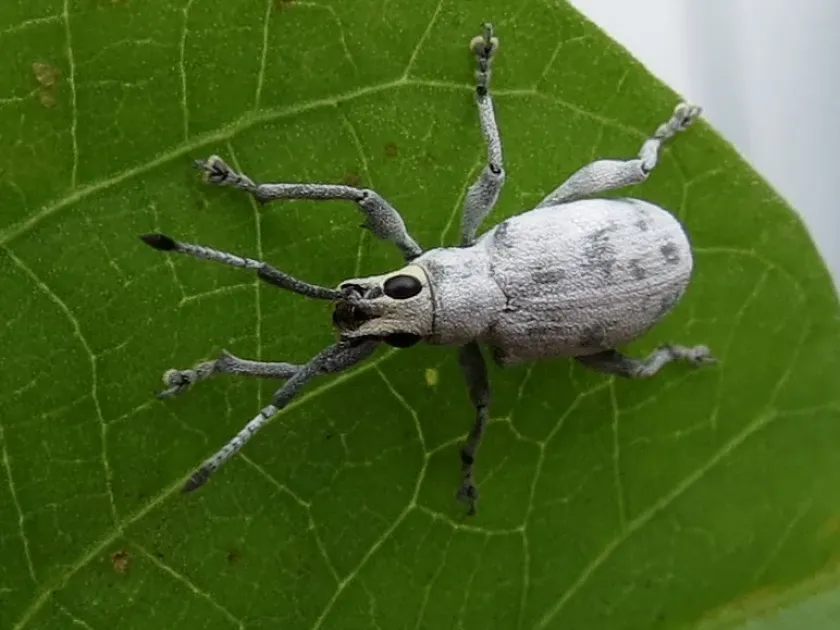
Adults exhibit a typical weevil morphology with a prominent rostrum. The body is often covered in small scales, which can vary in color and pattern, aiding in camouflage against host plants.
The larval stage is spent primarily underground or within the plant tissue, making them difficult to detect during standard field inspections without soil sampling.
Adults are active during the day, feeding on the foliage, while larvae focus their destructive activities on the root systems or the base of the stems, leading to severe plant stress.
Accurate species identification usually requires professional entomological examination of structural traits, such as the shape of the snout and the pattern of the scales on the elytra.
What it damages
This pest is known for its polyphagous habits, attacking a diverse range of crops including cotton, legumes, and several horticultural tree varieties, leading to economic losses.
Adults create characteristic notches along the leaf margins, significantly reducing the leaf area available for photosynthesis and weakening the overall vitality of the plant.
Larval feeding on roots interferes with the plant's ability to uptake water and essential minerals, which often causes the host plant to wilt and eventually collapse under stress.
High populations of Myllocerus undatus can severely impact yield quality and quantity, especially when the infestation occurs during the critical stages of plant development.
The physical trauma caused by both larvae and adults serves as a point of entry for various opportunistic fungal and bacterial pathogens that further degrade crop health.
Signs of infestation
The most recognizable sign of infestation is the notched or serrated appearance of leaf edges, caused by adult weevils feeding on the foliage.
Sudden wilting of plants during peak sunlight hours is a strong indicator of root damage, often caused by larvae feeding beneath the soil surface.
Presence of cream-colored, curved larvae in the soil around the base of the plant confirms the infestation and provides a baseline for evaluating the severity of the problem.
Finding adult weevils on the underside of leaves, especially in the morning, is a reliable sign of active population presence within the field.
Small droppings (frass) observed on the leaves are clear evidence of recent feeding activity, allowing farmers to track the movement and spread of the pest population.
Control measures
Effective management of Myllocerus undatus requires an integrated approach, utilizing multiple control tactics to keep populations below economic injury levels.
Cultural practices, specifically deep plowing of fields after harvest, play a crucial role in disrupting the life cycle of the weevil by exposing larvae to adverse conditions.
Biological control options, such as applying beneficial nematodes or entomopathogenic fungi, are highly effective in suppressing larval populations within the soil environment.
Chemical control involving systemic or contact insecticides should be applied strategically, targeting the period when adult emergence is at its peak.
- Crop rotation to break the pest's reproductive cycle.
- Monitoring with light traps to detect adult emergence.
- Sanitation by removing alternative weed hosts that harbor the population.
Taxonomy
- Latin name
- Myllocerus undatus
- Order
- Coleoptera (beetles)
- Family
- Curculionidae
- EPPO code
- MYLLUD
Discussion
No discussions yet — be the first.