
Myllocerus laetevirens weevil
Myllocerus laetevirens
Description
How to identify
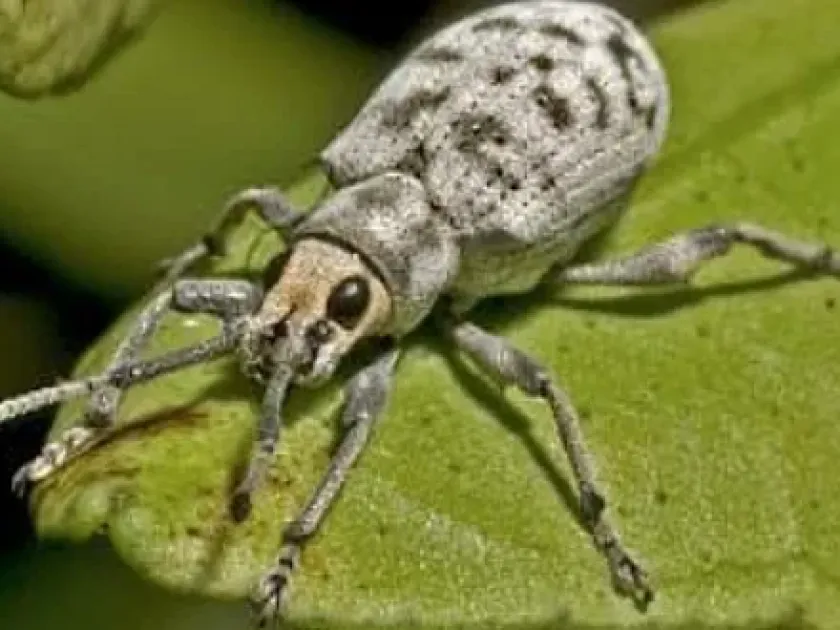
The Myllocerus laetevirens beetle is a small insect belonging to the Curculionidae family. Its body is covered with fine scales, which provide a distinctive greenish or grayish coloration, offering excellent camouflage against leaf surfaces.
The rostrum (snout) is of moderate length, typical for the Entiminae subfamily. They possess geniculate (elbowed) antennae, which are a diagnostic feature of these snout beetles, assisting in navigation and sensory perception.
The larvae are typically apodous (legless), white or cream-colored, with a hardened, darkened head capsule. They are adapted for a subterranean life, feeding primarily on the roots of various host plants.
Taxonomically, this species is classified within the order Coleoptera. Proper identification usually requires an examination of the male genitalia (aedeagus) or specific patterns of the scales on the elytra under magnification.
These pests thrive in warm climates, where the environmental conditions facilitate rapid development and allow for the completion of their life cycle within a single growing season.
What it damages
Myllocerus laetevirens is a known polyphagous pest, meaning it attacks a wide range of agricultural and wild plant species, causing economic losses in legumes, orchards, and technical crops.
Adult beetles feed primarily on the foliage, creating characteristic semi-circular or irregular notches along the leaf margins. This feeding habit is often referred to as "notching" and can significantly reduce the photosynthetic capacity of the plants.
The larvae cause hidden damage by feeding on the root systems. This underground activity weakens the plant, impairing its ability to uptake water and nutrients, which often leads to stunted growth or complete plant failure.
High infestations often result in severe defoliation of the canopy, negatively impacting the plant's overall health and reducing yield quality and quantity at harvest.
- Legumes (soybeans, beans)
- Fruit trees (pome and stone fruits)
- Berry bushes
- Ornamental nursery plants
When it appears
Adult activity typically begins in the spring as soil temperatures rise, prompting the beetles to emerge from their overwintering sites in the soil or plant debris to begin feeding.
Peak activity often correlates with the early vegetative growth stages of host plants. During these periods, the beetles are most visible on the leaves during the day, although they are known to exhibit "playing dead" behavior.
Mating and oviposition occur in the soil near the host plants. Females lay eggs in small clusters, ensuring the emerging larvae have immediate access to food sources upon hatching.
The species can have multiple generations per year depending on the regional climate. Feeding continues throughout the summer months until temperatures decline in the autumn.
Overwintering occurs primarily at the adult stage, where the beetles find refuge in the soil or protected areas, allowing them to withstand the harsh conditions of the dormant season.
Signs of infestation
The primary symptom of infestation is the presence of distinct "notches" on the leaf edges. These patterns are highly characteristic and serve as the main visual indicator of weevil activity.
Beetles can be detected by carefully inspecting the undersides of leaves or by using the "beat sheet" method—shaking branches over a white cloth to dislodge the insects.
General yellowing or wilting of the plant, without any obvious signs of disease, often indicates that root-feeding larvae have compromised the plant's structural integrity.
Excavating the soil around the root zone may reveal the presence of the white, legless larvae, confirming the underlying cause of the observed plant stress.
Reduced crop density in patches within the field is often a late-stage sign of a significant infestation that has been ongoing for some time.
Control measures
Implementing a robust crop rotation program is a fundamental management practice that disrupts the weevil's life cycle and reduces the available food source for emerging larvae.
Tillage operations, especially deep autumn plowing, are highly effective as they disturb the soil and expose larvae and pupae to predators and adverse weather conditions.
Chemical control involving systemic insecticides is recommended if monitoring reveals that pest populations have exceeded the economic injury level, particularly during peak adult emergence.
Biological control agents, including entomopathogenic fungi like Beauveria bassiana or beneficial nematodes, can be applied to the soil to target the larval stages effectively.
Regular monitoring using traps or field surveys is essential for informed decision-making, allowing for timely interventions and reducing reliance on broad-spectrum pesticides.
Taxonomy
- Latin name
- Myllocerus laetevirens
- Order
- Coleoptera (beetles)
- Family
- Curculionidae
- EPPO code
- MYLLLA
Discussion
No discussions yet — be the first.