
Myllocerus dorsatus
Myllocerus dorsatus
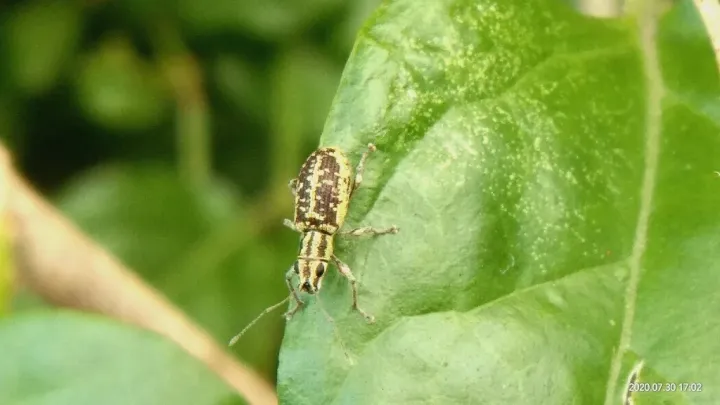
Description
How to identify
Myllocerus dorsatus is a species belonging to the order Coleoptera and the family Curculionidae, commonly known as true weevils.
The adult insects are characterized by a snout-like extension of the head, which is typical for the Curculionidae family members.
Their bodies are covered with dense scales, providing them with a mottled, grayish or brown appearance that acts as effective camouflage.
The life cycle undergoes complete metamorphosis, including egg, larva, pupa, and adult stages, with each stage inhabiting specific environments.
Accurate identification of this species often requires examination of the pronotal surface and oral structures under magnification by an entomologist.
What it damages
This pest acts as a polyphage, meaning it infests a wide range of agricultural crops, including vegetables, fruits, and several technical crops.
Larval stages are known to cause damage by feeding on root systems, which significantly weakens the host plant's ability to absorb water and nutrients.
Adult weevils consume the aerial parts of the plant, primarily feeding on the leaf margins, which is referred to as "notching" or leaf-edge damage.
Severe infestations can lead to substantial reduction in crop vigor, leading to stunted growth and potentially total loss of the harvestable product.
Feeding wounds created by the adults often serve as entry points for secondary pathogens, facilitating the development of plant diseases.
When it appears
Adult emergence typically coincides with the onset of favorable spring temperatures, signaling the beginning of their active feeding period.
The peak activity of the beetles often overlaps with the critical stages of plant development, such as flowering and fruit set.
Larvae remain active in the soil throughout the summer months, utilizing soil moisture for their development and continued feeding on roots.
The number of generations per year is highly dependent on regional climate conditions, temperature accumulation, and food availability.
As the season comes to an end, adults seek out overwintering sites, typically burrowing into the soil or hiding under dense plant debris.
Signs of infestation
The most prominent sign of infestation is the characteristic irregular or serrated appearance of leaf margins, often called "notching".
Plants displaying signs of wilting during daylight hours often indicate that larvae have caused extensive damage to the root system below ground.
Direct observation of the root zone can reveal the presence of the larvae or the tracks/tunnels they have carved into the roots.
General plant decline, including yellowing leaves and reduced vigor, often points to an underlying root-feeding pest problem.
Monitoring the undersides of leaves during the early morning hours is an effective way to detect adults that hide from intense sunlight.
Control measures
Implementing a proper crop rotation scheme is essential to disrupt the life cycle of the weevils and reduce population density.
Deep tillage after the harvest season helps destroy larvae and pupae residing in the soil by exposing them to desiccation and predators.
Systemic insecticides may be used when the population reaches an economic threshold to protect the crop during critical growth stages.
Maintaining clean fields by removing weeds is a crucial cultural control method, as weeds can act as alternative hosts.
- Using sticky traps for early pest detection and monitoring;
- Ensuring timely removal of crop residues to limit nesting sites;
- Applying biological controls, such as entomopathogenic fungi or nematodes.
Taxonomy
- Latin name
- Myllocerus dorsatus
- Order
- Coleoptera (beetles)
- Family
- Curculionidae
- EPPO code
- MYLLDO
Discussion
No discussions yet — be the first.