
Myllocerus weevil
Myllocerus
Description
How to identify
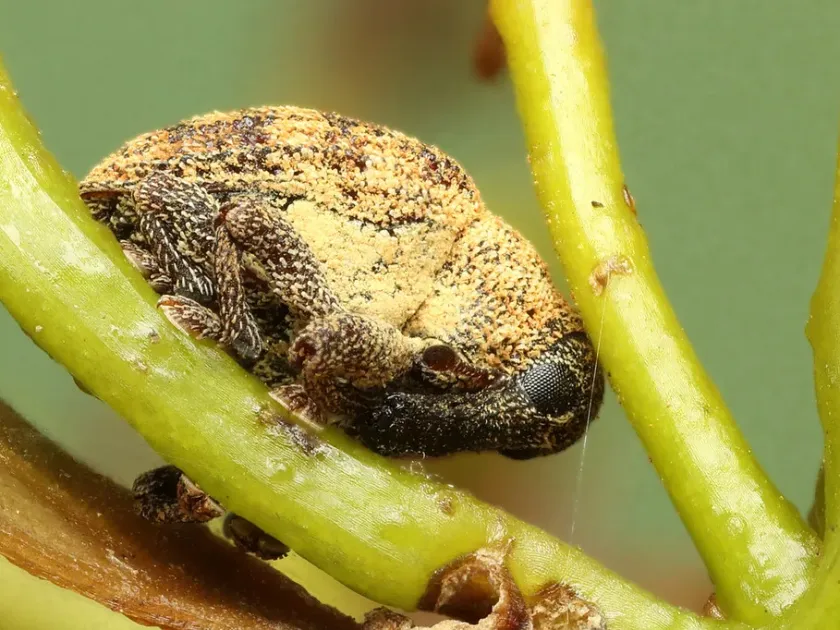
The Myllocerus genus belongs to the Curculionidae family of beetles. These are small insects, typically ranging from 5 to 10 mm in length.
Adult weevils are often covered in fine scales, which provide effective camouflage, allowing them to blend in with soil, bark, or leaf surfaces.
The key morphological feature is their short, broad snout (rostrum), which differentiates them from many other long-snouted weevil species.
Larvae are typically white, legless grubs with a well-developed head capsule, perfectly adapted for a subterranean lifestyle where they feed on plant roots.
They undergo complete metamorphosis (egg, larva, pupa, adult), with adults often being the most conspicuous stage causing visible foliage damage.
What it damages
These weevils are generalist polyphagous pests that attack a wide array of crops, including fruits, vegetables, and ornamental plants.
Significant economic damage is frequently reported in cotton, citrus orchards, legumes, and roses, where they can severely impact plant health.
Adults feed on foliage, creating characteristic semi-circular notches along the leaf margins, which can progress to complete leaf skeletonization.
Larval stages are subterranean and feed on roots, causing stunted growth, wilting, and in severe cases, the death of young seedlings or nursery stock.
The combined effect of foliar and root damage significantly lowers the plant's vigor, making it more susceptible to environmental stress and secondary infections.
When it appears
Adult weevils typically emerge in early spring as temperatures rise, coinciding with the flush of new growth on host plants.
The peak activity and feeding period for adults occur throughout late spring and early summer when plants are at their most vulnerable growth stage.
Eggs are laid in the soil near the root zone of host plants, where larvae begin feeding immediately upon hatching during the warm months.
Depending on the climatic zone, the pest may complete multiple generations within a single growing season, leading to persistent infestations.
As autumn approaches and temperatures drop, adults move into the soil or under leaf litter to enter a state of diapause for the winter season.
Signs of infestation
The most reliable sign of a Myllocerus infestation is the presence of irregular, notched patterns along the edges of leaves.
Sudden wilting or chlorosis of the plant, especially in the absence of obvious water stress, often points to hidden root damage caused by larvae.
Adults are often observed by shaking branches over a white sheet in the early morning, as they tend to drop to the ground when disturbed.
Small exit holes in the soil around the base of the plant indicate the emergence of new adult weevils from the soil surface.
- Notched leaf margins (scalloped edges).
- Wilting of young plants due to root damage.
- Visible beetles on leaves during dawn or dusk.
- Reduced vigor and delayed development of crops.
Control measures
Cultural control involves systematic weeding to eliminate alternate host plants that can sustain the weevil population during the off-season.
Deep plowing or mechanical cultivation of the soil during the pre-planting phase helps expose and destroy subterranean larvae and pupae.
For high-value crops, sticky barriers or bands on tree trunks can successfully intercept adults as they migrate from the soil into the canopy.
Chemical control with contact or systemic insecticides is recommended during periods of high adult activity to prevent widespread defoliation.
Biological control agents, such as entomopathogenic nematodes or fungi, can be applied to the soil to suppress the larval population naturally.
Taxonomy
- Latin name
- Myllocerus
- Order
- Coleoptera (beetles)
- Family
- Curculionidae
- EPPO code
- MYLLSP
Discussion
No discussions yet — be the first.