
House mouse
Mus
Description
How to identify
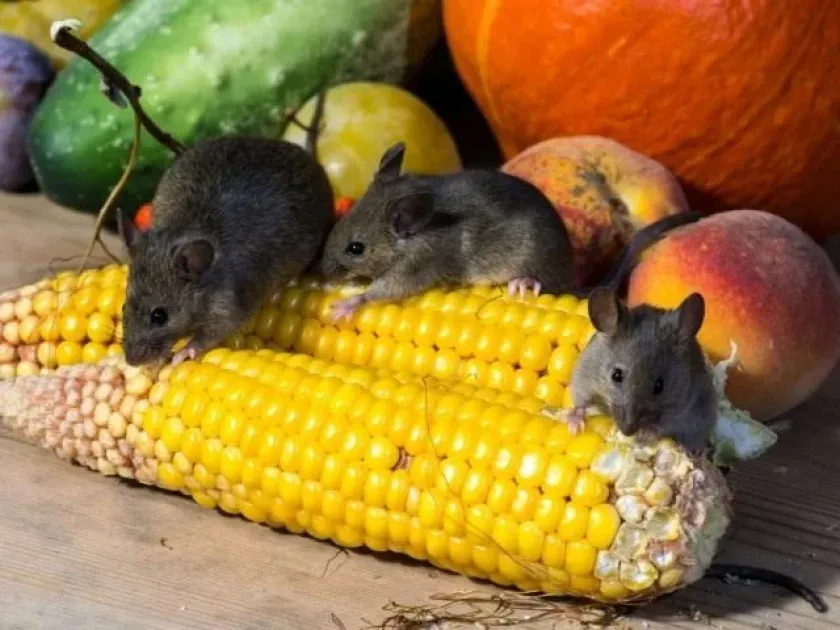
The house mouse (Mus musculus) is a small rodent belonging to the Muridae family within the order Rodentia. Adult body length typically ranges from 7 to 10 cm, with a tail nearly equal to the body length.
The coat color varies from light sandy to dark brown, with the belly usually being lighter than the back. The ears are rounded and relatively large, while the eyes are small and black.
This species is highly mobile and capable of squeezing through very narrow openings. Their sense of smell and hearing are well-developed, aiding them in quickly locating food resources.
Biologically, the species is extremely prolific: a female can produce up to 5–10 litters per year, with 5–8 pups in each. Sexual maturity is reached as early as the second month of life.
In the wild, they live in burrows or dense vegetation, but they frequently move into human structures, barns, and warehouses, where they find an abundance of food.
What it damages
The house mouse is a serious pest of agricultural crops both during the ripening stage in the field and during storage. The pest is omnivorous but prefers seeds of cereals, legumes, and vegetable crops.
In fields, mice damage winter grain crops by eating germinating seeds and gnawing through young stems. In orchards, they often gnaw the bark of young trees, which leads to the death of the saplings.
The greatest damage occurs in storage facilities and threshing floors. Mice do not just eat grain; they contaminate it with excrement, fur, and urine, making the produce unfit for processing and human consumption.
Rodents damage packaging materials, sacks, and even structural elements of buildings. Grain losses from mouse activity in indoor facilities can account for up to 10-15% of the total stored volume.
Furthermore, they are natural reservoirs for dangerous infectious diseases such as leptospirosis, tularemia, and listeriosis, which is critical for livestock complexes.
When it appears
House mouse activity continues year-round, although seasonality significantly influences their movement. During the warm season, populations breed actively in fields, gardens, and hedgerows.
With the onset of cold weather and the completion of the harvest, mass migration of rodents into heated buildings, warehouses, grain elevators, and private homes is observed.
During the grain storage period (autumn-winter), the intensity of damage inside storage facilities increases significantly. This is the peak time for monitoring population levels.
In conditions of mild winters or when an unlimited food source is available, reproduction indoors may continue continuously, without interrupting for winter diapause.
The spring period is characterized by the return of rodents to open spaces, creating a threat to fresh crops and seedlings.
Signs of infestation
The primary sign of an infestation is the presence of droppings — small black pellets found along walls, in corners, or directly in bags of grain.
The presence of a specific unpleasant (musky) odor, which becomes particularly noticeable in closed cupboards or poorly ventilated areas, indicates a high population density.
Gnaw marks on packaging, sacks, wooden building components, and wires serve as direct evidence of rodent activity.
- Presence of holes gnawed in walls, baseboards, and grain mass.
- Appearance of "mouse runs" in dust or along walls, which eventually become well-worn.
- Discovery of nests built from paper, rags, straw, or fibrous materials.
Visual sighting of the individuals themselves, which are often active during twilight and night hours, confirms a critical level of infestation.
Control measures
The primary protection measure is the observance of sanitary standards: sealing warehouses, installing metal mesh on ventilation openings, and maintaining cleanliness.
Grain storage should be conducted in rodent-proof containers or specially designed bins with concrete floors.
The use of rodenticides — chemical agents (blood anticoagulants) placed in areas of high pest traffic inside specialized bait stations — is recommended.
Physical traps (live traps, glue boards) are effective at low population densities, although they require constant monitoring and disposal of caught individuals.
Biological methods, including attracting natural predators or using ultrasonic repellers, can be employed as auxiliary measures for prevention.
Taxonomy
- Latin name
- Mus
- Order
- Rodents
- Family
- Muridae
- EPPO code
- MUSXSP
Discussion
No discussions yet — be the first.