
Flathead grey mullet
Mugil cephalus
Description
How to identify
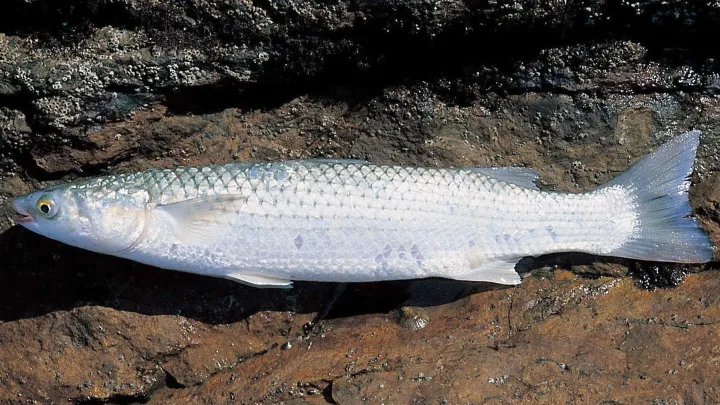
The flathead grey mullet (Mugil cephalus) is a large schooling fish belonging to the Mugilidae family, known for its cosmopolitan distribution across global waters.
It possesses a robust, torpedo-shaped body with large scales and a silvery-grey coloration, providing effective camouflage in diverse aquatic environments.
A distinctive feature of this species is the presence of fatty eyelids that partially cover the eyes, which are essential for its adaptation to turbid waters.
Adult individuals can grow up to 100 cm in length, though they are commonly found in the 40–50 cm range, often weighing several kilograms.
These fish are highly mobile and famous for their powerful jumping ability, which they frequently employ to overcome obstacles or escape predators.
What it damages
While not a pest to field crops, the flathead grey mullet can become a significant nuisance in managed water systems used for agricultural purposes.
Large schools of mullet often enter irrigation channels, where they contribute to the clogging of filters and intake screens, disrupting water distribution.
In aquaculture environments, these fish can compete for food sources with commercially farmed species, leading to reduced productivity and feed efficiency.
Their persistent searching for organic detritus on the bottom leads to increased water turbidity, which negatively impacts the quality of water used for irrigation.
The physical presence and migration of large schools can also contribute to the erosion of earthen banks in artificial canals and ponds.
##season##The movement of the flathead grey mullet is heavily influenced by water temperature, with increased activity levels during the warmer months of the year.
Spawning migrations typically occur in autumn and winter, causing the fish to move out of lagoons and estuaries into open marine environments.
In spring, young mullet migrate back into coastal freshwater and brackish systems to feed, which often overlaps with the beginning of the irrigation cycle.
During the peak of summer, they aggregate in shallow, warm areas where metabolic processes are accelerated, increasing their impact on water structures.
Seasonal shifts in salinity and nutrient availability dictate the concentration of mullet in inland water bodies throughout the agricultural year.
Signs of infestation
Visual identification of mullet presence is easily made by observing their characteristic silvery splashes on the water surface in channels and ponds.
Increased maintenance requirements for irrigation filters, specifically those clogged with organic debris and fish slime, are primary indicators of school presence.
A noticeable drop in flow rate at water intake stations often indicates that a school has obstructed the primary filtration grids.
Structural damage or warping of metal safety screens at irrigation gates often points to concentrated pressure from schools attempting to migrate through.
- Surface splashing and jumping behaviors
- Clogging of intake screens with debris
- Increased turbidity in irrigation channels
- Structural stress on water management barriers
Control measures
The most effective strategy to manage the impact of this species is the installation of high-quality, fine-mesh barriers at all major water intake points.
Ultrasonic deterrence technology is increasingly used to keep schools away from critical agricultural infrastructure without causing direct harm to the fish.
Regular dredging and cleaning of irrigation canals help prevent the accumulation of organic matter, making these areas less attractive to mullet.
Strategic management of water salinity and gates can act as a natural barrier to prevent unwanted migrations during the peak agricultural season.
When populations become excessive in managed systems, controlled netting operations are recommended to maintain ecological balance and system efficiency.
Taxonomy
- Latin name
- Mugil cephalus
- Family
- Mugilidae
- EPPO code
- MUGICE
Discussion
No discussions yet — be the first.