
Siberian musk deer
Moschus moschiferus
Description
How to identify
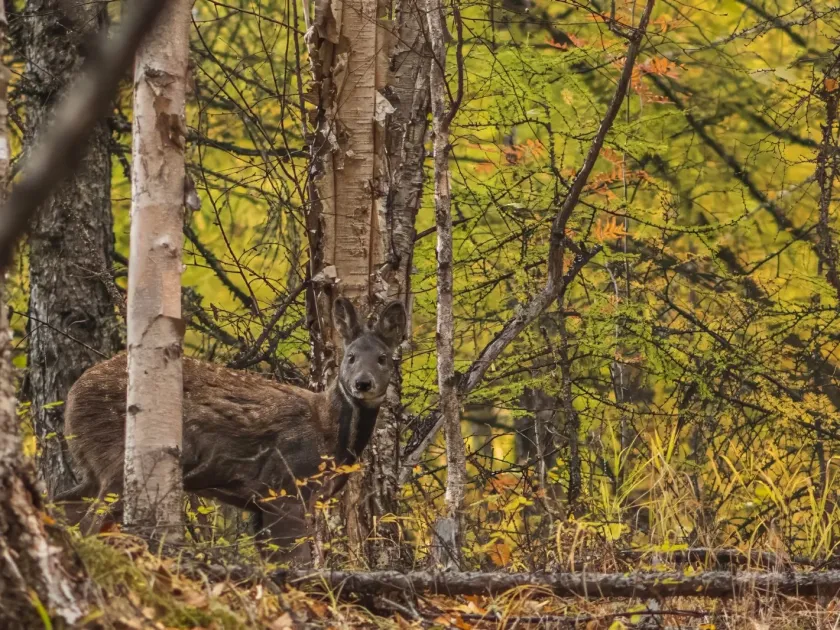
The Siberian musk deer (Moschus moschiferus) is a small ungulate belonging to the family Moschidae. Unlike other deer species, they do not possess antlers.
Adult animals typically weigh between 11 and 18 kg. Males are easily recognized by their long, prominent upper canines which grow downwards from the mouth and are used in territorial combat.
Their coat is generally dark brown with yellowish or white spots along the sides. They have strong, long hind legs, allowing them to leap with great agility across rocky, steep, and forested terrain.
These animals are solitary and shy, typically active during dawn, dusk, and at night. They prefer dense coniferous forests where the rugged topography provides shelter from predators.
While primarily herbivorous, they are forced to shift their diet to tree bark and buds during harsh winter months when snowfall limits access to grass and lichen.
What it damages
Damage occurs primarily during winter when natural food sources are covered by deep snow. The musk deer resorts to feeding on the bark and shoots of young saplings.
Targeted species include various coniferous trees such as cedar, spruce, and fir. Young plants in nurseries near forest borders are particularly susceptible to this type of browsing.
The browsing of terminal shoots causes severe crown deformity. When the bark is stripped away in a complete ring around the trunk, the sapling suffers irreversible damage and often dies.
Ornamental plantings on properties adjacent to forested areas can be devastated in a single season, with the deer stripping bark that leads to secondary infections and plant decay.
In forestry management, musk deer activity disrupts the natural regeneration process by destroying saplings that would otherwise grow into the future forest canopy.
Signs of infestation
The most distinct sign of feeding is the presence of tooth marks on the bark, usually found within one meter of the ground. The damage often appears as frayed edges on the wood.
Look for tracks in the snow or soil. Musk deer leave sharp, narrow, cloven hoofprints that are distinct from those left by domestic livestock or larger ungulates.
Droppings are another clear indicator. They are found as clusters of small, dark, oval-shaped pellets in areas where the animals have been foraging.
Evidence of feeding may also include broken off branch tips and discarded bark strips left around the base of the affected tree or shrub.
The development of narrow, worn pathways through dense vegetation towards the garden or nursery area confirms that the animals have established a frequent feeding route.
Control measures
Physical exclusion is the most effective control method. Installing high-tensile wire fences or metal mesh screens at least 2 meters high is essential to prevent entry.
Applying taste-based or scent-based repellents to the bark of young trees can deter browsing, as the animals will avoid plants with strong, unpleasant chemical signatures.
Individual tree protection, such as hard plastic or mesh tree guards, provides a physical barrier that prevents the deer from accessing the trunk and main stem.
Modifying the habitat by clearing dense brush near nursery borders can make the area less attractive as a hiding spot for the deer, reducing their presence in the area.
- Installation of 2-meter tall exclusion fencing.
- Individual tree bark protectors and guards.
- Application of non-toxic commercial repellent sprays.
- Habitat management to reduce dense cover near crops.
- Periodic monitoring of forest edges for deer tracks.
Taxonomy
- Latin name
- Moschus moschiferus
- Family
- Moschidae
- EPPO code
- MOSCMO
Discussion
No discussions yet — be the first.