
Musk deer
Moschus
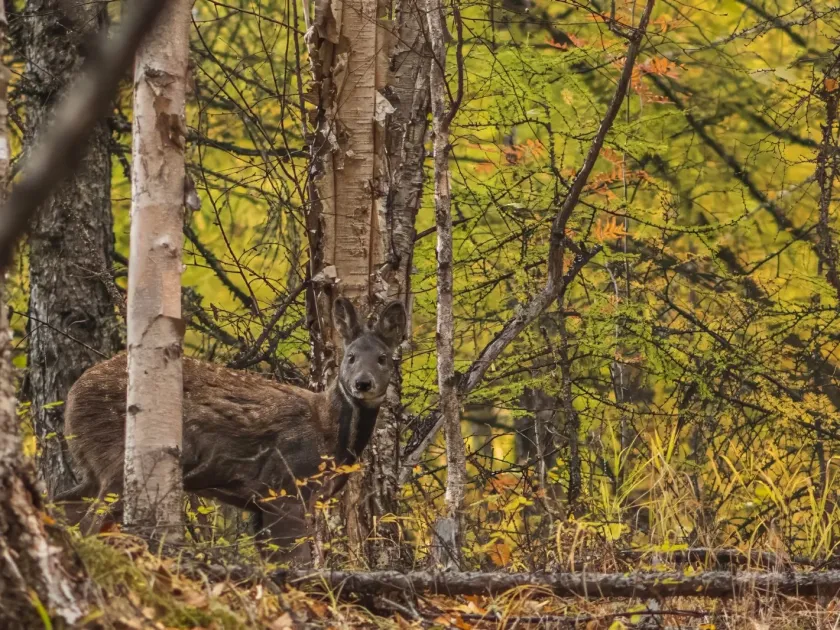
Description
How to identify
The Musk deer (genus Moschus) is a small ungulate native to the forested and alpine environments of Asia, belonging to the family Moschidae.
Unlike true deer, they lack antlers; instead, males possess enlarged, curved upper canines which grow throughout their lives and are used during mating season.
They are relatively small, weighing between 11 and 18 kilograms, and have a specialized build with longer hind legs, allowing for exceptional agility in mountainous terrain.
Their coat is coarse and thick, providing excellent thermal insulation in harsh climates and camouflage against the forest floor and rocks.
Musk deer are solitary and highly territorial animals, marking their range with a strong-smelling secretion from their scent glands.
What it damages
During the winter season, musk deer shift their feeding habits towards available vegetation, often targeting tree bark in young forest plantations.
The consumption of bark around the trunk can lead to girdling, which inhibits nutrient transport and often causes the death of the sapling.
They also browse on tender buds and succulent shoots of young trees, resulting in stunted growth and deformed crown structures in forestry nurseries.
Agricultural crops or home gardens situated near forest borders can suffer from browsing damage, where deer consume leaves and growing points of ornamental plants.
The damage caused is particularly harmful to young conifer stands, as the trees are unable to recover from significant loss of cambium layer during winter.
Signs of infestation
One of the primary signs of a musk deer presence is the distinctive, narrow, and sharp-edged hoof print found in soil or light snow cover.
Vertical or horizontal teeth marks on the bark of small trees, located at various heights, indicate active browsing by the deer.
Pellet groups, which are small and rounded, are frequently found near resting spots or preferred feeding trails in the undergrowth.
A noticeable, strong musk odor is often present in areas where territorial males have marked their home ranges, serving as a biological indicator.
Broken twigs and trampled vegetation surrounding trees provide clear evidence of animal activity, especially in early spring before growth restarts.
Control measures
Physical exclusion remains the most effective defense strategy; installing high, durable wire mesh fences around nurseries is essential for total protection.
Applying chemical repellents with bitter taste or pungent odors to the bark of valuable trees can effectively deter musk deer from feeding.
The use of motion-activated light and sound devices can startle animals and keep them away from sensitive agricultural sites during the night.
Implementing a buffer zone management strategy involves creating supplemental feed areas to distract deer away from high-value plantation zones.
- Erecting wire mesh fencing around sensitive areas.
- Application of taste-aversion repellents.
- Using motion-sensor deterrent technologies.
- Monitoring forest borders for early signs of entry.
Taxonomy
- Latin name
- Moschus
- Family
- Moschidae
- EPPO code
- MOSCSP
Discussion
No discussions yet — be the first.