
Silkworm
Morus
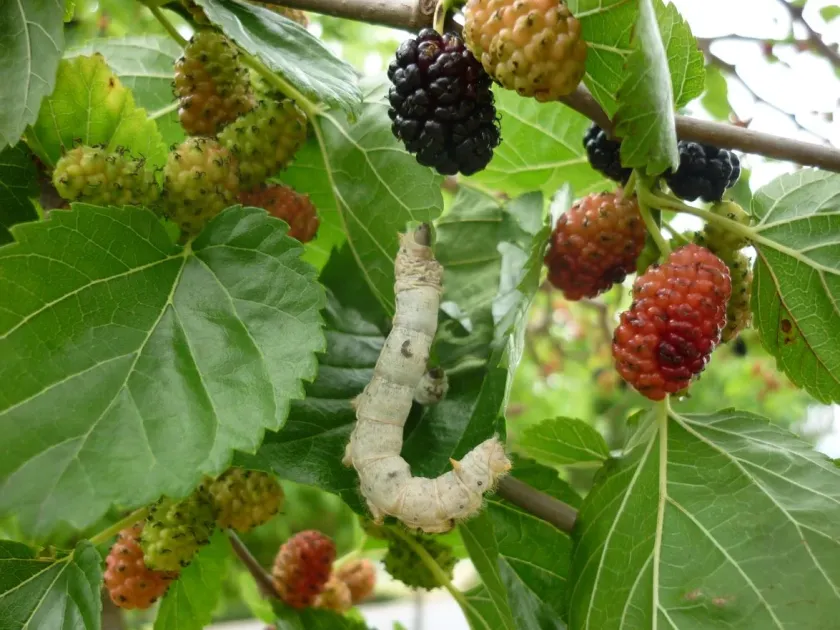
Description
How to identify
The silkworm moth (Latin: Bombyx mori) belongs to the order Lepidoptera, family Bombycidae. An adult specimen is a large moth with a wingspan of up to 60 mm, characterized by a light color with darker bands.
The larva (caterpillar) of this insect reaches up to 80 mm in length during its final stage and features a distinctive horn on its posterior end. The caterpillar's body is typically whitish-gray, providing camouflage against the branches of the host plant.
The insect undergoes a complete metamorphosis: egg (grain), larva, pupa, and adult. Its life cycle is strictly dependent on the availability of mulberry leaves, which provide the nutrients necessary for cocoon formation.
It is important to note that this species is fully domesticated. Its wild ancestor, Bombyx mandarina, is still found in parts of East Asia, residing primarily in wild mulberry habitats.
The reproductive system of the adult moth is well-developed, but due to centuries of selective breeding for silk production, adults have largely lost their ability to fly.
What it damages
The primary food source for the silkworm is the mulberry tree (Morus). Caterpillars possess powerful chewing mouthparts, allowing them to consume vast quantities of foliage in a short period.
During mass outbreaks or uncontrolled infestations, caterpillars can strip a tree completely, destroying up to 100% of the leaf surface. This causes severe physiological stress to the tree.
In sericulture industries, mulberry leaves are a critical raw material. Therefore, damage by silkworms results in significant economic losses by reducing the quality and quantity of the harvest.
Besides the direct consumption of green mass, defoliated trees become susceptible to secondary infections and environmental damage, which may significantly reduce their winter hardiness.
The agricultural impact is defined by the competition for the resource. In orchards or private gardens, the presence of the pest compromises the aesthetic and health status of the mulberry trees.
When it appears
The life cycle typically begins in the spring when temperatures reach the threshold required for egg hatching. This biological event is usually synchronized with the bud break of the mulberry tree.
Throughout the summer, caterpillars feed actively, passing through several molting stages. The rate of larval development depends heavily on ambient temperature and the availability of quality food.
Pupation occurs in late summer or early autumn, when the caterpillar starts spinning its silk cocoon. It seeks sheltered locations, such as branch forks or hidden leaf clusters, to complete this stage.
Adult moths emerge after the pupal phase. In temperate climates, there is usually one generation per year, though multiple generations are possible in warmer, controlled environments.
The species overwinters primarily in the egg stage. Eggs are laid by females on the tree bark, where they remain dormant and protected until the following spring's rise in temperature.
Signs of infestation
The primary sign of an infestation is the presence of heavily eaten leaves, where only the major veins remain. Skeletonized foliage is a clear indicator of larval activity in the canopy.
Accumulations of larval frass (excrement), appearing as small dark pellets, can be found on the leaves or on the ground beneath the tree. This is a tell-tale sign of a dense population.
Finding completed cocoons securely attached to branches or among fallen leaves serves as definitive proof that the caterpillars have successfully reached the pupal stage.
During twilight, one might observe moth activity in the canopy as females move to deposit eggs. Even with limited flight capacity, their movement on bark is often detectable.
General tree decline, such as stunted shoot growth, premature leaf yellowing, and decreased fruit yield, are indirect symptoms of a long-term infestation affecting the tree's health.
Control measures
The most effective method of control is the manual removal and destruction of egg masses during the dormant season. Careful inspection of the bark can significantly reduce the upcoming population.
Biological insecticides based on Bacillus thuringiensis are highly effective against young larvae and are considered environmentally friendly, as they minimize harm to beneficial garden insects.
In cases of severe infestation, contact-acting insecticides approved for use on fruit-bearing trees may be applied, ensuring strict compliance with pre-harvest waiting periods.
Cultural practices, including proper pruning to improve airflow and adequate fertilization, help maintain tree vigor and increase natural resistance to pest attacks.
- Regular monitoring of canopy health
- Use of light traps to capture adult moths
- Encouraging natural predators like birds and parasitic wasps
- Strict quality control of new plant material
Taxonomy
- Latin name
- Morus
- Family
- Sulidae
- EPPO code
- MORUSP
Discussion
No discussions yet — be the first.