
Cassava green mite
Mononychellus tanajoa
Description
How to identify
The cassava green mite (Mononychellus tanajoa) belongs to the Tetranychidae family, widely known as spider mites. These minute pests are characterized by their green or yellowish-green bodies and are specialized feeders on cassava crops.
The life cycle of Mononychellus tanajoa is highly temperature-dependent, occurring rapidly under hot and dry conditions. From egg to adult, the developmental process takes only a few days, allowing for a swift population surge.
These mites primarily colonize the youngest leaves and apical buds of the cassava plant. Their micro-size makes them almost invisible to the naked eye, often hiding beneath the leaf surface to feed on plant juices.
During dry seasons, the mite population expands exponentially. The lack of natural precipitation and humidity allows them to dominate the canopy of the plants without being washed away.
Dispersal occurs mainly through wind currents, which transport mites from field to field. This mobility and high reproductive capacity pose a constant threat to cassava production in tropical agricultural zones.
What it damages
The primary host for Mononychellus tanajoa is Manihot esculenta (cassava). The mite infestation causes direct damage by extracting sap from the mesophyll cells of developing leaves.
By targeting the apical meristem, the mite stunts the plant's growth significantly. This reduction in leaf area directly impairs photosynthesis, leading to reduced starch accumulation in the cassava tubers.
Signs of infestation
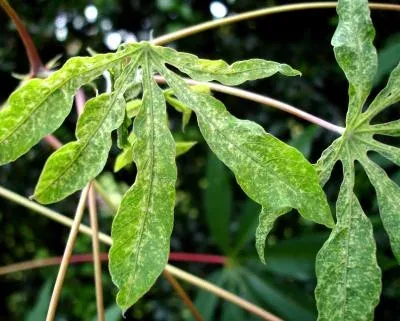
Early symptoms appear as light-colored spots or stippling on the leaves. As the infestation progresses, these spots merge, causing the leaf surface to turn pale yellow and eventually bronze.
Leaves become curled, deformed, and significantly smaller than normal. The plant canopy thins out, leaving only the stem tips, which are often described as having a "candle" appearance.
Severe infestations lead to massive leaf shedding. The plant stops growing in height and develops stunted, bushy branches, which is a major indicator of yield loss for farmers.
Control measures
Managing the cassava green mite requires an integrated approach focusing on biological and cultural controls. Enhancing the plant's innate resistance is the cornerstone of sustainable management.
- Biological control using phytoseiid mites is highly effective in reducing M. tanajoa populations.
- Using tolerant cassava varieties helps in maintaining plant health during peak mite infestation periods.
- Regular monitoring of fields allows for early detection and localized intervention before mass spread occurs.
- Maintaining field hygiene by removing infested plants and weed hosts limits the mite's potential for reproduction.
- Chemical control (acaricides) should be used as a last resort, ensuring that beneficial insect populations are preserved.
Taxonomy
- Latin name
- Mononychellus tanajoa
- Order
- Mites
- Family
- Tetranychidae
- EPPO code
- MONNTA
Discussion
No discussions yet — be the first.