
Fruit tree bark beetle
Monarthrum mali
Description
How to identify
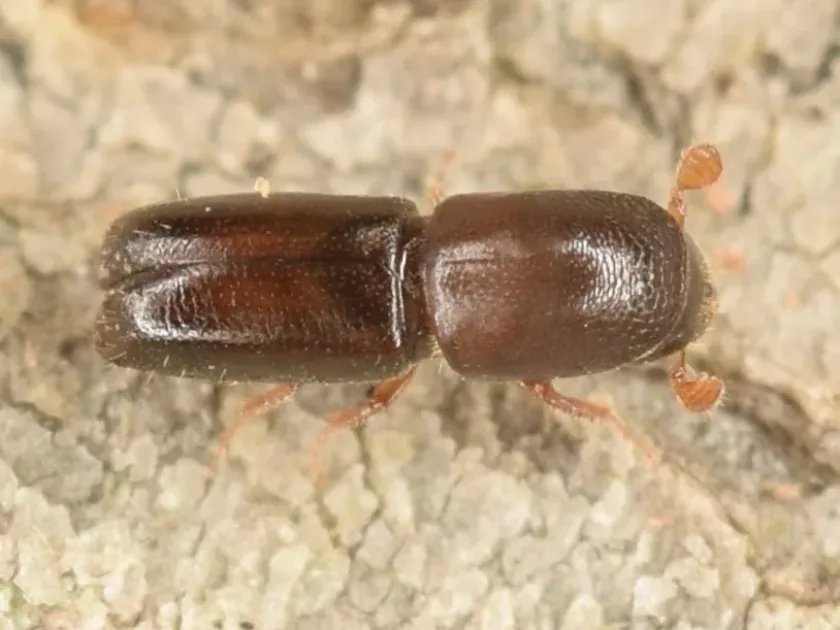
The fruit tree bark beetle, known scientifically as Monarthrum mali, is a small wood-boring insect belonging to the Curculionidae family and Scolytinae subfamily. Adults are cylindrical, measuring 2-3 mm, with a dark brown to black coloration.
The larvae are legless, curved, white grubs with a distinct brown head capsule. They spend their entire developmental phase deep within the wood, which makes them highly resistant to standard topical pesticide applications.
These beetles are adept flyers, allowing them to rapidly colonize neighboring trees, particularly when they are stressed or weakened by environmental factors.
The biological cycle is uniquely linked to ambrosia fungi; the beetles cultivate these fungi within their galleries, and it serves as the primary food source for their developing larvae.
Unlike some other bark beetles, Monarthrum mali is often attracted to trees suffering from water stress, physical damage, or previous disease infections, serving as a secondary pest.
What it damages
While apple trees are the primary host, this beetle also attacks pear, plum, cherry, and various deciduous forest trees located near agricultural areas.
The larvae and adults cause severe mechanical damage by tunneling through the bark and into the cambium layer. These galleries disrupt the flow of nutrients and water, starving the tree.
Infested trees show signs of decline, such as chlorotic foliage, stunted fruit development, and the eventual wilting of individual branches or the entire canopy.
Severe infestations can kill a healthy fruit tree within a few seasons if not addressed promptly, especially in orchards where maintenance has been neglected.
Furthermore, the galleries serve as entry points for various pathogens, including canker-causing fungi, which further degrade the structural integrity of the timber.
When it appears
Adult beetles emerge from their overwintering sites in the spring, typically coinciding with the apple tree blossoming period when temperatures consistently exceed 15 degrees Celsius.
The flight period is extended, generally occurring from mid-May through June. In warmer climates, the species may complete two full generations within a single year.
Drought conditions during the summer significantly increase the susceptibility of orchards, as stressed trees release volatile chemicals that attract the beetles from long distances.
Egg-laying occurs inside the newly excavated galleries. Larvae continue to feed throughout the summer, deepening their tunnels as they progress through their larval stages.
As autumn approaches, the new generation of beetles prepares for winter, often remaining inside the host tree galleries where they find protection from low winter temperatures.
Signs of infestation
The most reliable indicator of an infestation is the presence of numerous small, circular holes in the bark, resembling holes made by a fine nail or needle.
Fine, powdery, light-brown sawdust, often referred to as frass, accumulates at the base of the tree or in bark crevices as the beetles excavate their tunnels.
Visual decline of the tree, including yellowing leaves and premature fruit drop, often suggests that the vascular system is being compromised by internal gallery networks.
When the bark is carefully peeled away in affected areas, one can see complex, winding tunnels embedded in the sapwood, often stained by the fungi cultivated by the beetles.
In advanced cases, patches of bark may begin to slough off, revealing the extensive damage underneath, which is often accompanied by dark, necrotic tissue.
Control measures
The most effective management strategy is ensuring vigorous tree health through adequate irrigation, proper pruning, and balanced fertilization to increase the tree's natural resistance.
Sanitation is critical; all dead, dying, or heavily infested wood must be pruned and burned immediately to prevent the emergence of new adult beetles.
Use pheromone traps as a monitoring tool to determine the timing of beetle activity. This helps in scheduling timely insecticide applications during the peak flight period.
Systemic insecticides can be applied during the early adult emergence phase to provide a chemical barrier before the beetles bore deep into the bark tissue.
Whitewashing tree trunks with lime-based mixtures containing insecticidal additives can deter beetles from choosing a particular tree for nesting and egg-laying.
Taxonomy
- Latin name
- Monarthrum mali
- Order
- Coleoptera (beetles)
- Family
- Curculionidae
- EPPO code
- MNTHMA
Discussion
No discussions yet — be the first.