
Moina
Moina
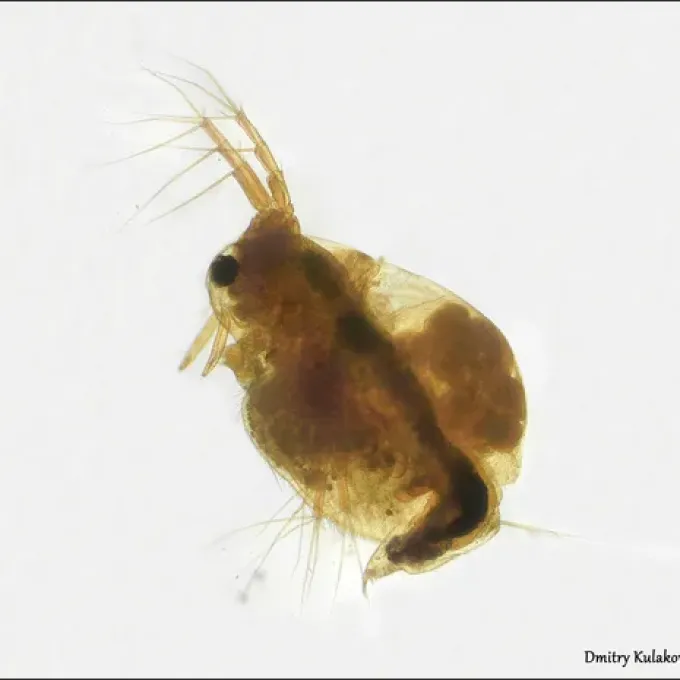
Description
How to identify
Moina is a genus of small cladoceran crustaceans belonging to the family Moinidae, often confused with common Daphnia species.
They are characterized by a rounded head and the absence of a prominent rostrum, making them distinct under microscopic examination.
These organisms are highly efficient at reproducing, and their populations can reach extremely high densities within very short periods.
The life cycle of Moina is remarkably fast, often completing development from neonate to adult in just a few days under optimal temperatures.
Being transparent and small, they are often overlooked in large water bodies until a massive population bloom occurs.
What it damages
In aquaculture, Moina acts primarily as a competitor for food resources, specifically targeting the phytoplankton needed by fish larvae.
By consuming large volumes of microalgae, they deprive young fish of their essential initial nutrition, leading to slower growth rates.
Rapid population blooms can cause severe depletion of dissolved oxygen, particularly during the night, posing a risk to cultured aquatic species.
The indirect harm involves disrupting the ecological balance of the pond, which can stress the main culture and lead to poor health outcomes.
In water filtration systems, high densities of these crustaceans can clog fine mesh screens and cause maintenance complications for operators.
When it appears
Moina population explosions typically occur in the spring and summer months when water temperatures range between 20°C and 30°C.
They thrive in stagnant or slow-moving waters enriched with organic matter, which provides the necessary food base for their reproduction.
The presence of excess nutrients in the water frequently triggers a massive increase in their numbers, leading to blooms.
They are highly opportunistic and can quickly colonize new water environments whenever the conditions become favorable.
When the environment degrades or dries out, Moina produces resistant resting eggs that can survive for long periods until conditions improve.
Signs of infestation
A primary indicator of a Moina bloom is the shift in water appearance to a cloudy or milky texture, visible upon close inspection.
Observation of a water sample in a transparent container will reveal the rapid, erratic swimming motion of the small crustaceans.
If fish larvae show stunted growth despite adequate feeding, it may indicate that Moina is outcompeting them for natural pond nutrients.
Diurnal fluctuations in oxygen levels, especially dangerously low readings at dawn, are common in tanks heavily populated by Moina.
Physical aggregation at the water's surface, particularly in the morning, indicates that the population has reached its peak density.
Control measures
Effective management begins with limiting the nutrient influx into the water system to restrict the growth of their primary food source, the phytoplankton.
Mechanical control using high-efficiency fine-mesh filters is a standard and safe way to reduce population numbers in controlled environments.
In larger facilities, biological control through the introduction of specific planktivorous fish species can help keep the population in check.
Chemical intervention should be used cautiously, ensuring that the substances applied are certified for aquaculture and safe for the target species.
- Filtration: Utilizing fine mesh nets to mechanically extract the crustaceans.
- Nutrient Management: Reducing organic fertilizers to control algal blooms.
- Biological Regulation: Introducing natural predators of zooplankton.
- Environmental Adjustment: Optimizing water quality and light exposure.
Taxonomy
- Latin name
- Moina
- Family
- Moinidae
- EPPO code
- MOINSP
Discussion
No discussions yet — be the first.