
Social vole
Microtus socialis
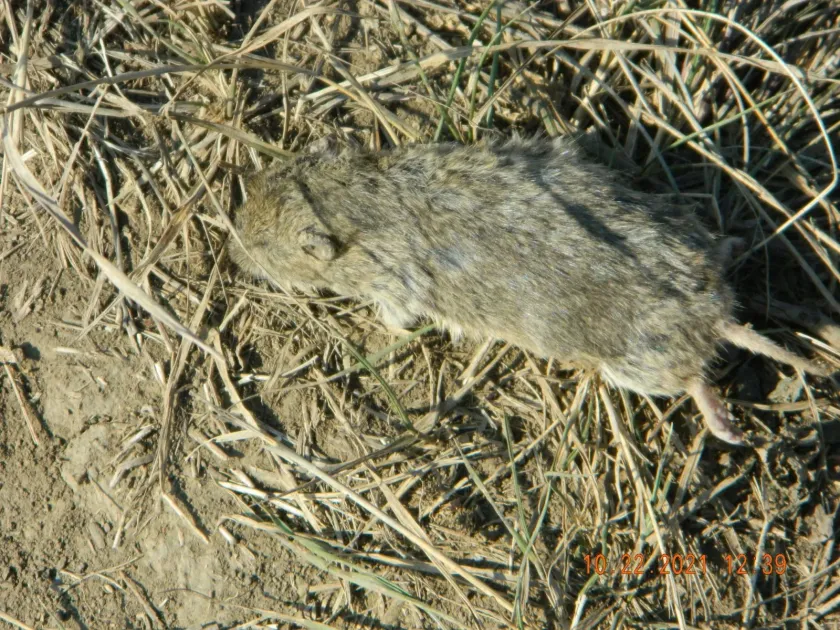
Description
How to identify
The social vole (Microtus socialis) is a small rodent belonging to the Cricetidae family, widely distributed across steppe and semi-desert regions.
It is characterized by a compact body, typically reaching up to 12 centimeters in length, with a short tail that is less than one-third of the body length.
The fur color ranges from pale sandy-gray to brownish, providing excellent camouflage in open grassland habitats where the species thrives.
These rodents are highly social, living in large colonies that construct complex underground burrow systems with multiple entrance holes.
They are primarily nocturnal but may exhibit diurnal activity when population density is high, making them a significant agricultural threat.
What it damages
The social vole is a polyphagous pest that causes severe damage to cereal crops, including wheat, barley, and oats, especially during the growth stages.
In addition to cereals, they feed extensively on alfalfa, clover, and other forage grasses, reducing yields and the overall quality of agricultural pastures.
Winter crops are particularly vulnerable, as voles consume emerging seeds and young seedlings, often leading to large bare patches in fields.
In orchards and nurseries, they can girdle the bark of young trees during the winter months, potentially resulting in the death of the saplings.
The economic impact of high vole populations is significant, as they can destroy large portions of a harvest within a very short timeframe.
When it appears
The breeding season for the social vole is extensive, lasting from early spring until late autumn, often resulting in several generations per year.
Population peaks are typically observed during mid-to-late summer, coinciding with the maturation of cereal crops when food is most abundant.
Social voles remain active throughout the winter, using sub-snow tunnels to continue feeding on dormant vegetation and stored root stocks.
Migration from harvested fields to areas with active vegetation is a common behavior, putting newly planted winter crops at immediate risk.
Mild winter temperatures significantly improve the survival rates of young voles, setting the stage for rapid population growth in the following spring.
Signs of infestation
The most reliable sign of a social vole infestation is the presence of numerous burrow openings surrounded by soil mounds and fecal droppings.
Well-defined surface runways or trails are often visible in the grass, connecting burrow entrances to preferred feeding sites within the field.
Damaged crops exhibit gnawed stems and leaf bases, often left in small piles near the burrow entrances or along the foraging paths.
Visible thinning of crops or the appearance of dead patches in a field is a major indicator that a colony has established itself in that location.
Increased presence of predatory raptors, such as kestrels or common buzzards, circling over a specific area often points to high vole activity.
Control measures
Deep tillage or autumn plowing is one of the most effective mechanical methods to destroy burrow systems and disrupt the vole's habitat.
Regular field scouting is essential to identify infestations at an early stage, allowing for targeted interventions before widespread damage occurs.
When chemical control is necessary, rodenticides should be applied directly into the burrows to minimize exposure to non-target wildlife and birds.
Biological control methods, including the installation of perches to attract predatory birds, can help suppress vole populations naturally.
Maintaining clear field margins by removing weeds and tall grass reduces the available cover and food sources for the rodents.
Taxonomy
- Latin name
- Microtus socialis
- Order
- Rodents
- Family
- Muridae
- EPPO code
- MICRSO
Discussion
No discussions yet — be the first.