
Kadoyama ambrosia beetle
Microperus kadoyamaensis
Description
How to identify
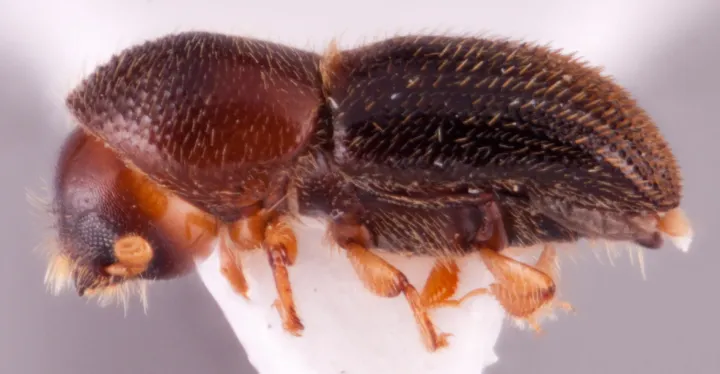
The Kadoyama ambrosia beetle (Microperus kadoyamaensis) belongs to the Curculionidae family and the Scolytinae subfamily. It is a tiny insect, typically measuring between 2 and 3 millimeters in length.
The adult beetle has a cylindrical body shape typical of the tribe Xyleborini. Its color ranges from deep brown to black, and the body surface is covered in fine, short hairs, aiding in its identification under magnification.
Morphologically, the structure of the pronotum and elytra is critical for species verification. The head is deeply recessed into the pronotum, which is a common characteristic of many wood-boring bark beetles.
Larvae are legless, white in color, and possess a well-defined chitinous head capsule. They lead an entirely cryptic life inside the woody tissues of the host, feeding on the mycelium of symbiotic fungi.
Sexual dimorphism is present but subtle, with females generally being larger than males. Detecting these beetles is difficult due to their life cycle being spent entirely within the internal structure of the tree.
What it damages
This beetle is a classic ambrosia beetle, meaning it colonizes weakened, dying, or freshly cut deciduous trees. It poses a risk to various woody species across East Asian forestry and orchard landscapes.
The primary damage is caused not by the beetle itself, but by the symbiotic fungi it introduces into the wood. These fungi degrade the wood structure and clog the vascular system, preventing water transport.
A mass infestation can rapidly deteriorate the physiological health of a tree. In conditions of drought or environmental stress, even healthy trees can be overwhelmed if the beetle population is sufficiently large.
The timber value is severely compromised due to the presence of numerous galleries and the characteristic dark staining caused by fungal growth. This makes the wood unsuitable for commercial use.
Affected trees often become reservoirs for secondary pests and pathogens. This cascading effect can lead to the widespread degradation of forest patches if not managed promptly.
When it appears
The activity of the Kadoyama ambrosia beetle is strictly linked to temperature. The flight period begins in early spring as soon as consistent positive temperatures are recorded in the forest environment.
During the summer months, reproduction is at its peak. The species is capable of completing multiple generations per year, depending on the climatic conditions and the availability of suitable host material.
As autumn approaches, activity declines. Beetles typically overwinter within the galleries created inside the wood, which provide a stable microclimate shielded from harsh weather conditions.
The timing of the beetle's life cycle often aligns with the onset of the tree's growing season. This period of physiological stress for the tree makes it highly susceptible to the initial attack.
The life cycle involves egg, larval stages, pupation, and the adult stage. The entire transformation happens within the gallery system, provided the humidity is sufficient for the fungi to grow.
Signs of infestation
The first indication of an infestation is the presence of small entry holes on the bark surface. These are often accompanied by tiny piles of wood dust, known as boring dust or frass.
When the bark is removed or the wood is sliced, one can observe branched galleries with stained, darkened walls. This dark coloration is caused by the ambrosia fungi that the beetles cultivate.
Visual symptoms on the tree include premature yellowing or wilting of the foliage. In severe cases, the overall vigor of the tree declines, and dieback may be observed on affected branches or trunks.
A faint, fermented, or musty odor often emanates from the infested wood. This is a telltale sign of active fungal growth, which the beetles rely upon for survival and brood development.
Heavy infestations result in a high density of exit holes. If the colonization is extensive, the bark may become loose or brittle, indicating that the tree has been heavily compromised.
Control measures
Sanitation is the most effective management strategy. Removing and destroying infested or fallen timber is crucial to prevent the beetle population from spreading to healthy, living trees.
Forest management should prioritize the timely removal of logging residues. Storing fresh, unbarked timber near healthy forests should be avoided to prevent the creation of breeding sites.
Monitoring using pheromone-based traps can help track beetle activity and population density. This data is essential for timing preventative measures effectively during the flight season.
Chemical control is often limited in efficacy due to the beetles residing deep within the wood. However, preventative spraying of trunks with registered insecticides can sometimes deter initial colonization.
Encouraging natural predators, such as insectivorous birds and parasitic wasps, supports biological control. A healthy, diverse ecosystem is inherently more resistant to ambrosia beetle outbreaks.
Taxonomy
- Latin name
- Microperus kadoyamaensis
- Order
- Coleoptera (beetles)
- Family
- Curculionidae
- EPPO code
- MIPRKA
Discussion
No discussions yet — be the first.