
Harvest mouse
Micromys minutus
Description
How to identify
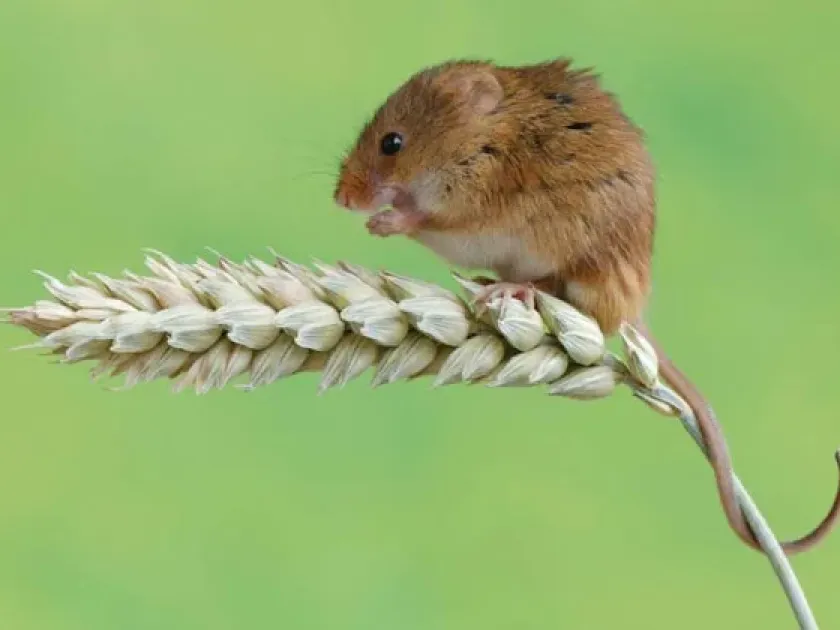
The harvest mouse is the smallest rodent species in the Cricetidae family. Adult individuals measure between 5 and 7 centimeters in length, with a prehensile tail that is roughly equal to the body length, aiding in balance and climbing.
The rodent is easily identifiable by its distinct coloration: the upper body is typically a tawny or reddish-brown, which contrasts sharply with the white fur on the belly and inner limbs.
They possess relatively large, dark eyes and small rounded ears that are largely concealed within their thick fur. Their feet are anatomically adapted for gripping stalks, making them highly agile climbers.
Unlike most ground-dwelling mice, harvest mice are expert builders. They construct complex, spherical nests woven from grass leaves and stalks, anchored securely above the ground to protect themselves from predators.
During the winter, harvest mice often relocate to farm outbuildings, haystacks, or granaries where they seek refuge from cold weather and gain access to stored food sources.
What it damages
The harvest mouse primarily impacts cereal crops such as wheat, oats, rye, and barley. Their most significant damage occurs during the milk and dough stages of grain development when they feed on the ripening heads.
To access the grain, the rodents gnaw through the stems, which leads to lodging. This not only destroys a portion of the crop but also complicates mechanical harvesting, resulting in increased losses for farmers.
Beyond cereal grains, they can damage fodder crops and seed plants. In forest nurseries, they have been known to feed on the bark of young saplings, potentially weakening or killing the plants.
In stored grain facilities, these rodents cause substantial losses by feeding on the stock and contaminating the grain with their droppings and urine, rendering it unfit for storage or consumption.
While their individual impact is small, in years of high population density, these rodents can cause localized but significant yield reductions, requiring proactive intervention from agricultural producers.
When it appears
The harvest mouse is active throughout the warmer months. As soon as temperatures rise in the spring, the rodents begin breeding and constructing their signature nests in fields with thick, tall vegetation.
Population density peaks in mid-summer, coinciding with the maturation phase of cereal crops. This is when the presence of their elevated nests becomes most noticeable in agricultural fields.
As the autumn harvest begins and fields are cleared, the rodents are forced to migrate. They seek refuge in hedgerows, tall meadows, or sheltered stacks of hay and straw left near field edges.
During the winter, harvest mice remain active but are restricted to their nesting sites. They do not hibernate, so they must maintain access to food reserves to survive the cold season successfully.
In the spring, as soon as temperatures allow for vegetative growth, the populations disperse from their wintering grounds to colonize fresh pastures and agricultural fields for the new breeding cycle.
Signs of infestation
The most distinctive sign of a harvest mouse presence is the spherical grass nests, which are clearly visible during summer at a height of 50 to 100 centimeters above the ground.
Field inspectors can identify damage by spotting areas of lodged or broken stems. Close examination of the stems often reveals the small, sharp teeth marks left by the rodents while feeding.
In storage facilities, presence is often indicated by gnawed grain bags and the accumulation of fecal matter in grain bins, which is a clear indicator of rodent activity.
Small, well-worn pathways or runways through dense vegetation connecting feeding areas to nests are another classic sign of their habitual activity within a specific plot.
In nurseries or young plantations, damage to the stems and bark of saplings serves as a diagnostic sign that indicates the presence of these small rodents in the vicinity of the seedlings.
Control measures
Effective population management starts with rapid and clean harvesting. Reducing the duration that mature crops are left in the field limits the food supply and prevents further rodent development.
Post-harvest plowing is a crucial practice. By turning the soil, farmers destroy the rodents' nesting sites and disrupt their burrowing systems, which significantly reduces their chances of survival during the winter.
Field maintenance is vital; keeping field margins clear of high weeds and removing plant debris removes the cover these mice need to construct their spherical nests and hide from predators.
If population levels exceed safety thresholds, the use of targeted rodenticides in bait stations is recommended. This method ensures efficacy while reducing the impact on non-target species.
Encouraging biological control by installing nesting boxes or perches for birds of prey—such as owls, kestrels, and buzzards—creates a natural, sustainable way to suppress harvest mouse populations.
Taxonomy
- Latin name
- Micromys minutus
- Order
- Rodents
- Family
- Muridae
- EPPO code
- MCRMMI
Discussion
No discussions yet — be the first.