
Harvest mouse
Micromys
Description
How to identify
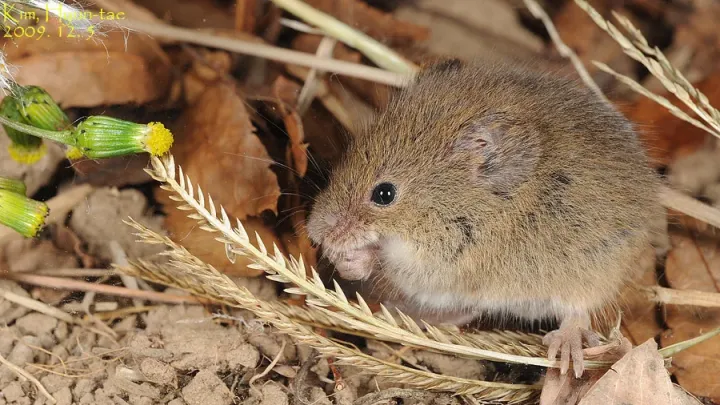
The harvest mouse (Micromys minutus) is the smallest rodent species in Europe, belonging to the family Cricetidae. An adult specimen typically weighs between 7 and 10 grams and has a body length of only 5 to 7 centimeters, with a tail of equal length.
These mice are easily distinguished by their orange-brown or reddish-brown coat on the back and a clean white or pale underside. Their ears are small and rounded, partially hidden by dense fur, and their tail is prehensile, specifically adapted for climbing stalks.
Unlike most mice, this species spends a significant portion of its life above ground level. They are famous for constructing spherical nests made of woven grass leaves, which are securely attached to cereal stalks at heights of up to one meter.
Their reproduction is highly prolific during the warm months. A single female can produce up to four litters per season, with 3 to 9 pups in each, which allows the population to spike rapidly when food sources are abundant.
During the winter, harvest mice become less active in fields. They often seek refuge in haystacks, straw piles, or farm outbuildings, where they continue to feed on available grains and seeds until the start of the next planting season.
What it damages
The primary economic impact of the harvest mouse occurs in cereal crops such as wheat, rye, and barley. The rodents gnaw at the developing grains during the milk stage, causing direct yield losses before the harvest even begins.
In addition to cereals, they can cause damage in vegetable crops and forest nurseries. By gnawing on seeds, seedlings, and the bark of young trees, they hinder the development of forest plantations and cause significant losses in specialized seed beds.
Significant damage also occurs during nest building. By stripping and weaving stems of grain crops, they cause the crops to lodge, which makes mechanical harvesting much more difficult and leads to further loss of yield during the harvest process.
Large-scale outbreaks of this rodent can lead to substantial financial losses for grain producers. Their feeding behavior often results in the waste of grain, as they frequently harvest more than they consume, leaving behind damaged ears.
Furthermore, these rodents are potential vectors for various diseases. Contamination of grain stores with droppings poses a risk to both the quality of the harvested product and the safety of the livestock that might consume contaminated feed.
Control measures
Controlling the harvest mouse is best achieved through integrated agricultural practices that aim to reduce the available habitat and food sources, minimizing the need for chemical intervention.
Efficient and timely harvesting is the most important measure to prevent population growth in fields. By removing cereal crops rapidly, farmers deprive the mice of their food supply and their primary locations for building nesting structures.
Post-harvest deep ploughing is an essential agrotechnical tool. This process destroys nesting sites and wintering burrows, significantly reducing the survival rate of the population and preparing the field for the next crop cycle.
In storage facilities, strict sanitation protocols must be enforced. Maintaining the integrity of storage buildings and using rodent-proof barriers are essential steps in protecting harvested grain from infestation by mice.
- Practice crop rotation to disrupt the pests' lifecycle.
- Control weeds around field edges to reduce secondary food sources.
- Remove straw and hay stacks from fields promptly after harvest.
- Encourage natural predators such as owls and raptors to reduce population density.
Taxonomy
- Latin name
- Micromys
- Order
- Rodents
- Family
- Muridae
- EPPO code
- MCRMSP
Discussion
No discussions yet — be the first.