
Puncturevine stem weevil
Microlarinus lypriformis
Description
How to identify
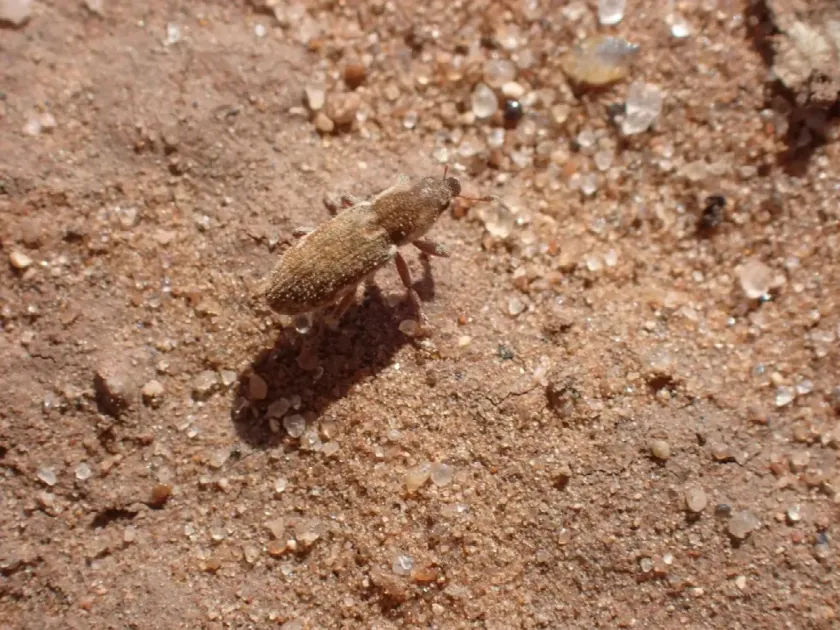
The Puncturevine stem weevil (Microlarinus lypriformis) is a beetle belonging to the Curculionidae family. It is a small, dark-colored insect specifically adapted for living on and inside the stems of its host plant.
Adult weevils are characterized by a long snout, typical of the family, and a mottled dark-grey to brown appearance, which provides excellent camouflage against plant debris and stems.
The larvae are legless, C-shaped, creamy-white grubs with a distinct brown head. They are rarely seen as they spend their entire development cycle hidden within the internal tissues of the plant.
The lifecycle involves eggs being deposited into cavities created by the female in the plant stem. After hatching, the larvae tunnel through the stem, consuming the pith as they grow.
This species was intentionally introduced to various countries as a classical biological control agent to manage infestations of the invasive weed Tribulus terrestris.
What it damages
The primary host for Microlarinus lypriformis is Tribulus terrestris, commonly known as puncturevine or goathead, a weed that produces sharp, spiny burs.
Larval feeding activity occurs within the stem, causing significant structural damage to the pith and vascular tissues, which disrupts the flow of nutrients and water throughout the plant.
Adult weevils also feed on leaf tissue and young buds, but the most severe damage is caused by the tunneling larvae, which can effectively weaken or kill the plant.
When infestation levels are high, the weed's ability to produce seeds is drastically reduced, which is the main objective of using this insect in weed management programs.
By suppressing the vigor of the host plant, the weevil prevents the spread of the weed, protecting livestock and agricultural equipment from the damaging burs.
When it appears
The seasonal activity of the stem weevil is highly dependent on the phenology of the host plant and local climatic conditions, generally aligning with the warmer months.
Adults emerge from their overwintering sites as temperatures rise in late spring and begin searching for host plants to initiate feeding and mating.
During the peak summer season, multiple generations may be produced, allowing the weevil population to increase rapidly in areas with dense puncturevine infestations.
As autumn approaches and temperatures drop, adults seek shelter for hibernation, often in the soil or protected crevices of plant residues to survive the winter.
Monitoring for the presence of these weevils is most effective during the active growth phase of the puncturevine, typically from June through August.
Signs of infestation
The most reliable sign of a puncturevine stem weevil infestation is the presence of small, circular exit holes on the stems of Tribulus terrestris.
Plants showing signs of attack often exhibit premature yellowing, wilting, or a stunted growth appearance compared to healthy, non-infested individuals.
Internally, split stems will reveal evidence of larval tunneling, frass (larval waste), and sometimes the larvae themselves or pupal chambers.
A reduction in the number of spiny fruits (burs) on a patch of puncturevine is a strong indicator that the stem weevils are successfully suppressing the weed's reproduction.
- Circular exit holes on stems.
- Wilting of individual runners or stems.
- Presence of larval tunnels and frass inside the pith.
Control measures
As Microlarinus lypriformis is a beneficial biological control agent, management practices should focus on protecting its population rather than eliminating it.
Avoid the use of broad-spectrum insecticides in areas where the weevils have been released or are actively managing puncturevine populations.
Agricultural planning should include the maintenance of host plant reserves to ensure that the weevil population has sufficient resources to sustain itself through the season.
When applying herbicides to control other weeds, ensure that the spray does not drift into areas where Microlarinus lypriformis is being utilized for puncturevine management.
Integrated weed management should balance chemical control with the biological services provided by these weevils to achieve a sustainable reduction in invasive weed density.
Taxonomy
- Latin name
- Microlarinus lypriformis
- Order
- Coleoptera (beetles)
- Family
- Curculionidae
- EPPO code
- MICLLY
Discussion
No discussions yet — be the first.