
Tribulus weevil
Microlarinus lareyniei
Description
How to identify
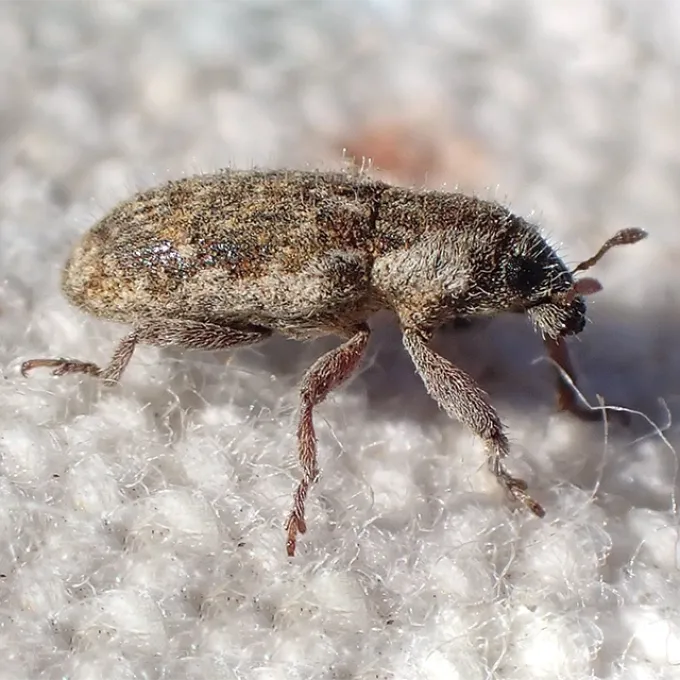
The weevil Microlarinus lareyniei belongs to the family Curculionidae. It is a small insect, typically measuring between 2.5 and 3.5 millimeters in length, making it quite subtle during field inspections.
The body color of the adult beetle ranges from dark brown to black. The elytra are covered with dense, fine, light-colored hairs that create a characteristic mottled or spotted pattern.
The head features a rostrum typical of weevils, which is used both for feeding and for boring holes into plant tissues prior to egg deposition.
The larva of this species has a C-shaped, legless body that is white or cream in color with a brownish head, well-adapted to living within plant structures.
The pupa develops inside the plant parts infested by the larva, which provides the insect with protection against environmental stressors and potential predators.
What it damages
The primary host plant for this species is puncturevine (Tribulus terrestris), a persistent weed found in many arid and semi-arid regions globally.
The larvae are internal feeders, tunneling into the fruits and seeds of the plant, which leads to the direct destruction of the reproductive organs.
Damage to the fruit significantly hinders seed development and viability, thereby reducing the reproductive potential of the weed population in the infested area.
Adult beetles also feed on the leaves and stems, creating small pits and marks, although this damage is generally less severe than the impact caused by the larvae.
Due to its high host specificity, this species is not considered a crop pest but rather a beneficial agent for the biological suppression of invasive weeds.
When it appears
The life cycle of the weevil is closely tied to ambient temperatures and the availability of the host plant throughout the growing season.
Adult beetles emerge from their overwintering sites in the spring when temperatures are consistently high enough to support feeding and mating activity.
Females deposit eggs primarily into the young fruit ovaries of puncturevine, using their rostra to create oviposition sites in the pericarp.
The development from egg to adult can take anywhere from a few weeks to a month, allowing for multiple generations per season under favorable moisture and temperature conditions.
As autumn approaches, the adults seek shelter to overwinter, often burrowing into the soil or hiding beneath dense plant debris near the host plants.
Signs of infestation
The most prominent sign of infestation is the presence of small, circular exit holes on the surface of puncturevine fruits, left by emerging adult beetles.
If the fruit is opened, one can observe larvae feeding internally, reducing the seed content to a powdery mixture of frass and plant tissue.
Host plants suffering from high larval infestation show a marked decrease in seed germination rates, which becomes evident in the following season.
On leaves, one might notice signs of adult feeding, which appear as tiny stippling or pin-prick marks on the leaf epidermis.
In areas with high weevil populations, the overall vigor of the puncturevine is noticeably suppressed, resulting in smaller plants and reduced biomass coverage.
Control measures
In agricultural and environmental management, Microlarinus lareyniei does not require control measures, as it acts as a beneficial biocontrol agent.
Management efforts should instead focus on promoting and preserving the population of this weevil to maximize its impact on the puncturevine weed.
The use of broad-spectrum insecticides should be avoided in areas where the weevil has been released or is actively being used for biological control.
Implementing reduced tillage practices helps protect overwintering sites, which is crucial for ensuring a strong and early emergence of the beetle in the spring.
Integrated weed management strategies effectively incorporate this biological agent to reduce dependency on chemical herbicides and promote ecological stability.
Taxonomy
- Latin name
- Microlarinus lareyniei
- Order
- Coleoptera (beetles)
- Family
- Curculionidae
- EPPO code
- MICLLA
Discussion
No discussions yet — be the first.