
Metapocyrtus
Metapocyrtus
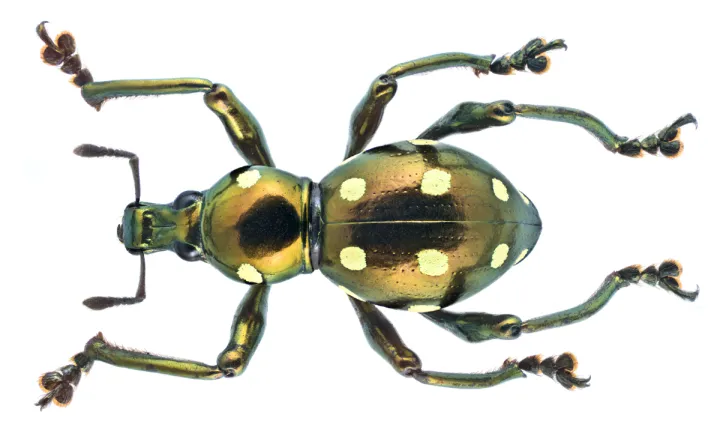
Description
How to identify
Metapocyrtus is a genus of weevils belonging to the family Curculionidae within the order Coleoptera. These insects are well-known for their robust exoskeleton and characteristic appearance.
Adult individuals often exhibit vivid warning colors, which serves as a form of mimicry in their natural habitat. They possess a prominent snout, a typical feature of the Curculionoidea superfamily.
The size of adult beetles varies by species but generally ranges between 10 and 15 mm in length. Their bodies are typically compact and dense, well-adapted to survive in humid tropical environments.
The larvae, like those of most weevils, are legless and lead a cryptic lifestyle, developing either within plant tissues or directly in the soil surrounding the root zone.
The genus is highly diverse, containing numerous species distributed primarily throughout Southeast Asia, particularly in the Philippines, where they are considered endemic components of the local fauna.
What it damages
This pest affects a wide range of tropical and ornamental crops, including various fruit trees, coffee plantations, and citrus groves.
Adults primarily feed on young leaves, chewing along the margins, which leads to significant deformation of the leaf blade and a reduction in the plant's overall photosynthetic capacity.
In certain instances, damage to the bark of young shoots is observed, which can trigger the drying of branch tips and lead to the general weakening of saplings.
The larval stage poses the most significant threat to the root systems of young plants by feeding on fine roots, which prevents proper nutrient uptake and water absorption.
Severe infestations of this pest can result in a significant loss of marketability for commercial produce and a substantial decline in overall yield.
When it appears
The developmental cycle of Metapocyrtus is closely tied to the climatic conditions of its home regions, where there is no distinct cold season to limit activity.
Peak adult activity is typically observed during periods of high humidity and heat, conditions that favor intense feeding and reproduction.
Females lay eggs directly into plant tissues or into the soil near the root zone, ensuring that the emerging larvae have immediate access to a food source.
The duration of the life cycle varies depending on ambient temperatures, progressing through the egg, larva, pupa, and adult stages.
Pupation generally occurs in the soil, where the insect remains protected from external environmental factors and predators until the young adult emerges.
Signs of infestation
The first indicator of the pest's presence is characteristic notched or scalloped feeding damage on the edges of the leaves.
The presence of insect excrement on leaf surfaces and within shoot axils also indicates the activity of adult beetles within the plant canopy.
The wilting of apical shoots without an apparent soil-related cause often signals potential damage to the root system caused by the pest's larvae.
Upon inspecting the root ball of nursery plants, one may discover larval tunnels that disrupt the integrity of the plant's vascular tissues.
During the evening or early morning, adults can often be found on the undersides of leaves, as they prefer to remain hidden during periods of intense daylight.
Control measures
Effective management of Metapocyrtus requires a comprehensive approach, integrating agrotechnical, mechanical, and chemical control methods.
Mechanical collection of adult beetles during the early morning hours, when they are less mobile, is a highly effective method for small plots or greenhouses.
The application of systemic insecticides helps neutralize larvae feeding within plant tissues and affects adults through contact with treated surfaces.
Maintaining cleanliness in plantation aisles by removing weeds is essential, as these plants can serve as alternative hosts for the pest during the off-season.
- Application of biological pesticides based on entomopathogenic fungi.
- Regular monitoring and inspection of the root systems of young crops.
- Adherence to strict quarantine procedures when importing planting material.
Taxonomy
- Latin name
- Metapocyrtus
- Order
- Coleoptera (beetles)
- Family
- Curculionidae
- EPPO code
- METUSP
Discussion
No discussions yet — be the first.