
Ciscaucasian hamster
Mesocricetus raddei
Description
How to identify
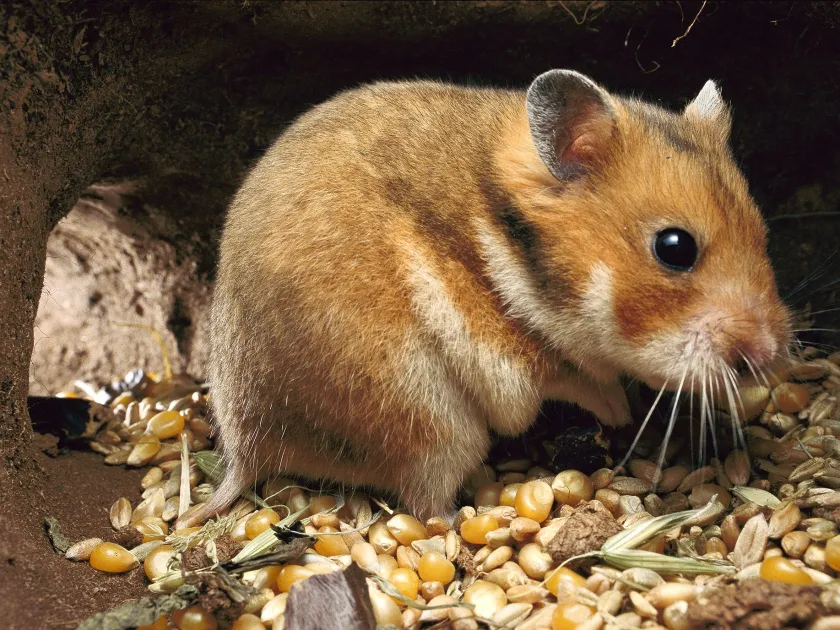
The Ciscaucasian hamster (Mesocricetus raddei) is a rodent species belonging to the Cricetidae family. It is a sturdy-bodied animal measuring approximately 18–28 cm in length.
These rodents are characterized by a distinct dark stripe along their back and a dense, yellowish-brown to reddish coat that provides excellent camouflage in dry grasslands.
They are primarily nocturnal and crepuscular, making them difficult to detect during daylight hours despite their significant impact on agricultural productivity.
The hamster excavates elaborate burrows consisting of multiple tunnels and deep storage chambers, which are crucial for their survival during winter months.
High reproductive rates and territorial behavior make these rodents a formidable pest, especially in areas where food sources are abundant throughout the season.
What it damages
Ciscaucasian hamsters cause significant damage to various crops, with a preference for cereals like wheat, barley, and maize, which are staples of their diet.
During the ripening phase of cereals, hamsters clip the stalks and gather the grain to transport it into their burrows, leading to measurable yield losses.
In addition to grain crops, they frequently invade vegetable gardens and fields to consume root vegetables, melons, and other succulent plant parts.
The mechanical damage caused by their movement along established paths and burrowing activity can ruin significant portions of agricultural land.
Large colonies can cause total loss of crops on localized patches, resulting in visible bare areas within healthy fields that require immediate attention.
When it appears
Activity begins in the early spring as the animals emerge from hibernation to feed on fresh vegetation and establish their feeding territories for the season.
Population growth peaks during the summer months due to multiple litters, placing increasing pressure on crops as the season progresses toward harvest.
Late summer and early autumn represent the period of maximum activity, as the hamsters focus on hoarding food reserves to survive the upcoming winter.
During the winter, Ciscaucasian hamsters remain in their burrows in a state of hibernation, occasionally waking during warm spells to feed on stored reserves.
Monitoring for signs of activity is most effective during the vegetative growth and maturation stages, when the hamsters are most visible and vulnerable.
Signs of infestation
The most prominent sign of a hamster infestation is the presence of large burrow entrances, usually 8–10 cm in diameter, surrounded by fresh soil and vegetation.
Well-trodden paths connecting the burrow network to the feeding grounds are easily observable in affected fields, indicating the intensity of their activity.
Cut stems and leftover grain debris near the burrow entrances are clear indicators of recent feeding and hoarding activities by the rodents.
The sudden appearance of bare patches in a field where crops were recently standing is a classic symptom of high hamster density.
- Characteristic soil mounds at burrow exits.
- Specific audible squeaking or rustling sounds in the evening.
- Presence of grain remains inside excavated storage chambers.
Control measures
Deep autumn plowing is the most effective cultural method to destroy burrow structures, disrupt food storage, and expose the rodents to environmental stressors.
Chemical control using rodenticides is recommended for severe infestations but must be performed using strictly targeted baiting techniques within the burrows.
Careful application of baits prevents secondary poisoning of non-target wildlife, ensuring that only the target population is affected by the treatment.
Integrated pest management should also focus on maintaining field edges and removing weeds that provide cover and additional food for the hamsters.
Encouraging the presence of natural predators, such as birds of prey, can act as a natural deterrent, helping to keep rodent populations under control.
Taxonomy
- Latin name
- Mesocricetus raddei
- Order
- Rodents
- Family
- Muridae
- EPPO code
- MSCRRA
Discussion
No discussions yet — be the first.