
Newton's hamster
Mesocricetus newtoni
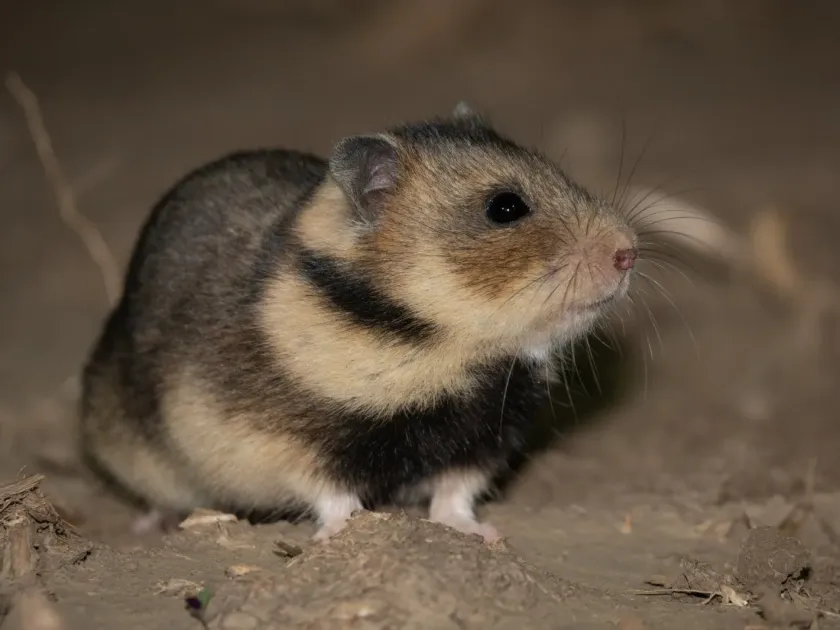
Description
How to identify
Newton's hamster (Mesocricetus newtoni) belongs to the order Rodentia and the family Cricetidae. It is a relatively small rodent species, morphologically similar to the Syrian hamster, but specifically adapted to the steppe and forest-steppe ecosystems of the Balkan Peninsula.
Adult specimens possess a stocky body, short tail, and dense fur. A key distinguishing feature is a dark dorsal stripe and dark patches on the cheeks and flanks, which provide effective camouflage within their natural grassland environment.
This species is a narrow-range endemic found in Bulgaria and Romania. Unlike the common hamster, it is smaller in size yet exhibits high territoriality and aggressive behavior when defending its deep and complex burrow systems.
Systematically, this rodent occupies the niche of a typical field pest, preferring open landscapes, including arable lands, hayfields, and pastures, where it establishes deep underground networks to ensure survival and breeding success.
The hamster is primarily nocturnal, making it difficult to detect during daylight hours. This behavior allows the population to expand silently, often resulting in significant crop losses before the presence of the pest is officially identified by agronomists.
What it damages
Newton's hamster causes substantial damage to a wide range of agricultural crops. It poses the greatest threat to cereal crops, including wheat and barley, by chewing on stalks and consuming grain kernels during the milk-wax stage of maturity.
Significant losses are also documented in corn and vegetable fields. The rodent feeds on roots, tubers, and succulent plant parts, leading to the destruction of young seedlings and a drastic reduction in total yield per hectare.
In addition to direct consumption, the pest causes mechanical damage to agro-ecosystems. By digging deep burrows, the rodents disrupt soil structure, damage the root systems of perennial grasses, and create obstacles for modern agricultural machinery.
During periods of food scarcity, hamsters may attack orchards, gnawing on the bark of young fruit trees. This behavior can result in the complete death of nursery saplings, presenting serious economic risks to fruit-growing enterprises.
Damage is usually focal but extremely intense. In areas with high population density, these hamsters can destroy up to 15-20 percent of a crop, making timely detection and management strategies essential for economic security.
When it appears
Active life for Newton's hamster begins in early spring, once the snow has melted and the soil has warmed up. During this time, the rodents start restoring their burrows and feeding aggressively on young spring vegetation.
The peak of activity and reproduction occurs during the summer months, coinciding with the maturation of primary cereal crops. During this phase, hamsters actively gather and store food, expanding their territory into adjacent fields.
Autumn marks a phase of preparation for the winter. The hamsters continue harvesting, filling their underground chambers with grains, legumes, and crop residues, which is when their impact on the field becomes most visible to farmers.
During the winter, the rodent enters a state of hibernation. While they are not obligate sleepers, their activity is significantly reduced, and they spend most of the winter underground, effectively pausing their damage to agricultural crops.
The life cycle is closely linked to the agricultural calendar. Early harvesting and deep tillage operations interfere with the rodent's established routines, forcing them to migrate or limiting their ability to build adequate food reserves for the winter.
Signs of infestation
The primary sign of a colony is the presence of burrow entrances, typically 5 to 8 centimeters in diameter, surrounded by mounds of excavated soil. These are easily noticeable when inspecting the edges of fields or roadside strips.
In fields, one can observe clear "bald patches" where plants have been destroyed or consumed. Often, stalks of cereal crops are bent towards the ground, as hamsters pull them down to gain easier access to the grain heads.
Fresh digging trails and furrows on the soil surface indicate active colony expansion. Hamsters establish consistent paths between their burrows and feeding sites, which become evident upon a thorough survey of the crop rows.
Increased activity of predatory birds during the day is a common secondary indicator of high rodent density in the area. Additionally, one may find plant debris and discarded hulls around the burrow openings, indicating feeding activity.
When examining damaged plants, clear teeth marks from the rodent's incisors are the definitive diagnostic marker. This distinguishes hamster damage from impacts caused by insects, birds, or other abiotic factors affecting plant health.
Control measures
Effective management of Newton's hamster requires an integrated approach that combines agrotechnical, biological, and chemical control measures to maintain the pest population below economically damaging levels throughout the season.
- Deep plowing of fields to destroy the underground burrow systems.
- Timely harvesting to reduce the availability of food sources.
- Continuous removal of weeds from field boundaries and surrounding areas.
- Application of approved rodenticides following specific regulatory protocols.
- Installation of raptor perches to attract natural predators like hawks and owls.
Chemical control involves the use of specialized bait, which is placed directly into the burrow openings. It is critical to follow safety guidelines to prevent accidental exposure to non-target wildlife and ensure environmental protection.
Agrotechnical methods, such as crop rotation and the creation of buffer zones, help reduce the attractiveness of fields to hamsters. Regular monitoring allows for the localized treatment of infestation centers before they spread widely.
Biological control methods, such as encouraging local raptor populations, offer an environmentally friendly and sustainable solution. By integrating these strategies, growers can effectively manage the hamster population while minimizing the need for heavy chemical intervention.
Taxonomy
- Latin name
- Mesocricetus newtoni
- Order
- Rodents
- Family
- Muridae
- EPPO code
- MSCRNE
Discussion
No discussions yet — be the first.