
Common hamster
Mesocricetus
Description
How to identify
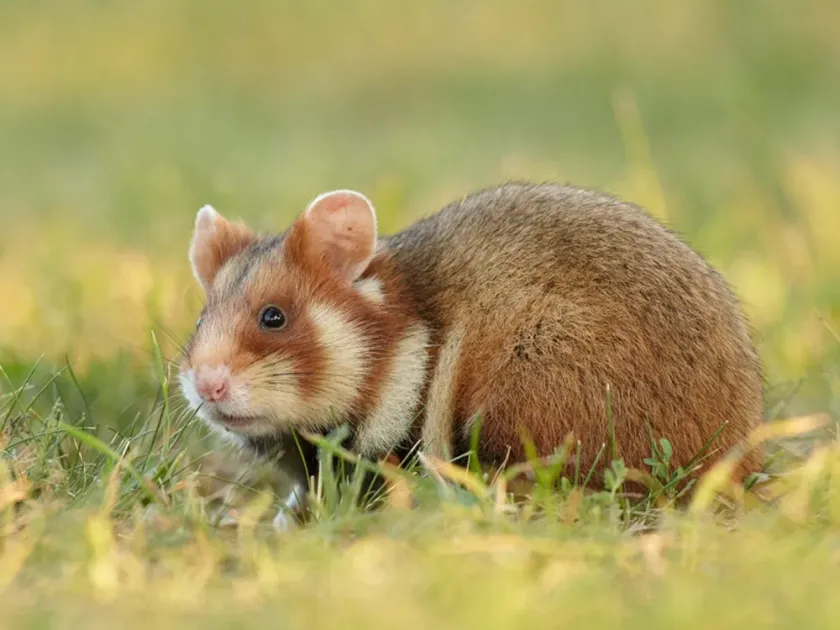
The common hamster (Cricetus cricetus) belongs to the order Rodentia and the family Cricetidae. It is a large, stout rodent measuring up to 35 cm in body length, weighing up to 700 grams.
They are easily recognizable by their unique coloration: a bright reddish-brown back, a pitch-black belly, and white patches on the sides, cheeks, and forehead.
These rodents are nocturnal and crepuscular, living in deep, complex burrows that can reach depths of up to 2 meters, containing separate chambers for food storage.
Unlike smaller mouse-like rodents, they are known for their aggressive behavior and powerful build, often defending their territory vigorously when disturbed.
They exhibit high reproductive rates, with females producing multiple litters per year, which can lead to a rapid population explosion in agricultural environments.
What it damages
The common hamster infests a wide range of crops, including cereals, corn, sunflower, sugar beets, and potatoes, causing significant economic losses to farmers.
During the grain-filling stage, these rodents cut down cereal stalks and carry them back to their burrows, significantly reducing the actual harvest volume.
They cause severe damage to root crops, pulling them from the ground and destroying both the root system and the marketable part of the vegetables.
A major aspect of the damage is the hamster's habit of hoarding vast amounts of food for winter; a single individual can store up to 15 kg of grain in its underground chambers.
In addition to direct consumption, the destruction caused by trampling and soil contamination by feces significantly impacts the quality and storage stability of the harvest.
When it appears
Common hamsters wake from hibernation in early spring, usually around March or April, immediately beginning their search for fresh green vegetation to feed on.
The period of maximum damage occurs during mid-to-late summer, as they prepare for the coming winter by harvesting seeds and grains from fields.
Reproductive activity spans from spring until late summer, ensuring a constant supply of juvenile hamsters that increase their food requirements on the field.
Autumn is the peak hoarding season, where they actively harvest corn, sunflowers, and cereals, making this the most critical time for monitoring potential crop loss.
Once the ground starts to freeze, typically in late October or November, they seal their burrows and enter deep hibernation until the following spring.
Signs of infestation
The most prominent sign of an infestation is the presence of large burrow entrances, often 6–10 cm in diameter, accompanied by soil mounds and well-defined tracks.
In cereal fields, patches of cut stalks lying in piles indicate that hamsters have been working in the area, preparing the crop for transportation to their dens.
Remnants of vegetable crops and discarded seed husks near burrow entrances serve as clear evidence of the rodents' current feeding habits in that vicinity.
Nocturnal activity can often be detected by hearing characteristic sounds or observing the quick movement of hamsters near the edges of crop fields.
A systematic survey of the field will often show a central hub of damage spreading outward, which helps in identifying the exact location of the primary burrow system.
Control measures
Deep autumn plowing is the most effective agronomic method for controlling common hamsters, as it destroys their burrow systems and buries their food reserves.
Rodenticides applied directly into the burrows are a standard chemical control method, though they must be carefully managed to prevent harm to non-target species.
Maintaining clean field margins by removing weeds and tall grass reduces the natural cover that hamsters rely on to hide and establish their colonies.
Biological control, such as installing poles for predatory birds like hawks or owls, can help manage hamster populations naturally over large agricultural areas.
Early identification of burrow sites and immediate localized intervention are essential to preventing the spread of the population across the entire field.
Taxonomy
- Latin name
- Mesocricetus
- Order
- Rodents
- Family
- Muridae
- EPPO code
- MSCRSP
Discussion
No discussions yet — be the first.