
Mongolian gerbil
Meriones unguiculatus
Description
How to identify
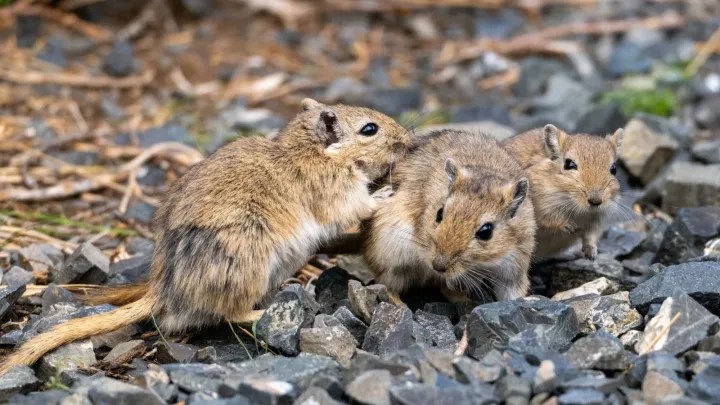
The Mongolian gerbil (Meriones unguiculatus) is a member of the rodent order, family Cricetidae. It is a small mammal with a compact body typically measuring 10–13 cm in length, accompanied by a tail of similar length.
The dorsal side of the gerbil features a sandy or brownish coat, which helps in camouflage within arid environments, while the ventral side is significantly lighter in color.
One of the key identification traits of this species is the presence of dense fur on the soles of the hind feet, a feature that distinguishes it from many other desert-dwelling rodents.
They possess large, prominent eyes and rounded ears. As a highly social species, they live in large, complex underground burrow systems that serve as both nests and food storage chambers.
Although often seen as pets, in agricultural settings, they are considered pests due to their digging habits and consumption of agricultural products, which can cause significant damage to seedlings.
What it damages
The Mongolian gerbil causes substantial damage to grain crops such as wheat, barley, and millet. They consume both emerging shoots and developing grains during the maturation stage.
By chewing through stems at the base, they cause significant thinning of crops, leading to patches of barren land within the field and overall reduction in harvest yields.
During the harvest season, these rodents collect and store large quantities of grains inside their burrows, essentially depleting a significant portion of the yield from surrounding areas.
Technical crops can also suffer, as gerbils may gnaw on roots and rhizomes, leading to the decay and death of young plants, particularly in areas with limited water resources.
Their burrowing activity disrupts the soil surface, leading to increased erosion risks and the degradation of pastures when they inhabit areas bordering agricultural land.
When it appears
Activity levels are highest during the spring and summer months when the availability of green vegetation is abundant, supporting successful reproduction and growth of young gerbils.
As autumn approaches, the focus shifts towards gathering winter food supplies. During this time, damage to cereal crops is most critical as they harvest grains to fill their storage caches.
In winter, Mongolian gerbils do not hibernate; instead, they retreat to their deep burrow systems where they survive on stored food supplies, maintaining minimal surface activity.
Population spikes often occur after mild winters and favorable weather conditions, allowing for multiple breeding cycles throughout the year, which exacerbates pest pressure in the spring.
Monitoring efforts should ideally begin early in the spring, as soon as the ground thaws, to identify active burrow entrances and assess the size of the rodent population on the field.
Signs of infestation
The most obvious signs of infestation are the complex tunnel systems with multiple surface entrances, often marked by piles of loose soil or earth mounds at the entry points.
Damage to crops manifests as localized "bald spots" where plants have been entirely consumed or cut off at the base, leaving nothing behind but remnants and bare soil.
Visible trails and paths connecting burrow entrances to feeding grounds indicate the frequent movement of gerbils, which is a clear indicator of a well-established colony.
Traces of feces and chewed plant fibers near the burrow entrances serve as strong biological evidence of the rodents' presence and activity within the agricultural environment.
Daytime sightings of individuals moving quickly across the field confirm the presence of the pest, as they are primarily diurnal creatures that forage during daylight hours.
Control measures
Effective control usually involves the application of rodenticides, administered as baits, which must be carefully placed to target the pests while ensuring safety for other wildlife.
Mechanical control techniques, such as deep plowing and soil cultivation, are essential for destroying burrow systems and disrupting the gerbils' natural habitat, forcing them to relocate.
Maintaining clean field edges by managing weed growth helps reduce secondary food sources, making the agricultural land less attractive for colony establishment.
Encouraging biological control by supporting populations of natural predators like raptors (hawks, owls) can significantly keep the gerbil population in check within large-scale fields.
- Regular monitoring of burrow activity;
- Use of approved chemical baits according to regulations;
- Deep tillage to collapse underground tunnels;
- Strategic management of peripheral vegetation.
Taxonomy
- Latin name
- Meriones unguiculatus
- Order
- Rodents
- Family
- Muridae
- EPPO code
- MERIUN
Discussion
No discussions yet — be the first.