
Tristram's jird
Meriones tristami
Description
How to identify
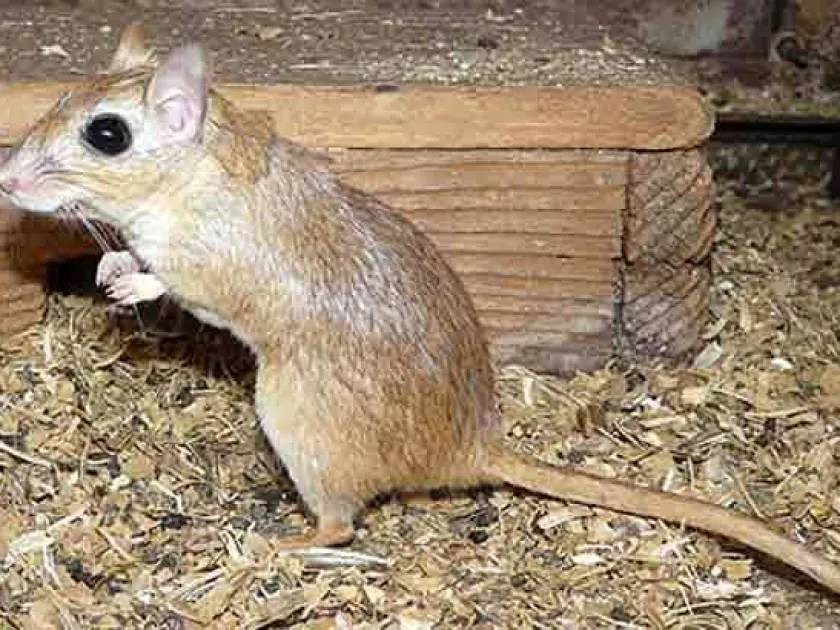
Tristram's jird (Meriones tristami) is a small rodent belonging to the Muridae family. Adults typically measure between 10 and 15 centimeters in length, featuring a tail of equal length often ending in a dark tuft of hair.
The coat is ochre-brown on the dorsal side with a paler, whitish underbelly, providing excellent camouflage in agricultural environments. They possess moderate-sized ears and strong limbs designed for digging burrows in compact soil.
These rodents are primarily nocturnal and crepuscular. In agroecosystems, they frequently establish complex burrow systems along field borders, road verges, and fallow lands that are less prone to frequent mechanical tilling.
They are highly prolific breeders, with females capable of producing several litters per season. Population density is heavily influenced by the availability of food sources and local climatic conditions during the year.
While expert identification involves examining tooth morphology and skeletal features, field identification is usually carried out by assessing the structure of the burrow system and characteristic signs of feeding activity.
What it damages
The primary damage is inflicted upon cereal crops, including wheat, barley, and oats. Jirds consume seedlings, destroy tillering nodes, and feed on grains within the ears during the ripening stage.
In addition to cereals, they cause significant losses to pulses, vegetable crops, and sunflower seeds. When population density is high, they can destroy substantial portions of the harvest on field edges.
Much of the damage is attributed to the storage behavior of these rodents. A single colony can stockpile several kilograms of grain in underground chambers, effectively removing it from the supply chain and causing further economic losses.
In orchards and tree nurseries, jirds are known to strip the bark from the roots of young trees, which often leads to the decline or death of the saplings.
The extensive burrow networks disrupt soil structure and increase the risk of erosion, complicating field operations and the efficient use of heavy agricultural machinery.
When it appears
Tristram's jird remains active throughout the warmer months. However, the peak periods for reproduction and intensive foraging occur during the spring and early summer seasons.
In the autumn, activity levels increase as the rodents prepare food stores for the winter. This is the period when they are most frequently observed impacting newly sown winter cereal crops.
During the winter, they do not hibernate; instead, they rely on food cached in their burrows. In mild winters with available resources, reproduction may continue, leading to rapid population surges in the following spring.
Mass migrations occur when food resources are depleted in abandoned areas or following harvest, causing the pests to invade adjacent fields with green vegetation.
Agronomists should prioritize monitoring population levels during critical stages, such as the emergence of seedlings and the dough stage of grain development.
Signs of infestation
The most prominent sign of infestation is the presence of multiple burrow entrances, often arranged in clusters or rows along the boundaries of agricultural plots.
Fresh soil mounds and vegetation debris around the burrow openings are strong indicators of active colonies and ongoing feeding activity.
Patches of missing crops, where plants have been entirely consumed or clipped at the base, are common. These areas are often connected to burrow entrances by well-worn footpaths.
Evidence of consumption, including half-eaten grains and stems, is frequently found near the burrow sites, along with small droppings which confirm recent usage of the trails.
- Network of underground burrow holes
- Bare patches in the crop field
- Clippings of stems and plant debris
- Visible footpaths between burrows and fields
- Accumulated grain stores in caches
Control measures
Effective management begins with agronomic practices, such as deep autumn plowing to destroy burrows and food caches, combined with weed management along field borders to eliminate cover.
When population levels exceed the economic injury threshold, the use of rodenticides becomes necessary. Baits should be placed directly inside the burrows to minimize the risk to non-target wildlife and livestock.
Biological control methods include enhancing the habitat for natural predators like birds of prey, weasels, and foxes. Installing perches in fields can help attract raptors to assist in keeping rodent populations in check.
Mechanical control, such as burrow flooding, may be practical on small scales, although it is often labor-intensive and less effective for large-scale agricultural operations.
Systematic monitoring of perimeter areas and field boundaries is essential to identify hotspots early and prevent the spread of jirds into the main production areas of the field.
Taxonomy
- Latin name
- Meriones tristami
- Order
- Rodents
- Family
- Muridae
- EPPO code
- MERITR
Discussion
No discussions yet — be the first.