
Persian jird
Meriones persicus
Description
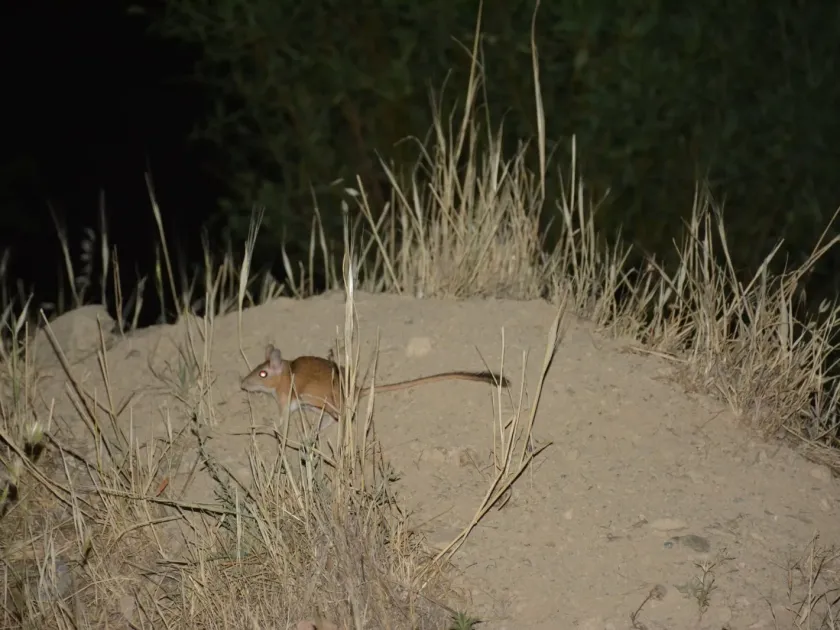
How to identify
The Persian jird (Meriones persicus) belongs to the order Rodentia and the family Cricetidae. It is a robust species of the subfamily Gerbillinae, characterized by a long, well-furred tail with a prominent black tuft at the tip.
The dorsal fur ranges from pale sandy to grayish-brown, while the underside is typically white. Adults can reach body lengths of 15 centimeters, and their tails are often longer than their bodies, serving as a key identification feature.
These rodents prefer rocky habitats, slopes, and dense soils where they construct complex burrow systems. They are primarily nocturnal or crepuscular, making them difficult to observe during daylight hours.
Breeding occurs throughout the spring and summer months, with females capable of producing several litters per season. This high reproductive rate allows populations to recover quickly after environmental stressors.
The species is highly adapted to arid environments, where they rely on moisture content in vegetation to survive, which directly links their survival strategy to the consumption of agricultural crops.
What it damages
The Persian jird causes significant damage to a variety of agricultural crops, including cereals, legumes, and vegetable crops. Damage occurs both during the growing season and while crops are in storage.
Cereal crops like wheat and barley are particularly vulnerable. The rodents consume stems and grains, leading to reduced yields and significant economic loss in infested fields.
Melons and other cucurbits are also targeted, as the rodents gnaw through the rinds to access the moisture inside, rendering the produce unmarketable and susceptible to rot.
In orchards and nurseries, jirds may damage the bark of young trees and saplings, which inhibits growth and can lead to the death of the plants if girdling occurs.
Furthermore, their burrowing behavior negatively impacts soil structure, disrupting irrigation systems and interfering with agricultural machinery, leading to soil erosion and degradation.
Signs of infestation
The primary indicators of a Persian jird infestation are the presence of burrow entrances, typically found along field margins, rocky outcrops, or slopes, often surrounded by excavated soil mounds.
Well-defined trails connecting burrows to feeding areas are often visible in fields. Plants near these trails frequently show signs of being chewed or cut at the base.
Residual plant parts, such as bits of stems and grain husks, are often found scattered near the burrow entrances, marking active feeding sites for the rodent colony.
On damp soil, fresh footprints can be observed near the burrows in the early morning, confirming recent activity and the presence of a localized population.
The accumulation of droppings near burrow entrances is another definitive sign of an established colony, necessitating immediate attention to manage population density.
Control measures
Effective management of the Persian jird involves a combination of mechanical and chemical strategies. Deep plowing of fields is essential to destroy burrow systems and reduce available shelter.
Chemical control usually involves the application of rodenticide baits placed directly inside burrows. This targeted approach is crucial to minimize impact on non-target wildlife and livestock.
Regular monitoring of population density is vital for successful management. If economic damage thresholds are met, organized deratization measures must be implemented across the entire affected area.
Biological control, such as encouraging the presence of avian predators like hawks and owls through the installation of perches, can help maintain lower rodent populations in agricultural areas.
- Practice consistent weed management along field edges to eliminate cover.
- Ensure timely harvesting to reduce the available food supply for the rodents.
- Apply authorized rodenticides strictly according to safety and regulatory guidelines.
Taxonomy
- Latin name
- Meriones persicus
- Order
- Rodents
- Family
- Muridae
- EPPO code
- MERNPE
Discussion
No discussions yet — be the first.