
Midday jird
Meriones meridianus
Description
How to identify
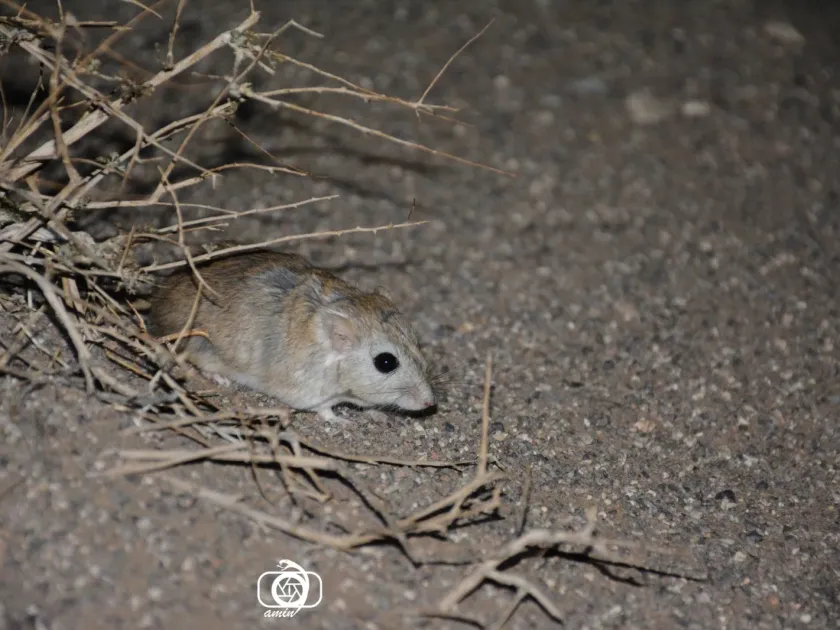
The midday jird is a small rodent belonging to the Cricetidae family. Its body length reaches up to 13 cm, and it features a distinctive furry tail ending in a dark tuft.
The dorsal coloration ranges from sandy-yellow to brownish, providing excellent camouflage in desert and semi-arid environments. The belly and limbs are typically white or light cream.
Distinguishing features include large dark eyes and relatively prominent ears. Their hind legs are well-developed, allowing them to move in rapid, leaping motions when threatened.
They are primarily nocturnal or crepuscular creatures, spending their days in deep, elaborate burrow systems that feature multiple exits and dedicated nesting chambers.
This species shows high adaptability to arid climates, making it a dominant rodent species in various dryland agricultural landscapes across its range.
What it damages
This pest poses a significant threat to grain, pulse, and melon crops. Winter wheat, barley, and millet are particularly vulnerable during the early seedling stage.
Jirds dig up seeds directly from the soil immediately after sowing, causing poor germination and forcing farmers to perform costly reseeding of damaged areas.
During the grain-filling stage, these rodents cut stems and gather ears, transporting them to their burrows. A single family colony can hoard several kilograms of grain.
Young trees and shrubs in shelterbelts are also subject to damage, as the rodents gnaw on the root systems, leading to weakened growth or total plant mortality.
On pastures and grasslands, midday jirds consume substantial amounts of palatable vegetation, significantly reducing the carrying capacity of livestock grazing lands.
When it appears
Activity begins in early spring as soon as the ground thaws. During this period, the rodents start their reproductive cycles, which are crucial for population growth.
The peak of damage occurs during the summer months when crops are maturing. High temperatures and abundant food sources support large colony sizes and intense foraging.
In autumn, jirds exhibit increased activity as they focus on gathering food supplies for the winter. This often involves mass migration toward fields with late-harvested crops.
They do not hibernate, remaining active in their burrows during winter. In milder winter spells, they may emerge to feed if their stored resources become depleted.
The species has a high reproductive rate, capable of producing multiple litters per season, which allows for rapid recovery of population density after control efforts.
Signs of infestation
The most reliable indicator of a jird infestation is the presence of numerous burrow entrances, usually marked by fresh soil mounds located in clusters or small colonies.
Networks of well-trodden paths connecting burrows to feeding grounds are clear signs of rodent activity. Along these paths, one can often find piles of clipped plant debris.
In grain fields, patches of destroyed vegetation appear as bare spots. Close inspection usually reveals cleaned seed hulls or segments of stems bitten off at the base.
Nocturnal observation with bright spotlights can often reveal the jirds as they move quickly between burrows. Their eyes reflect light, making them easy to spot at night.
An infestation typically begins in localized patches that expand rapidly over time. If left untreated, the density of burrow systems increases, making the damage more severe.
Control measures
Agronomic control starts with deep autumn plowing. This mechanical disruption destroys the burrow networks and nesting chambers, drastically reducing the local population.
The use of poisoned baits containing second-generation anticoagulants is a standard practice for high-density infestations. Baits should be placed inside burrows to minimize non-target exposure.
Consistent field monitoring is essential. Implementing control measures as soon as the threshold of economic damage is reached is critical for protecting the potential yield.
Biological control, such as installing perches for predatory birds like hawks and owls, can help manage jird populations naturally throughout the crop growing season.
Maintaining clean field borders and removing dense weeds around the perimeter eliminates nesting sites and reduces the attractive habitat for these rodents.
Taxonomy
- Latin name
- Meriones meridianus
- Order
- Rodents
- Family
- Muridae
- EPPO code
- MERNME
Discussion
No discussions yet — be the first.