
Libyan jird
Meriones libycus
Description
How to identify
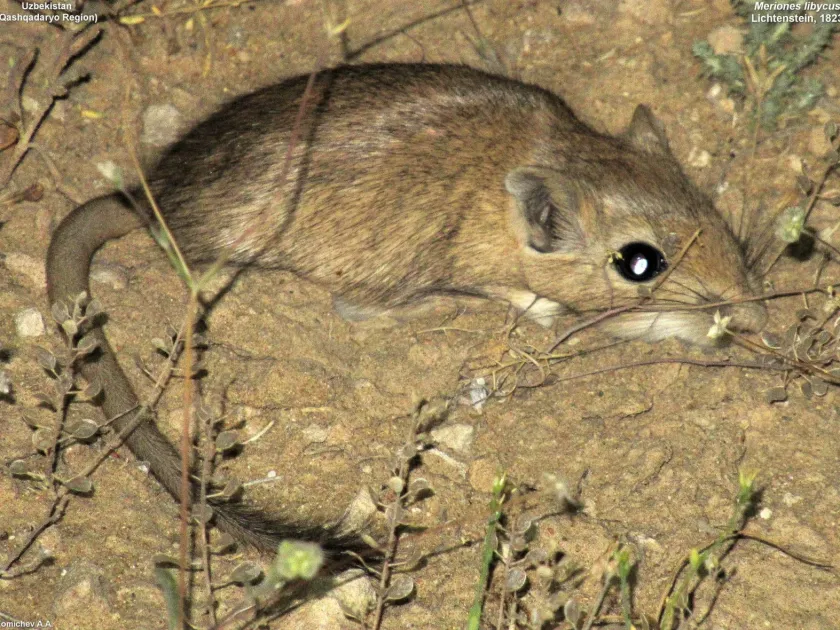
The Libyan jird (Meriones libycus) is a rodent belonging to the Cricetidae family. It is a robust species, with adults reaching a body length of up to 16 centimeters, supported by strong hind legs adapted for jumping.
Their coat color, ranging from sandy yellow to clay-like, provides excellent camouflage in arid environments. A distinct feature is the long tail, usually ending in a black-haired tip.
These rodents are fossorial, meaning they live in complex burrow systems with multiple exits. The layout of these burrows is highly dependent on soil density and the proximity of food sources.
Libyan jirds are highly reproductive, capable of multiple litters per year when environmental conditions, such as water and food availability, are favorable.
While they play a role in natural desert ecosystems, their high population density near farmlands makes them significant agricultural pests that require active management.
What it damages
They cause substantial damage to cereal crops like wheat, barley, and millet. Jirds consume both seeds at the sowing stage and young seedlings, leading to reduced plant stands.
Vegetable and melon crops are particularly vulnerable. The jirds gnaw through the roots, causing the plants to wither and die rapidly, which can lead to complete loss of patches.
Beyond feeding, they hoard large quantities of grain and seeds in their burrow systems. This extraction of biomass significantly lowers the total yield harvested from the fields.
Pastures are also at risk as these rodents consume young forage grasses, potentially leading to rangeland degradation and increased soil erosion due to excessive digging.
Infrastructure is not spared; jirds are known to gnaw through irrigation piping, including drip systems, in search of moisture, resulting in costly repairs and water loss.
Signs of infestation
The most prominent sign is the presence of numerous fresh soil mounds near burrow entrances, often grouped together in areas where the population is concentrated.
Visible trails or paths created by the rodents between their burrows and food sources are common in fields with high infestation levels, marking their movement patterns.
Cut stems and seed husks left scattered around burrow openings indicate active foraging and hoarding behavior, confirming the presence of the pests in the immediate area.
The increased presence of predatory birds circling above a field during daylight hours often points to a high density of jirds, which are partially diurnal in their foraging habits.
In the evening, one might observe the rodents near their burrows, characterized by their alert behavior and distinct social signaling sounds before they dive into their holes.
Control measures
Targeted use of rodenticides, placed directly into the burrow systems, is the most effective way to manage populations while limiting exposure to non-target species.
Deep plowing of the fields acts as a primary agronomic control method. It destroys the underground burrow architecture, forcing the rodents to relocate and disrupting their breeding cycle.
Implementing strategic crop rotation helps reduce pest pressure by ensuring that the preferred food sources are not consistently available in the same location year after year.
Biological control methods, such as erecting perches for predatory birds, can help maintain lower rodent populations by encouraging natural predation within the agricultural landscape.
Regular field scouting starting in early spring is essential to detect early infestation sites, allowing for timely intervention before the population reaches an uncontrollable level.
Taxonomy
- Latin name
- Meriones libycus
- Order
- Rodents
- Family
- Muridae
- EPPO code
- MERNLI
Discussion
No discussions yet — be the first.