
Melalgus confertus
Melalgus confertus
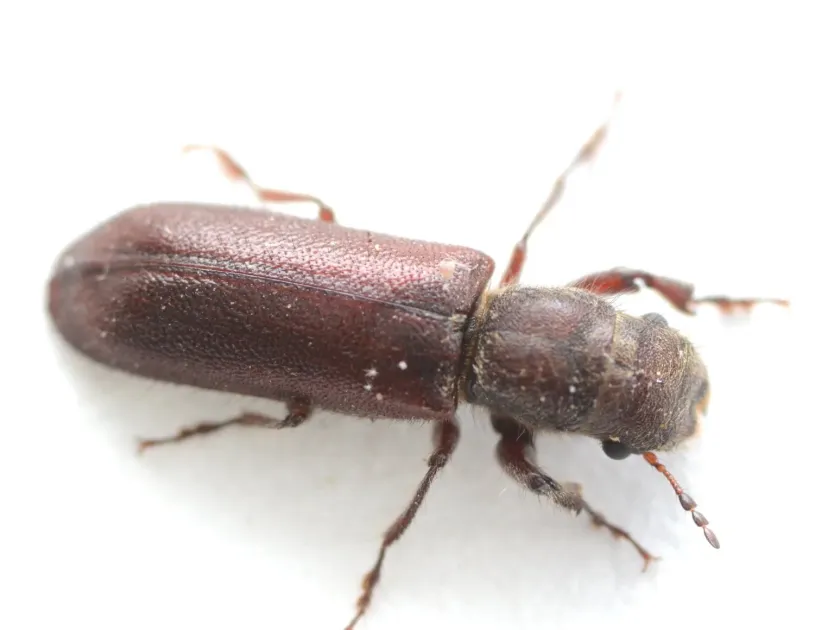
Description
How to identify
Melalgus confertus is a species of beetle belonging to the family Bostrichidae, also known as auger beetles or false powderpost beetles. These insects are well-adapted for boring into plant tissues.
Adult beetles are relatively small, typically measuring between 4 and 7 millimeters in length. Their bodies are cylindrical and sturdy, with a dark brown to black coloration that helps them blend in with bark surfaces.
The pronotum, which is the upper part of the thorax, is strongly developed and hood-like, featuring prominent bumps or granulations. This distinctive structure is a key identification feature for this species.
The larvae are white, C-shaped grubs with a well-developed head and strong mandibles designed for excavating tunnels within the sapwood and heartwood of their host trees.
Understanding the life cycle is essential, as the beetle spends most of its existence hidden within the host plant, making early identification difficult without specialized trapping methods.
What it damages
Melalgus confertus acts as a primary borer, meaning it can attack live trees, although it prefers those already stressed by environmental factors like drought or physical injury.
The larvae create extensive, meandering galleries under the bark and deep into the wood. This boring activity disrupts the vascular system, significantly reducing the tree's ability to transport nutrients.
Host plants include various fruit tree species such as apple, pear, and stone fruits, as well as several species of ornamental trees and native woody plants found in orchard peripheries.
In cases of heavy infestation, the structural integrity of the branches is severely compromised, leading to dieback, branch breakage, and in severe instances, the death of the entire tree.
Secondary damage occurs when the entry and exit holes made by the beetles serve as focal points for fungal and bacterial infections, which can exacerbate the decline of the host tree.
Signs of infestation
The most reliable sign of an infestation is the presence of small, perfectly circular exit holes on the bark, often accompanied by fine, wood-colored frass (boring dust) accumulating near the holes.
Visible symptoms on the tree canopy include wilting of leaves, yellowing of foliage, and localized branch death. These signs indicate that the larvae have severely disrupted the internal vascular flow.
Inspecting the bark surface may reveal sunken areas or small fissures where adult beetles have penetrated. In advanced infestations, the bark may become loose or peel off easily in affected areas.
Monitoring during the flight period is effective, as adults can often be found on the trunks or main branches during warm, sunny evenings or at night when they are most active.
If a tree shows persistent signs of weakness, such as dieback of the top branches or sparse foliage, a careful examination of the trunk for boring evidence is highly recommended.
Control measures
Sanitation is the cornerstone of Melalgus confertus management. All infested branches must be pruned and disposed of properly, preferably by burning, to eliminate larvae and pupae.
Maintaining tree vigor through appropriate fertilization and irrigation prevents the trees from becoming susceptible to boring insects, as stressed trees are primary targets.
Protective measures include white-washing tree trunks to prevent sunburn, which reduces the attractiveness of the bark to egg-laying females and helps maintain tissue health.
When necessary, systemic or contact-based insecticides can be applied during the adult beetle flight period to reduce the population density in heavily infested orchards.
- Pruning and destroying infested plant material
- Maintaining adequate water and nutrient levels
- Applying trunk wraps or whitening agents
- Regular inspection of the orchard during active seasons
- Using pheromone traps for monitoring populations
Taxonomy
- Latin name
- Melalgus confertus
- Order
- Coleoptera (beetles)
- Family
- Bostrichidae
- EPPO code
- MLAGCO
Discussion
No discussions yet — be the first.