
Megalometis
Megalometis
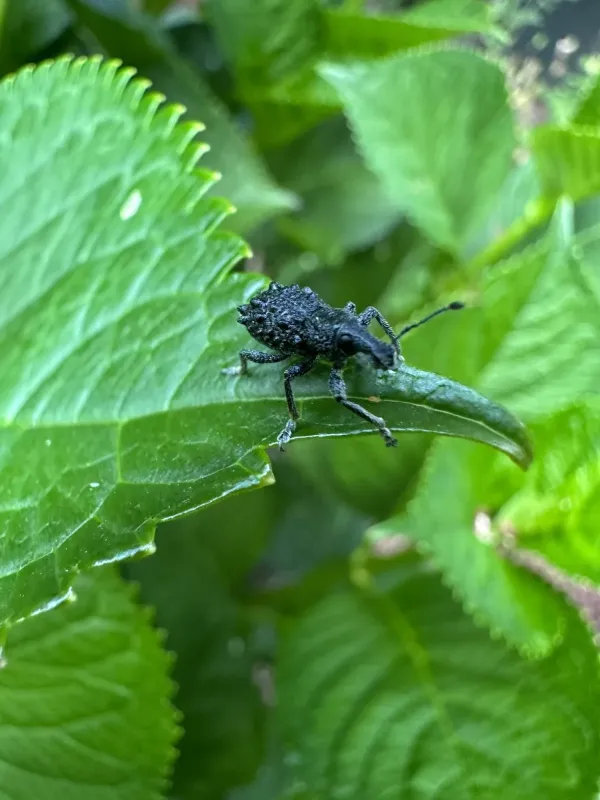
Description
How to identify
Megalometis (genus Megalometis) belongs to the order Coleoptera and the family Curculionidae (weevils). These insects are characterized by their elongated snout, which is a hallmark feature of this large group of beetles.
Adult beetles possess a robust body, often covered in dense scales or hairs, providing effective camouflage against soil or plant bark. Body length typically ranges between 5 and 10 millimeters, depending on the specific species.
Larvae are typically soil-dwelling and lead a hidden lifestyle. They are legless, white-colored, and equipped with a well-developed head capsule designed for feeding on plant tissues such as roots and tubers.
Identifying adult beetles is challenging due to their nocturnal habits and their tendency to drop to the ground and play dead when disturbed. In the field, they are most frequently located by inspecting the base of plants or the soil surface near the stem.
Classification within this genus often requires specialized morphological analysis, as many species exhibit high host specificity and similar external appearances.
What it damages
Megalometis causes significant economic losses across a variety of agricultural crops, targeting vegetable and industrial plants. They are particularly destructive during the early stages of plant development.
Both adults and larvae inflict damage by attacking the root system, sprouts, and young stems. Root injury disrupts nutrient uptake, often resulting in systemic wilting and eventual plant death.
Mass outbreaks can destroy large sections of a crop, leading to sparse plant stands and significant yield reduction. Furthermore, injured roots are highly susceptible to secondary fungal infections.
In intensive farming, damage often goes unnoticed until the impact on the crop is severe, as the primary destruction occurs below the soil surface.
Crops most vulnerable to infestation include root vegetables and legumes, where damage to the taproot or primary roots proves fatal for the plant's growth cycle.
When it appears
The lifecycle of Megalometis is closely tied to climatic conditions. Adult emergence typically coincides with the beginning of the growing season when soil temperatures rise to optimal levels.
Peak adult activity occurs during late spring and summer, when mating and egg-laying take place in the upper soil layers or near the base of the host plants.
Larvae progress through several developmental instars, feeding on roots throughout the summer months. They are capable of surviving harsh conditions by entering diapause within the soil profile.
Overwintering occurs either as adults or larvae, often sheltered deep within the soil or in crop debris, allowing them to withstand low winter temperatures.
The cyclical nature of their development requires constant monitoring, especially during the seed germination phase and early seedling establishment.
Signs of infestation
The first indicator of a Megalometis infestation is patchy wilting or chlorosis in the field, which cannot be attributed to drought or nutrient deficiencies.
Upon closer inspection of the root system, characteristic feeding marks such as grooves or hollow cavities become visible. These sites are often accompanied by secondary rot.
Adult feeding activity may be observed as notched edges on young leaves, which occurs primarily during nighttime hours.
Confirmation of the pest can be achieved by excavating the soil in the root zone, where larvae congregate to feed on young roots.
- Sudden wilting of seedlings.
- Feeding grooves or hollows on the taproot.
- Presence of adult beetles under soil clumps or mulch.
Control measures
Effective management of Megalometis relies heavily on crop rotation. Avoiding susceptible crops in fields with a history of infestation is the most sustainable way to lower population density.
Deep autumn plowing is a critical agronomic practice, as it exposes soil-dwelling larvae to low temperatures and natural predators, significantly reducing survival rates.
The use of insecticidal seed treatments is the most reliable strategy for early-stage protection, ensuring the crop is shielded during the most vulnerable germination phase.
In cases of high pest pressure, soil-applied insecticides or systemic treatments during the active growth phase may be necessary to suppress populations.
Regular field monitoring using light traps or pheromone lures allows for the detection of initial adult flight, enabling timely intervention before significant economic damage occurs.
Taxonomy
- Latin name
- Megalometis
- Order
- Coleoptera (beetles)
- Family
- Curculionidae
- EPPO code
- MGLMSP
Discussion
No discussions yet — be the first.