
Plantain weevil
Mecinus pyraster
Description
How to identify
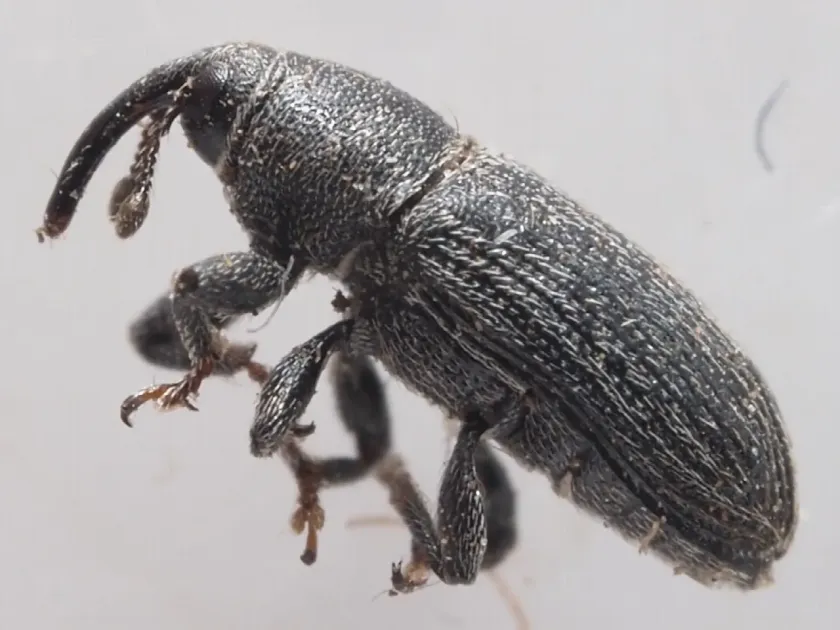
The plantain weevil, known scientifically as Mecinus pyraster, belongs to the Curculionidae family. It is a small snout beetle typically measuring between 2.5 and 3.5 millimeters in length.
The beetle is characterized by a slender, elongated snout (rostrum) typical of the genus. Its body is dark, often with a metallic sheen, and is covered in fine, dense hairs which give it a dull appearance.
The larvae are legless, C-shaped, and possess a cream-colored body with a well-sclerotized head, adapted for boring into plant tissue to feed and grow safely protected within the stem.
Eggs are deposited individually by females into prepared galleries in the stems. This strategy ensures the larvae have immediate access to plant nutrients upon hatching and are shielded from predators.
Adults are highly mobile and capable of flight, allowing them to migrate between host plants and colonize new fields effectively during the active growing season.
What it damages
While primarily associated with plantain species, the plantain weevil is a documented pest for crops such as flax, where it can cause significant yield losses if left uncontrolled.
Adult beetles feed on leaves, creating characteristic small, round holes known as shot-hole damage. This feeding pattern reduces the leaf area available for photosynthesis, weakening the overall plant.
The most severe damage is caused by the larvae, which tunnel through the inner stems. By destroying the vascular tissue, they restrict the transport of water and nutrients, causing stunted growth.
Heavily infested stems often exhibit reduced structural integrity, making them susceptible to lodging during high winds or heavy rainfall, which severely compromises harvest quality.
- Destruction of internal vascular tissue
- Reduced plant photosynthetic capacity
- Weakened stems and increased lodging
- Poor seed development and crop yield loss
- Increased susceptibility to secondary pathogens
When it appears
Adult weevils emerge from overwintering sites in early spring, synchronized with the onset of favorable temperatures, usually when the average daily temperature exceeds 10-12 degrees Celsius.
The mating and oviposition phase occurs shortly after emergence. During this time, adults are most active and visible on the foliage of host plants.
Larval development occurs within the plant tissue throughout the summer months. The duration of the cycle is highly dependent on ambient temperature, with warmer conditions accelerating development.
By late summer, the new generation of adults begins searching for suitable overwintering locations, such as leaf litter, soil crevices, or sheltered areas within the field debris.
Agronomic scouting is critical during the initial spring migration phase to prevent the establishment of large populations that can lead to severe damage later in the season.
Signs of infestation
The earliest signs of infestation are small, pin-like holes in the foliage. Frequent inspection of field edges is recommended, as this is where adult populations usually establish first.
Stems that appear abnormally twisted or swollen are indicative of larval feeding inside. Dissecting these stems will reveal tunnels and larval frass, providing clear diagnostic evidence.
Yellowing of the upper part of the plant or premature wilting, despite adequate soil moisture, often suggests that the vascular system has been severely compromised by larval activity.
Poor uniformity in the field and patches of stunted growth are often overlooked signs of a developing plantain weevil infestation that requires immediate investigation.
Reduced grain or seed filling at the end of the season is a major economic sign of historical larval infestation within the stem, which effectively "steals" nutrients from the reproductive organs.
Control measures
Crop rotation is the most effective cultural control method, as it disrupts the life cycle of the pest by removing the host crop from the field for several years.
Field sanitation is essential; destroying weeds in the Plantaginaceae family in the vicinity of the field reduces the population density before they migrate to the main crop.
Deep autumn plowing of crop residues is a highly recommended practice, as it buries overwintering adults and larvae at depths from which they cannot emerge in the spring.
Chemical control via systemic or contact insecticides may be necessary during the peak adult migration phase to minimize egg-laying and subsequent larval damage.
Integrated pest management (IPM) programs should incorporate the use of sticky traps to monitor adult flight activity, allowing for the precise timing of control measures to reduce unnecessary chemical use.
Taxonomy
- Latin name
- Mecinus pyraster
- Order
- Coleoptera (beetles)
- Family
- Curculionidae
- EPPO code
- MECUPY
Discussion
No discussions yet — be the first.