
Mecaspis alternans weevil
Mecaspis alternans
Description
How to identify
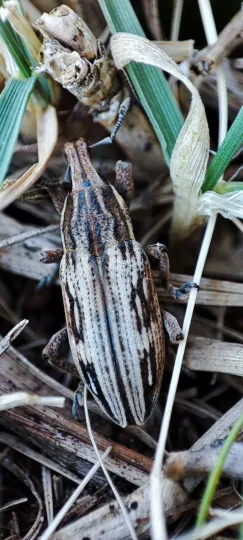
Mecaspis alternans is a beetle belonging to the order Coleoptera and the family Curculionidae. These weevils are characterized by their elongated rostrum and bodies covered in specialized scales that provide excellent camouflage.
Adult beetles typically measure between 8 and 12 millimeters in length. Their coloration ranges from grey to brownish tones, allowing them to blend seamlessly with soil particles and crop debris.
Taxonomically, this species is closely associated with plants from the Amaranthaceae family. They possess elbowed antennae with a clubbed tip, which is a definitive diagnostic feature for the Curculionidae family.
The larvae are apodous (legless), white to yellowish in color, and curved in a C-shape. Their development occurs in hidden environments, often making them difficult to detect during the early stages of infestation.
The life cycle involves complete metamorphosis: egg, larva, pupa, and adult. These insects are highly resilient and capable of thriving in various environmental conditions, particularly in arid climates.
What it damages
The primary hosts for this pest include members of the Amaranthaceae family, most notably sugar beet and related root crops. They are also commonly found on wild species such as Chenopodium.
Both adults and larvae cause significant damage to crops. Adult beetles feed on the margins of leaves, which can severely reduce the photosynthetic area of young plants during their critical growth phases.
The larvae develop by feeding on the roots or stems, damaging the plant's vascular system. This disruption causes stunted growth, wilting, and a significant decrease in overall yield.
In cases of high population density, the pest can decimate crops in the seedling stage. Young plants are particularly vulnerable as they lack the vigor to recover from root damage.
The economic impact of Mecaspis alternans increases significantly in years with mild winters, which favor the survival of overwintering populations.
When it appears
Adults emerge from overwintering sites, typically in the upper soil layers or dense vegetation debris, in early spring when soil temperatures reach 10-12 degrees Celsius.
The peak activity of adult weevils occurs during May and June, when they actively feed and lay eggs in the soil near the root collars of host plants.
Larval development takes place throughout the summer months. After several instars of feeding on root tissues, they complete their cycle by pupating in the soil towards the end of the summer.
New generation adults emerge in late summer. They feed intensively on weeds before entering a dormant state to survive the winter months, making late-season weed control essential.
Adult beetles are highly mobile and can easily colonize new fields from neighboring areas where weed hosts are present.
Signs of infestation
The primary visual sign of infestation is the presence of characteristic notched or scalloped edges on the leaves, caused by the feeding of adult weevils.
Infected plants may exhibit yellowing and wilting. Digging up the plant often reveals tunnels within the root system and the presence of larvae.
During the flowering season of host weeds, adults may be observed on the foliage. They exhibit a defensive reflex and often drop to the ground and play dead when disturbed.
The presence of a high density of Amaranthaceae weeds in or around the field is an indirect but reliable indicator of a potential infestation risk.
Severe root damage often causes the plant to lose its grip on the soil, allowing it to be easily uprooted during mechanical or physical inspection.
Control measures
The cornerstone of management is the systematic removal of Amaranthaceae weeds, which act as a reservoir for the pest population.
Strict adherence to crop rotation is recommended to break the life cycle, avoiding the planting of susceptible crops in fields previously infested with wild host weeds.
Deep autumn tillage helps to disrupt the larvae's habitat and exposes pupae to harsh environmental conditions, significantly reducing the overwintering population.
If the economic threshold of infestation is reached, the application of systemic or contact-based insecticides is necessary to ensure crop protection.
- Continuous field monitoring during the seedling stage.
- Use of high-quality seed treatments.
- Inter-row cultivation to disturb larval development in the soil.
Taxonomy
- Latin name
- Mecaspis alternans
- Order
- Coleoptera (beetles)
- Family
- Curculionidae
- EPPO code
- CLEOAL
Discussion
No discussions yet — be the first.