
Grain stalk moth
Martyringa xeraula
Description
How to identify
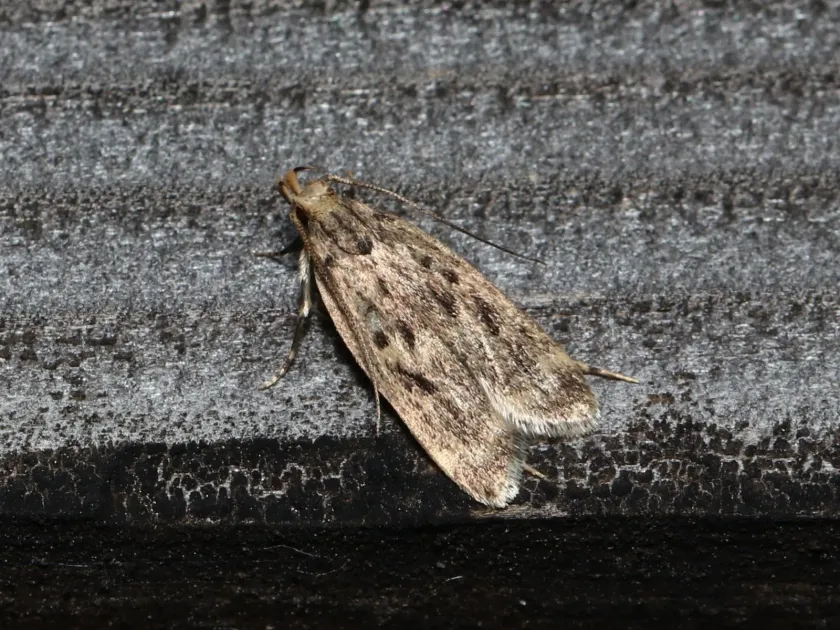
The grain stalk moth (Martyringa xeraula) is a species of the order Lepidoptera and the family Oecophoridae. The adult moth is a small insect with a wingspan of approximately 14–18 mm, typically characterized by a yellowish-gray color with dark, subtle patterns on the wings.
The larvae, or caterpillars, reach lengths of up to 12 mm and are notable for their mobility and pale, dirty-white bodies. Their dark brown head capsules serve as a key morphological feature for identification when inspecting infested plant tissues or storage areas.
The biological cycle consists of four distinct stages: egg, larva, pupa, and adult. Depending on environmental conditions, this moth can complete multiple generations per year. The larvae have the ability to enter diapause, which allows them to survive cold winters inside crop stalks or within storage facilities.
Reproduction involves the female depositing eggs near the base of the stalks or in small cracks in storage bins. The species thrives in environments with moderate humidity and temperatures, which are optimal for larval development and rapid population growth.
The pest is primarily nocturnal or crepuscular, leading a hidden lifestyle. This secretive behavior makes early detection of infestations extremely challenging for farmers and warehouse managers until significant damage has already occurred.
What it damages
The primary hosts for this pest are cereals, including wheat, barley, rye, and oats. Larvae bore into the stalks of these plants, creating internal tunnels that disrupt the transport of nutrients and water, ultimately weakening the plant structure.
Beyond field crops, Martyringa xeraula is a significant pest of stored grain. It thrives in grain elevators, silos, and storage facilities, where larvae feed directly on the grain kernels, significantly reducing the quantity and quality of the stored produce.
In the field, infested plants often exhibit stunted growth, yellowing, and wilting, particularly during the heading stage. Heavy infestations can lead to the death of the main shoot and a substantial reduction in the final harvest yield.
In storage environments, the larvae destroy the grain embryo, rendering it useless for seed propagation. The accumulation of silk webbing and larval frass facilitates the growth of mold and fungi, which can lead to rapid deterioration of the entire grain batch.
High population densities in silos can cause localized heating of the grain, creating a chain reaction of spoilage that results in severe economic losses for agricultural businesses.
Signs of infestation
The first signs of infestation in the field include the premature yellowing and wilting of the central leaf. Close inspection often reveals small, circular entry holes near the base of the stalk, frequently accompanied by fine powdery frass.
When an infested stalk is split open, one can typically find the larvae themselves or evidence of their destructive tunnels. The loss of rigidity in the stem is another diagnostic indicator of internal damage caused by the larvae.
In warehouses and silos, infestation is indicated by the presence of delicate, silken webs spanning across the grain surface. Grain kernels may become matted together in clumps, and a distinct, musty odor is often perceptible in the facility.
Adult moths may be seen flying near light sources during twilight or at night, providing a clear signal of an active reproductive population that requires immediate management action.
Laboratory analysis of grain samples, specifically through sieving and visual inspection, often reveals damaged kernels with visible excavation and the presence of pupal casings, confirming the moth's presence.
Control measures
Effective management requires an integrated approach combining agronomic practices and chemical control measures. Agronomic strategies are crucial for limiting the pest's field population before it moves into storage.
To reduce field populations, farmers should aim for timely harvesting and thorough post-harvest soil cultivation, such as deep plowing, which helps destroy the plant residues where larvae typically overwinter.
In storage facilities, rigorous sanitation is essential. This includes cleaning equipment, drying grain to below 14% moisture content to inhibit larval development, and conducting periodic fumigation using approved pesticides.
The use of pheromone traps provides a dual benefit: it allows for the precise monitoring of moth population levels and helps reduce adult populations by disrupting mating patterns.
- Crop rotation to break the moth’s life cycle.
- Selection of lodging-resistant cereal varieties to reduce stress.
- Sealing storage facilities to prevent migration of adult moths.
- Application of biological insecticides or bacterial agents in organic farming systems.
Taxonomy
- Latin name
- Martyringa xeraula
- Order
- Lepidoptera (butterflies)
- Family
- Lecithoceridae
- EPPO code
- MRTRXE
Discussion
No discussions yet — be the first.