
Marchalina hellenica
Marchalina hellenica
Description
How to identify
Marchalina hellenica is a specialized sucking insect pest belonging to the Margarodidae family, under the suborder of Coccids.
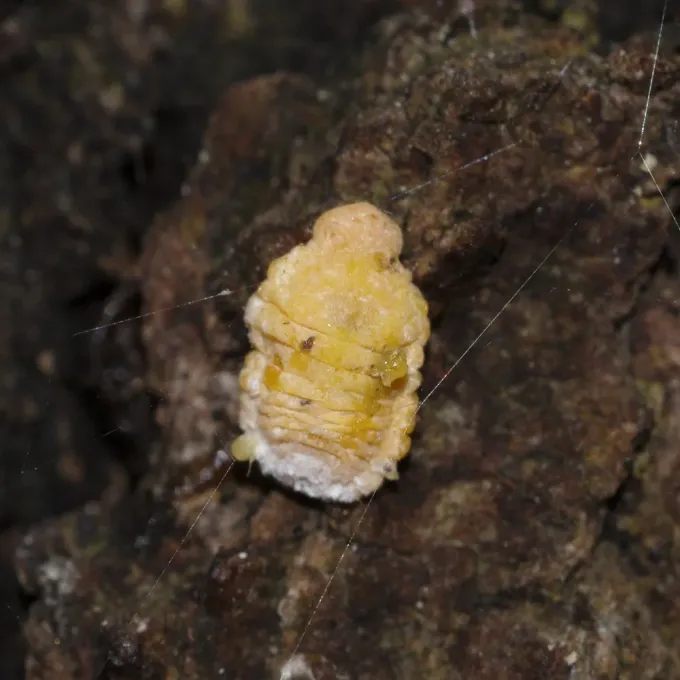
Adult females of this species are characterized by secretory glands that produce abundant waxy substances, forming distinctive white cotton-like coatings on tree bark.
The insect's body has an oval shape, soft tissues, and lacks wings, which limits their independent movement across the site once they have attached themselves to a host plant.
Males are extremely rare and possess wings, but their role in the life cycle is limited as reproduction predominantly occurs through parthenogenesis.
Identification of the pest is difficult at early stages, but as the population grows, the white fluffy secretions become visible to the naked eye on trunks and branches.
What it damages
The primary food source for Marchalina hellenica is various species of pine, particularly the Calabrian pine (Pinus brutia) and the Aleppo pine (Pinus halepensis).
The insect prefers to settle in bark crevices, where it pierces the tree tissues and extracts sap, leading to significant loss of nutrients for the plant.
Damage is caused not only to mature specimens but also to young seedlings, posing a threat to the natural regeneration of forest stands and shelterbelts.
An important aspect is the secretion of honeydew, which creates a favorable environment for the growth of sooty mold, which inhibits photosynthesis in the pine needles.
In Mediterranean-type regions, this pest has a massive impact on forestry, causing tree weakening and making them vulnerable to secondary pests.
When it appears
The life cycle of the pest is closely linked to seasonal temperature fluctuations, with the most active larval development observed during the spring.
Females lay eggs in white cotton-like ovisacs, which protect the offspring from unfavorable weather conditions and external factors.
Reproduction and feeding processes occur mainly in the warm seasons when sap flow in trees is at its peak, providing the insects with nutrition.
In the autumn-winter period, development slows down; however, the pest survives on the tree in the form of larvae of different ages, ready to enter an active phase with the arrival of warmth.
Population monitoring should be conducted constantly, paying special attention to the emergence periods of crawler larvae, as this is the most vulnerable stage of the life cycle.
Signs of infestation
The primary sign of Marchalina hellenica infestation is the presence of white, cotton-like masses on the trunks and larger branches of coniferous trees.
The presence of a sticky film on needles and branches, caused by honeydew secretion, indicates active feeding of the pest colonies.
The appearance of a black film on bark and needles, which is sooty mold growing on the honeydew, testifies to the long-term presence of the colony.
- Yellowing and premature shedding of needles.
- Stunted growth and development of young shoots.
- Attraction of ants, which feed on honeydew and protect the pests from predators.
Severe infestation leads to overall tree stress, expressed by thinning of the crown and reduced drought resistance.
Control measures
The main method of control in forest ecosystems is biological control based on the use of natural entomophages, such as predatory beetles and parasitic hymenopterans.
The use of chemical insecticides is effective only during the crawler emergence periods, as the waxy coating of adult females reliably protects them from pesticide exposure.
Agrotechnical measures include sanitary pruning of heavily infested branches, which helps to reduce the overall population of the pest on the tree.
It is important to restrict the movement of planting material from infested zones to unaffected areas to prevent the spread of Marchalina.
Monitoring using pheromone traps or visual trunk inspections allows for the timely detection of an outbreak and the initiation of protective measures before mass reproduction occurs.
Taxonomy
- Latin name
- Marchalina hellenica
- Order
- Hemiptera (bugs, aphids, leafhoppers)
- Family
- Marchalinidae
- EPPO code
- MARCHE
Discussion
No discussions yet — be the first.