
Red-legged weevil
Magdalis ruficornis
Description
How to identify
The red-legged weevil, known scientifically as Magdalis ruficornis, is a beetle belonging to the Curculionidae family within the order Coleoptera.
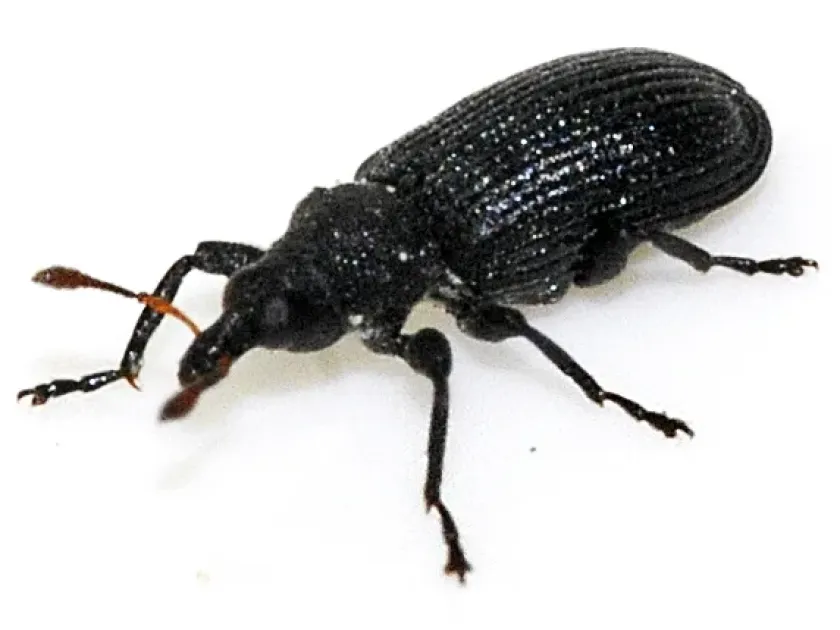
Adult beetles typically measure between 3 and 5 mm in length and possess a dark, metallic-black body, making them somewhat inconspicuous on bark.
As the common name implies, these weevils can be distinguished by their reddish-brown legs and antennae, which contrast with their dark coloration.
The larvae are apodous (legless) and possess a C-shaped, creamy-white body with a brown head capsule, specialized for life inside wooden tissues.
The development cycle concludes with the pupal stage, which takes place inside the wood, followed by the emergence of the adult through a round exit hole.
What it damages
The red-legged weevil primarily targets members of the Rosaceae family, causing significant stress to apple, pear, plum, cherry, and hawthorn trees.
It prefers trees that are already weakened by poor growing conditions, disease, or mechanical damage, making them more susceptible to infestation.
Adult weevils feed on buds and young foliage, while the larvae are responsible for the most severe damage by tunneling through the bark and cambium layer.
Heavy infestations disrupt the transport of nutrients and water within the branches, leading to leaf chlorosis, poor growth, and limb dieback.
In orchards and nurseries, persistent attacks can stunt the growth of young trees, rendering them unproductive or causing their eventual death.
When it appears
Adult weevils emerge from their overwintering sites in the wood during early spring, coinciding with the bud-burst stage of deciduous fruit trees.
The mating and egg-laying period occurs during the spring, with eggs placed in crevices in the bark or small holes bored by the females.
The larvae remain active throughout the summer months, feeding on the underlying tissues and extending their complex gallery networks.
Hibernation takes place primarily in the larval stage, deep within the wood, which provides a thermal buffer against harsh winter temperatures.
The life cycle is usually completed within one year, although unfavorable climatic conditions may occasionally prolong the larval development period.
Signs of infestation
Small, perfectly circular emergence holes on the surface of young branches are a primary visual indicator of a previous or active infestation.
Symptoms often include the sudden wilting of leaves on individual branches, which then turn yellow and drop prematurely as the tissue dies.
Removing a section of the bark in affected areas will reveal meandering tunnels packed with frass, characteristic of the red-legged weevil's activity.
Cracks appearing in the bark can often signify where the female weevils have oviposited or where larval activity is compromising structural integrity.
A general lack of annual terminal growth, despite adequate fertilization and irrigation, can suggest that the tree's internal circulation is compromised.
Control measures
Sanitation is critical; pruning and destroying infested branches effectively removes the larval population before the next generation of adults can emerge.
Promoting tree vigor through balanced fertilization and correct irrigation helps the tree develop its own defenses against wood-boring pests.
Chemical control, targeting the adults with systemic insecticides during the pre-flowering stage, can prevent mating and egg-laying cycles.
Mechanical methods such as trunk brushing or cleaning can remove overwintering sites and debris, reducing the local pressure of the weevil population.
Regular orchard inspections, especially during the spring season, are essential for the early detection and management of the red-legged weevil.
Taxonomy
- Latin name
- Magdalis ruficornis
- Order
- Coleoptera (beetles)
- Family
- Curculionidae
- EPPO code
- MAGDRI
Discussion
No discussions yet — be the first.