
Pine weevil (Magdalis proxima)
Magdalis proxima
Description
How to identify
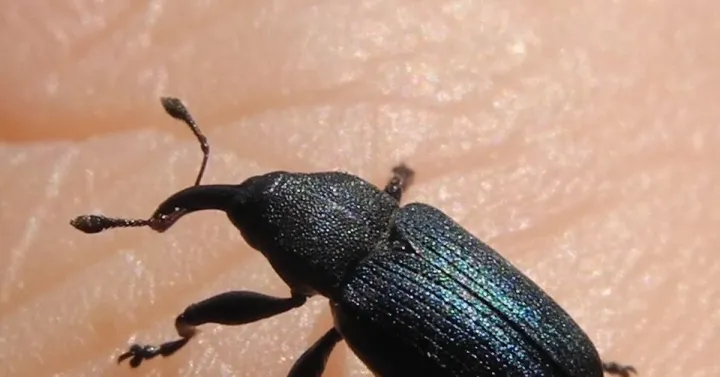
The pine weevil (Magdalis proxima) belongs to the Curculionidae family within the order Coleoptera. Adult beetles are small, typically ranging from 4 to 6 millimeters in length.
They are characterized by their dark black or brown body color, which often exhibits a distinct metallic sheen. The most recognizable feature is the elongated snout, which is typical for this beetle family.
The larvae are legless, white in color, and have a curved body shape. They develop within the bark and phloem of the host tree, making them difficult to detect early on.
Adults are capable of flying, which facilitates the spread of the population across forest areas, plantations, and pine nurseries during the warm spring and summer months.
While sexual dimorphism is not highly pronounced, females are generally larger than males, which is necessary for the egg-laying process in woody tissues.
What it damages
Magdalis proxima primarily attacks various species of pine (Pinus). Both adults and larvae contribute to the overall damage caused to the host plants.
Adult beetles cause damage by feeding on young shoots, where they create small, circular feeding holes that disrupt sap flow and damage the apical parts of the trees.
Larvae develop under the bark, excavating winding galleries that often girdle the branches or stems, effectively cutting off the tree's nutrient supply lines.
Significant infestations can lead to the wilting and death of young pine seedlings, causing severe economic losses in forestry nurseries and new plantations.
Weakened trees become susceptible to secondary infections and infestations by other pests like bark beetles, further exacerbating the damage to the forest ecosystem.
When it appears
Adult activity typically begins in the spring, once the average daily temperature consistently rises above the threshold required for beetle emergence.
During the spring period, the beetles engage in supplementary feeding, which is crucial for their maturation before they proceed to the reproductive phase.
Egg-laying occurs throughout late spring and early summer, with females selectively choosing suitable bark areas on young shoots or stressed trees.
Larval development continues throughout the summer months as they feed and grow within the inner bark, eventually preparing for winter dormancy.
The insect overwinters as a larva within its galleries, undergoing pupation in the following spring before emerging as a new generation of adult beetles.
Signs of infestation
One of the earliest visible symptoms is the yellowing of needles on young branches, which often leads to needle cast and branch dieback.
Observation of the stems often reveals small, neat holes on the bark surface where the adult beetles have engaged in feeding activity.
Resin flow or bleeding from the bark is a common response of the tree to the larval galleries created beneath the surface, indicating active infestation.
Peeling back the bark reveals intricate winding tunnels filled with frass, which are undeniable signs of larval feeding and presence.
- Premature yellowing of needles on apical shoots.
- Resin bleeding on the trunks and twigs.
- Small, circular entry/exit holes on the bark.
- Complex larval galleries under the bark layer.
Control measures
Effective management begins with strict sanitation practices, such as the prompt removal and destruction of infested trees and logging residue.
In forest nurseries, regular monitoring is essential; applying systemic insecticides during the adult emergence phase can help prevent significant damage.
Pheromone traps are highly effective tools for monitoring population density, allowing foresters to time their interventions for maximum impact.
Biological control, including the protection and encouragement of natural parasitoids, can help keep the weevil population in check without chemical intervention.
When chemical treatments are necessary, it is vital to use authorized pesticides and rotate chemical groups to prevent the development of resistance in the population.
Taxonomy
- Latin name
- Magdalis proxima
- Order
- Coleoptera (beetles)
- Family
- Curculionidae
- EPPO code
- MAGDPR
Discussion
No discussions yet — be the first.