
Pine weevil
Magdalis phlegmatica
Description
How to identify
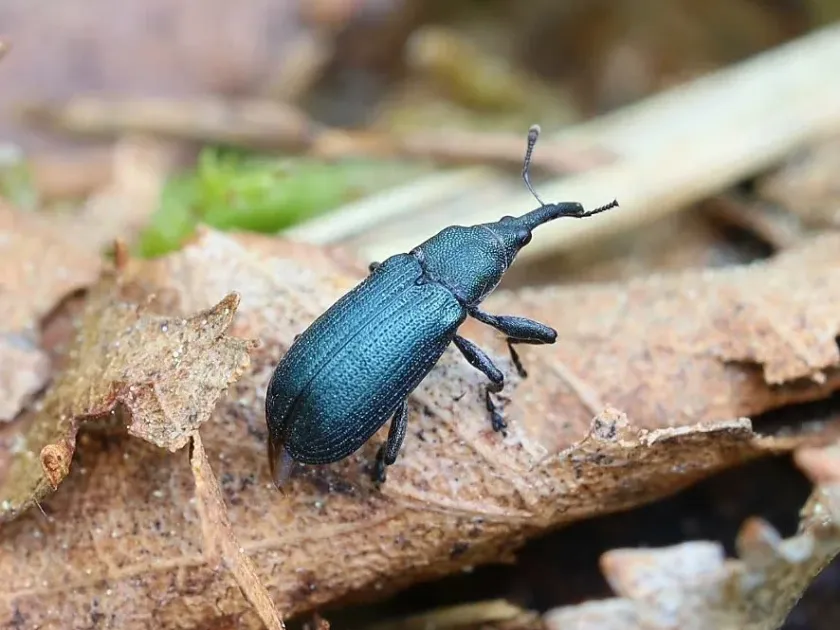
Magdalis phlegmatica, commonly known as a type of pine weevil, belongs to the order Coleoptera and the family Curculionidae. These beetles are relatively small, typically measuring between 3 and 5 mm in length, and are characterized by a prominent rostrum.
Their bodies are dark, ranging from blue-black to solid black, often exhibiting a metallic sheen. The surface is covered with dense punctures, giving the beetle a distinct matte appearance.
The larvae are legless, white grubs with brown head capsules, typically found in a curved, C-shaped posture. They develop deep beneath the bark of host trees.
Pupation occurs in a specially constructed chamber within the bark or sapwood. The pupae are creamy-white and gradually darken as the adult beetle matures.
This species is an oligophage, primarily attacking conifers, which makes it a notable pest in pine plantations and managed forest ecosystems.
What it damages
The primary hosts for Magdalis phlegmatica are various pine species, including the Scots pine. Occasionally, they may infest spruce trees if the site conditions are favorable for the pest.
They prefer weakened or stressed trees, often colonizing young plantations that are struggling due to environmental factors or poor forest management practices.
Healthy, vigorous trees are less susceptible because their natural resin flow acts as a physical barrier against colonization by both adults and larvae.
Adult feeding causes cosmetic and minor growth damage to shoots, but the most severe damage is caused by larvae tunneling through the phloem and cambium layer.
Extensive larval feeding disrupts the flow of nutrients and water, which, if persistent or severe, can lead to the mortality of branches or the entire young tree.
When it appears
The flight period of adult weevils typically begins in the spring, usually between April and May, as temperatures rise and the bark of the host trees warms up.
After a period of maturation feeding, the beetles mate and females lay eggs into small niches they excavate in the bark of thin stems or twigs.
Larval development takes place throughout the summer months. The larvae grow steadily, creating winding galleries filled with frass under the bark.
They usually overwinter as mature larvae within their feeding galleries or prepared chambers, ready to pupate early in the following spring.
The species generally completes one generation per year, although weather variations can slightly alter the timing of their emergence and developmental stages.
Signs of infestation
One of the earliest signs of infestation is the presence of small, round exit holes on the bark, indicating that the new generation of adults has emerged.
Foliage symptoms include yellowing, wilting, or premature shedding of needles on affected branches, reflecting the damage to the tree's vascular system.
If the bark is carefully peeled away from affected areas, characteristic larval tunnels (galleries) packed with sawdust-like frass can be observed.
Young trees may exhibit stunted growth or distorted tips, which are common visual cues that the tree is under physiological stress due to larval boring.
- Chlorotic or yellowing needles on branch tips.
- Small, clean-cut exit holes on the tree trunk.
- Accumulation of wood dust (frass) under the bark or on the ground.
- Dieback of individual branches or young saplings.
Control measures
Sanitation is the most effective management strategy; this involves identifying and removing infested trees before the new generation of beetles can emerge.
Promoting forest health through proper silvicultural practices, such as appropriate spacing and thinning, helps trees maintain enough vigor to resist weevil attacks.
In nurseries or high-value forest stands, systemic insecticides may be applied during the adult emergence period to prevent further egg-laying.
Encouraging natural predators, such as woodpeckers and various parasitoid wasps, is essential for maintaining natural biological control in wild forests.
Monitoring population levels with the use of pheromone traps or systematic field inspections allows foresters to intervene early and minimize economic damage.
Taxonomy
- Latin name
- Magdalis phlegmatica
- Order
- Coleoptera (beetles)
- Family
- Curculionidae
- EPPO code
- MAGDPH
Discussion
No discussions yet — be the first.