
Pine perforation weevil
Magdalis perforata
Description
How to identify
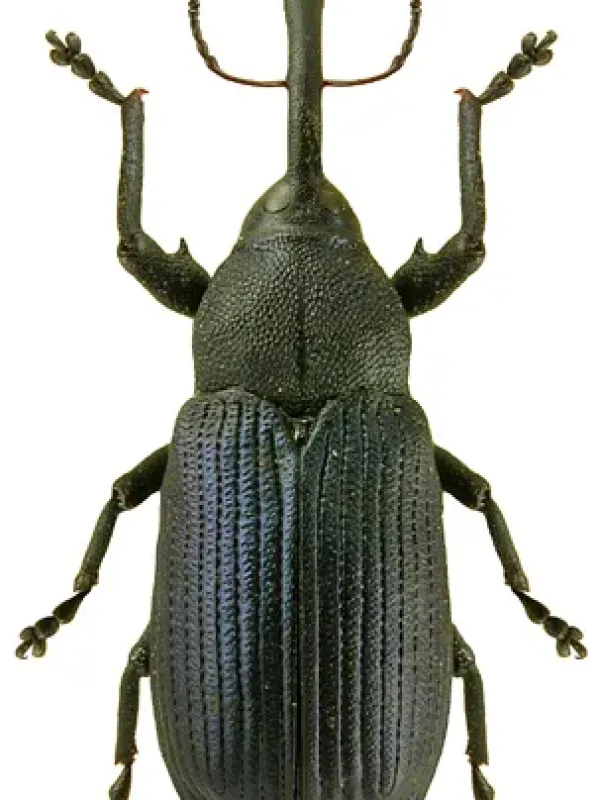
The pine perforation weevil (Latin: Magdalis perforata) is a member of the Coleoptera order and the Curculionidae family. These beetles are relatively small, usually measuring between 3 and 5 millimeters in length.
The adult insect has a dark, often black or brownish-black coloration with a distinct, elongated rostrum. Its elytra are covered with fine punctures, giving the beetle a matte appearance under close inspection.
The larvae are typically whitish or cream-colored, legless, and exhibit a C-shaped body structure. They are specifically adapted for life within the subcortical layers of host trees.
Development includes a complete metamorphosis consisting of egg, larva, pupa, and adult stages. This species is native to coniferous regions, thriving in temperate forest environments.
Adult beetles possess strong mobility and are well-adapted to navigating through the branches of coniferous trees to feed and find mates during the warmer months.
What it damages
This pest primarily targets pine trees (Pinus genus), though it can occasionally affect other conifer species found within its native distribution range.
Adult beetles feed by creating small, characteristic perforations in the bark of young shoots and twigs, which weakens the integrity of these plant structures.
The larvae cause significant damage by tunneling through the cambium layer and inner bark, effectively disrupting the flow of water and nutrients throughout the affected limb.
Severe infestations often lead to the premature needle drop, wilting of shoots, and, in young saplings, can cause the death of the entire tree if the girdling is extensive.
Furthermore, the damage caused by the larvae creates ideal entry points for opportunistic fungal pathogens and secondary infestations by other bark-dwelling insects.
When it appears
The flight of adult beetles usually begins in the spring, typically between May and June, coinciding with rising ambient temperatures above 12–15 degrees Celsius.
After mating, the females deposit eggs individually into crevices in the bark of thin branches or stems of young pine trees, starting the next generation.
Eggs hatch within approximately two weeks, and the emerging larvae immediately begin feeding, burrowing deeper into the bark to develop over the summer months.
By late summer or early autumn, the larvae complete their development and prepare individual pupal chambers beneath the bark to withstand the winter months.
The winter period is passed in the larval stage inside these protective chambers, ensuring the population survives until the return of spring warmth.
Signs of infestation
The most visible sign of an infestation is the appearance of numerous small, clean-cut holes in the bark of young twigs, which look like drill marks.
Frass (fine sawdust produced by feeding larvae) collecting at the base of branches or in bark fissures is a definitive indicator of larval activity underneath the bark surface.
Yellowing and subsequent wilting of needles on specific branches are symptomatic of damaged conducting tissues, often appearing as the infestation progresses.
In cases of heavy infestation, the bark on affected sections may appear dry and brittle, and localized dead patches may develop around the tunnels of the larvae.
- Drill-like holes in shoot bark.
- Presence of sawdust (frass) on branches.
- Yellowing and wilting of needles.
- Death of tips or small branches.
Control measures
Effective management begins with strict sanitation practices, including the prompt removal and destruction of infested, dead, or dying trees to reduce local pest populations.
Targeted insecticide applications during the adult emergence phase in spring can be highly effective in preventing the beetles from laying eggs on healthy host material.
Using pheromone-based traps in forest nurseries and high-value plantations allows for the monitoring of population levels and aids in scheduling timely chemical interventions.
Maintaining tree vigor through proper irrigation, adequate spacing, and balanced fertilization programs helps trees naturally resist minor beetle attacks.
In areas where the pest is established, integrated pest management (IPM) strategies, which combine cultural, mechanical, and chemical measures, provide the most sustainable results.
Taxonomy
- Latin name
- Magdalis perforata
- Order
- Coleoptera (beetles)
- Family
- Curculionidae
- EPPO code
- MAGDPE
Discussion
No discussions yet — be the first.