
Pine weevil Magdalis memnonia
Magdalis memnonia
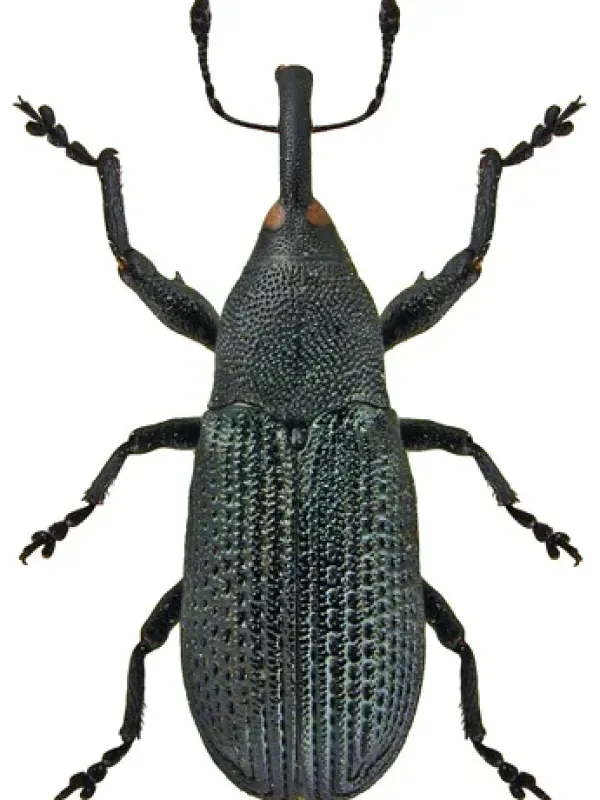
Description
How to identify
Magdalis memnonia is a species of weevil belonging to the family Curculionidae. These small beetles typically measure between 3 and 5 mm in length and possess a dark, almost black, elongated body with a subtle metallic sheen.
Like many members of the weevil family, they exhibit a prominent, slightly curved snout (rostrum) which they use for feeding and excavating egg-laying sites. The larvae are white, legless, and have a distinct dark head capsule, residing within the wood.
The pupal stage occurs within small chambers carved inside the sapwood of the host tree. Because the entire development takes place under the bark, the beetle remains hidden from view for most of its life cycle.
Identification is easiest during the adult stage in late spring when they emerge to feed on the foliage and young shoots of their host trees. They can be found via visual inspection or by using an insect sweep net.
Their appearance and host specificity make them a recognizable pest in forest nurseries and young pine plantations. Monitoring should focus on the mid to upper canopy of young trees during the primary flight season.
What it damages
The primary host for Magdalis memnonia is the Scots pine (Pinus sylvestris) and other closely related pine species. It poses a significant threat to young plantations and forest understories that are still in their development phase.
The larvae damage the tree by feeding on the phloem and sapwood of twigs and branches. This boring activity creates galleries that disrupt the vascular flow of nutrients, ultimately causing branch dieback.
Heavily infested trees show stunted growth, deformed crowns, and in severe cases, the death of individual branches or the entire tree. This physiological stress makes the pine susceptible to secondary attacks from bark beetles.
Economic damage is twofold: the reduction of timber quality and the loss of aesthetic value in ornamental or park settings. Broken branches due to structural weakening can also create entry points for pathogens.
In forest management, infestations can lead to substantial losses if not addressed early. The destruction of apical and lateral shoots significantly hinders the vertical and lateral growth of young pines.
When it appears
Adult activity begins in late spring, typically in May, and can continue through June. This is the period when beetles emerge from their overwintering sites to feed and seek mates.
During the mating season, females deposit eggs into small notches or holes they drill into the bark of young branches. This phase is critical as it marks the beginning of the new annual generation.
Larvae hatch and feed on the inner tissues throughout the summer months. They continue to excavate tunnels and grow, eventually reaching maturity by late summer or early autumn, depending on the ambient temperatures.
Pupation occurs in late summer within the galleries. The resulting adults or late-stage larvae typically overwinter inside the woody tissues of the infested branches, shielded from the harsh cold.
The synchronization of the lifecycle with the growth period of the pine makes spring the most effective time for monitoring and implementing control measures to prevent successful egg-laying.
Signs of infestation
Initial signs of an infestation include small entry holes scattered on the bark of twigs. These holes are often accompanied by resin flow, which is the tree's natural defense mechanism against the boring beetle.
Yellowing needles on specific branches are a tell-tale sign that the vascular system of that branch has been compromised by larval mining. These branches eventually turn brown and die.
Frass, or fine wood dust produced by larvae, is often visible around the entry holes or beneath infested branches. The presence of this material is a reliable indicator of active larval feeding inside.
Structural damage is another sign; infested branches often become brittle and break off easily under moderate wind or heavy snow loads, revealing the complex internal gallery systems.
Peeling back a small section of bark on a suspect branch will reveal the characteristic, winding galleries packed with frass, confirming the presence of the weevil larvae.
Control measures
Sanitation is the cornerstone of control. Removing and destroying infested branches or entire trees before the new generation of adults emerges is essential to preventing the spread of the population.
Chemical control using systemic or contact insecticides may be necessary in high-value plantations or ornamental settings. These applications should be timed to match the peak adult emergence window.
Good silvicultural practices are vital. Maintaining tree health through proper nutrition and avoiding overly dense plantings can reduce the likelihood of a major infestation taking hold.
Biological monitoring using pheromone or sticky traps can help track population trends and timing for interventions. Encouraging natural predators can also play a role in integrated pest management.
- Prune and destroy infested branches immediately.
- Apply insecticides during the adult flight period.
- Ensure proper site hygiene to remove breeding material.
- Monitor plantation health regularly for early detection.
Taxonomy
- Latin name
- Magdalis memnonia
- Order
- Coleoptera (beetles)
- Family
- Curculionidae
- EPPO code
- MAGDME
Discussion
No discussions yet — be the first.