
Himalayan weevil
Magdalis himalayana
Description
How to identify
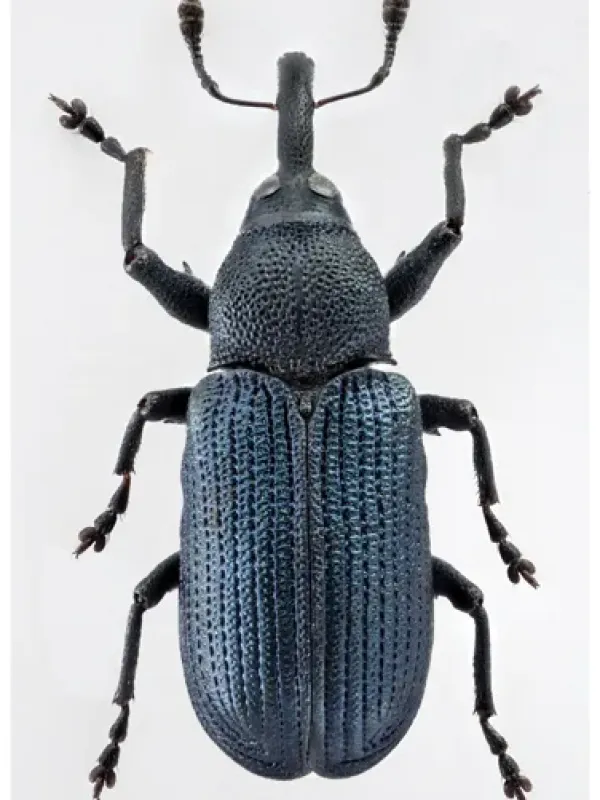
The Himalayan weevil (Magdalis himalayana) is a member of the Coleoptera order and the Curculionidae family. These insects are distinguished by their elongated snouts and compact, robust bodies, which often display dark or metallic colorations.
Adult beetles are equipped with a tough exoskeleton, allowing them to withstand various environmental stressors. The species is well-adapted to life within mountain forest ecosystems, successfully completing its complex life cycle within host trees.
Larvae are legless, C-shaped, and creamy white in color with a well-developed head capsule. They live concealed inside the woody tissues of the host, making visual detection difficult until significant damage occurs.
The life cycle is closely linked to the host tree's physiology. Adults feed on needles and new shoots before mating, while the larvae focus their energy on consuming the inner bark and cambium layers.
Detection is often aided by the presence of characteristic small, circular exit holes on the bark, which indicate that the adult beetles have emerged from their larval galleries.
What it damages
This pest primarily targets coniferous trees, especially those within the Pinaceae family, such as pine and spruce. It preferentially attacks trees that are already stressed, weakened, or damaged by external factors.
The primary damage is caused by the larval stage. As they tunnel through the sub-cortical layers and sapwood, they disrupt the transport of nutrients and water, which often leads to the decline and eventual death of the tree.
Outbreaks of this weevil can destroy large sections of forest stands. Weakened trees, once infested, become prone to secondary colonization by other opportunistic pests and pathogens.
Adults contribute to the damage by feeding on needles and young buds, which reduces the tree's vigor and negatively impacts the growth rates of young seedlings and ornamental trees alike.
In forestry, the presence of Magdalis himalayana serves as a significant biological indicator, signaling poor forest health and the need for immediate sanitary intervention to prevent spread.
When it appears
Adult activity typically begins in the spring as temperatures rise, signaling the end of their overwintering phase. They emerge to feed and locate suitable host trees for the upcoming season.
The breeding season generally spans late spring to early summer. During this time, females carefully select sites under the bark to deposit eggs, ensuring that the larvae have immediate access to food upon hatching.
Larvae develop throughout the summer months, increasing in size and expanding their gallery network deep within the wood, which ensures they remain protected from most external threats.
As autumn approaches, the population prepares for overwintering. Most individuals spend the winter as larvae or pupae, securely sheltered inside the tree trunks where they are insulated from winter temperatures.
The specific timing of each life stage may vary depending on altitude and local climate, as mountain species are highly sensitive to thermal conditions in their habitat.
Signs of infestation
The most reliable sign of an infestation is the appearance of small, circular exit holes in the bark. In some cases, fine boring dust may be visible around these openings.
Wilting of individual branches or an overall yellowing of the tree's canopy are major red flags, indicating that the vascular system has been compromised by larval feeding activity.
Close inspection of the bark might reveal small slits where females deposited their eggs. Resin flow or "bleeding" from these spots is a common sign of a tree's defensive response to the pest.
A noticeable decline in annual growth rings and the loss of tree vigor are diagnostic indicators that should prompt a thorough inspection for internal galleries.
When a portion of the bark is peeled away, the complex, winding patterns of larval galleries are clearly visible, confirming the presence of Magdalis himalayana in the infested wood.
Control measures
The cornerstone of management is maintaining strict sanitary conditions. Removing and destroying infested trees before the next generation of beetles emerges is crucial for population control.
Pheromone traps are highly effective for monitoring adult activity. These tools allow foresters to track population trends and time any necessary interventions with high precision.
Biological control, such as encouraging natural predators like insectivorous birds or parasitic wasps, helps maintain the population at non-threatening levels within healthy forests.
Chemical control involving systemic or contact insecticides may be implemented during the adult flight period if an outbreak threshold is reached, ensuring minimal impact on the environment.
Overall forest health management, including proper site selection and thinning practices, builds tree resilience, making stands less attractive and susceptible to Magdalis himalayana attacks.
Taxonomy
- Latin name
- Magdalis himalayana
- Order
- Coleoptera (beetles)
- Family
- Curculionidae
- EPPO code
- MAGDHI
Discussion
No discussions yet — be the first.