
Pine bark weevil
Magdalis duplicata
Description
How to identify
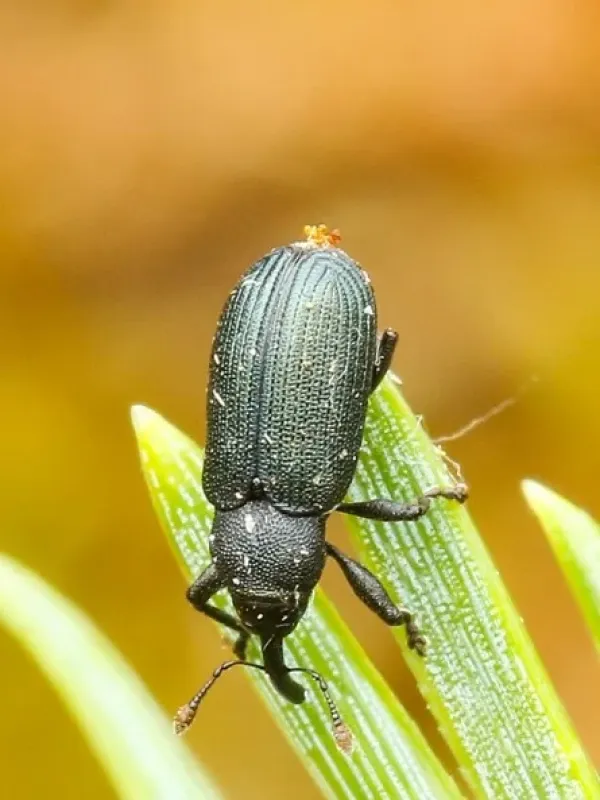
The Pine bark weevil (scientific name Magdalis duplicata) is a member of the Curculionidae family, known for its destructive impact on conifer forests. The adult insect is small, typically measuring between 3 and 5 mm in length, and is characterized by a dark, metallic-bronze or black exoskeleton.
The larvae are legless, slightly curved, and white in color with a distinctive brown head capsule. They spend their entire developmental phase feeding within the cambium and phloem layers of the host tree, making them difficult to detect until significant damage has already occurred.
Adult weevils possess a long, distinct snout typical of the family. The elytra (wing covers) are marked with deep, longitudinal grooves and are covered in fine, short hairs, which provide a clear diagnostic feature when observing specimens under magnification.
The species completes its life cycle in one year. Adults overwinter in forest litter or deep cracks in the bark, emerging in the spring when temperatures consistently reach levels suitable for mating and active feeding on host trees.
Understanding the biological requirements of Magdalis duplicata is essential for effective forest management. This species thrives particularly in stands where trees are under stress, making it a critical focus for foresters and entomologists.
What it damages
The primary hosts of the Pine bark weevil are pine species, although it can occasionally infest spruce. It is particularly dangerous in young forest plantations or stands that have been weakened by environmental factors such as drought or pollution.
Adults cause damage by feeding on needles and the current year's shoots, leaving small, circular pits. While this feeding does not always kill the tree, it significantly stresses the host, making it more susceptible to further attacks and pathogen entry.
The larvae are responsible for the most severe damage. By mining through the cambium, they disrupt the flow of nutrients and water throughout the tree, leading to gradual yellowing of the crown, branch death, and eventual mortality of the entire tree.
Outbreaks of Magdalis duplicata often create "patchy" mortality in forests. Once a tree is severely weakened by the larvae, it frequently attracts secondary pests, such as bark beetles, which finalize the destruction of the host.
In nurseries, the impact of this weevil can be devastating, as even a small population can kill a significant portion of the seedlings if left unmanaged during the early growth stages.
When it appears
Activity usually begins in late April or May, coinciding with the flowering of pine trees. During this period, adults emerge from overwintering sites and move to the tree crowns to feed on fresh shoots.
The mating and egg-laying period occurs throughout late spring and early summer. Females select weakened areas of the trunk or branches, boring small niches into the bark where they deposit their eggs.
Larval development begins in early summer. The larvae bore into the inner bark layers and feed voraciously throughout the summer months, creating complex, winding galleries that effectively ring-bark parts of the tree.
Wintering occurs at the larval stage within specially constructed pupal chambers found under the bark. Pupation does not take place until the following spring, when the cycle of emergence begins anew.
Monitoring efforts are most effective during the spring emergence phase. Foresters often use pheromone traps or visual inspections of needle health to assess population levels before the eggs are laid.
Signs of infestation
The first external sign of infestation is the presence of small, puncture-like wounds on the needles and tender shoots, which indicate where the adult weevils have been feeding.
Another key indicator is the accumulation of "frass" or sawdust found in the crevices of the bark. This material is pushed out by the larvae as they construct their galleries, marking the exact location of active feeding.
If the bark is carefully peeled back, one can see the characteristic irregular galleries filled with brown waste material. These galleries are clear evidence that the tree is currently supporting a larval population.
Crown symptoms include the premature yellowing and shedding of needles, starting from the upper parts of the tree. This indicates that the conductive tissues have been severed by the larval activity.
In mature trees, a visible flow of resin, often referred to as "pitching," can be a sign that the tree is attempting to repel the larvae. However, heavy infestation usually overwhelms this defense mechanism, leading to rapid decline.
Control measures
Sanitation is the cornerstone of control. Regularly removing and destroying heavily infested trees prevents the population from spreading and reduces the likelihood of future outbreaks in the area.
In nursery settings, systemic or contact insecticides are often employed. Application should be timed precisely to match the spring emergence of adults, ensuring they are eliminated before they can lay eggs.
Encouraging natural predators, such as woodpeckers, parasitoid wasps, and predaceous beetles, can provide a degree of biological control, helping to keep weevil populations at manageable levels without chemical intervention.
Pheromone monitoring allows for early detection of the weevil's presence. By knowing exactly when and where the population is building, forest managers can target their efforts more efficiently.
Maintaining forest health through proper spacing and thinning reduces stress on individual trees, making the stand less attractive to the Pine bark weevil. A healthy forest is naturally more resistant to such infestations.
Taxonomy
- Latin name
- Magdalis duplicata
- Order
- Coleoptera (beetles)
- Family
- Curculionidae
- EPPO code
- MAGDDU
Discussion
No discussions yet — be the first.