
Elm weevil
Magdalis armigera
Description
How to identify
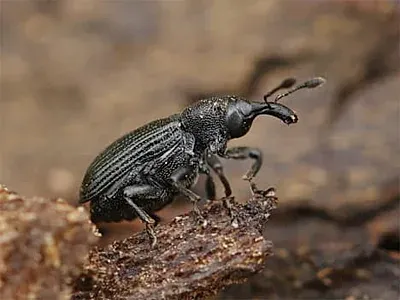
The elm weevil (Magdalis armigera) belongs to the order Coleoptera and the family Curculionidae. These beetles are relatively small, usually measuring between 3 to 5 mm in length.
The beetle exhibits a dark coloration, ranging from brown to black, often with a subtle metallic or dull luster across its exoskeleton, which aids in its camouflage against bark.
The defining feature of this species is its elongated rostrum (snout), a classic anatomical trait of weevils, which is used for feeding and preparing sites for egg deposition.
The larvae are white, legless, and have a curved, C-shaped body with a hardened brownish head capsule, specifically adapted for boring through woody tissues.
Before becoming adults, the larvae construct specialized pupal chambers beneath the bark, where they undergo transformation into the adult stage.
What it damages
As the name suggests, the primary host for Magdalis armigera is the elm tree (Ulmus). It primarily attacks weakened or stressed trees, though high populations can affect healthy specimens.
Adult beetles cause damage to buds and tender shoots in early spring, creating small feeding punctures that hinder the tree’s leaf development and overall spring vigor.
The most significant damage is caused by the larvae, which tunnel into the cambium layer. This activity disrupts the transport of water and nutrients throughout the tree.
Persistent larval feeding under the bark leads to the dieback of branches and can eventually compromise the structural integrity of the entire trunk.
Furthermore, the physical damage created by these beetles acts as an entry point for fungal pathogens, which often accelerate the decline of the infested tree.
When it appears
Adult beetles emerge in early spring, coinciding with the budding period of elm trees. This is when they begin their primary feeding activities and search for mates.
Females lay eggs in small, excavated galleries in the bark of twigs or stems. The egg-laying period is often spread across several weeks depending on temperature.
Once the larvae hatch, they begin creating galleries under the bark, where they reside and feed for the majority of the summer season.
Pupation typically occurs towards the end of summer. The new generation of adults often remains within their pupal cells to overwinter, protected by the tree's bark.
In certain regions, depending on climatic conditions, the life cycle may be completed within a single year, though cooler climates can sometimes delay development.
Signs of infestation
The most recognizable sign of an infestation is the presence of small, circular "shot-holes" on the surface of the bark, which indicate where new adults have emerged.
Early spring damage often appears as shriveled or deformed buds and leaves on specific branches, caused by the adult beetles feeding on new growth.
Thinning of the crown and the yellowing of foliage in mid-summer are common indicators that the internal vascular system is being compromised by larval tunnels.
Accumulation of "frass" or wood dust in the crevices of the bark or at the base of the tree is a classic sign of active larval boring underneath the surface.
Individual branches that appear dead or brittle while the rest of the tree is healthy may indicate localized colonization by the elm weevil.
Control measures
Sanitation is the most effective management tool. Removing and destroying infested branches or severely weakened trees helps prevent the spread of the population to healthy elms.
Applying contact or systemic insecticides during the spring emergence period can significantly reduce the number of beetles and prevent successful egg-laying.
Maintaining tree health through proper irrigation and soil care increases the elm's natural resistance, making it less attractive to colonizing beetles.
Monitoring using pheromone-based traps can help tree managers track adult activity and determine the most effective timing for chemical control measures.
- Prune and destroy infested timber immediately.
- Maintain proper tree vigor through appropriate fertilization.
- Monitor bark surfaces for new emergence holes each season.
Taxonomy
- Latin name
- Magdalis armigera
- Order
- Coleoptera (beetles)
- Family
- Curculionidae
- EPPO code
- MAGDAR
Discussion
No discussions yet — be the first.