
Elm bark weevil
Magdalis armicollis
Description
How to identify
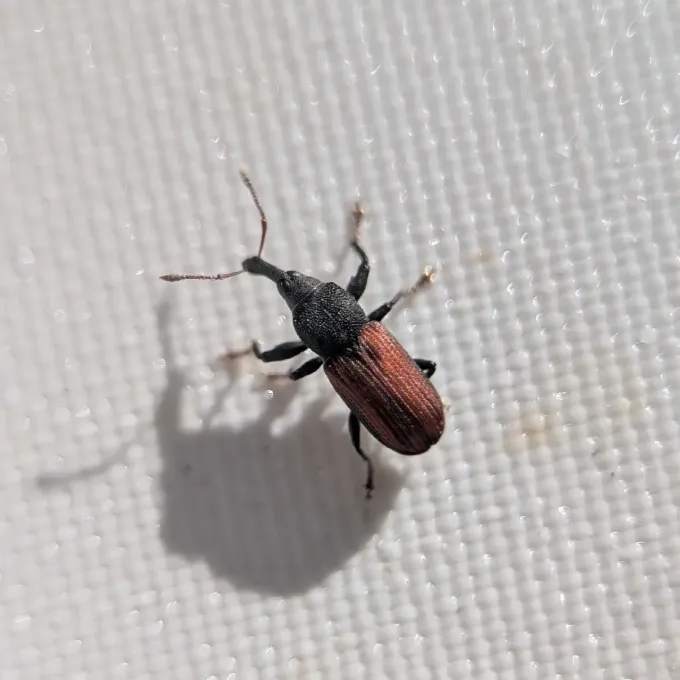
The elm bark weevil (Magdalis armicollis) is a small beetle belonging to the Curculionidae family within the order Coleoptera. Adult beetles typically measure between 3 to 5 mm in length and possess a dark, almost black or brownish coloration.
These weevils feature a distinctive rostrum (snout) characteristic of the family, as well as notably thickened front femora. Their bodies are covered with sparse, fine hairs, giving them a dull appearance.
The larvae are legless, white or cream-colored, and have a curved body shape with a well-defined brown head capsule. They develop primarily beneath the bark of host trees, making them difficult to detect until significant damage has occurred.
Pupation takes place within the wood in specialized cells. The overall morphology of the adult can vary slightly depending on the nutritional conditions the larva experienced during its development.
Precise identification often requires an entomologist to use microscopy, as several species within the Magdalis genus exhibit very similar physical characteristics.
What it damages
The primary hosts for this weevil are trees of the genus Ulmus (elms). The pest tends to target stressed, old, or physically damaged trees, making it a significant concern in urban landscapes and park management.
While adult weevils feed on young leaves and the tender bark of twigs, the most severe damage is caused by the larvae, which bore galleries into the cambium layer of the tree.
Heavy infestations lead to a severe disruption of sap flow, eventually causing the wilting and death of individual branches or even the entire crown of the tree.
Such damage severely compromises the tree's health, often inviting secondary invaders like bark beetles and wood borers, and increasing susceptibility to fungal pathogens.
In nursery settings, this species can be particularly destructive, potentially killing young saplings or significantly stunting their growth if left unmanaged.
When it appears
The life cycle of the elm bark weevil begins in the spring when adults emerge from their overwintering sites, typically coinciding with the bud break of elm trees. Adult activity peaks during late spring and early summer.
Mating occurs in late May and June, followed by the female laying eggs in small niches she gnaws into the bark of weakened branches or trunks.
Larvae develop throughout the summer months, feeding on the cambium and creating winding galleries. This period is the most critical as the tree's vascular system is compromised.
Pupation usually takes place in late summer or early autumn within prepared cells inside the wood or just beneath the bark.
The pest typically overwinters as a larva within the galleries or as an adult in the soil and leaf litter, awaiting the return of favorable temperatures in the following spring.
Signs of infestation
The first external sign of infestation is the presence of numerous small, circular exit holes on the bark, created by the adults as they emerge from the tree.
The dieback of branch tips or entire branches is a common symptom of larval feeding activity beneath the bark. Upon inspection, one may find loose or peeling bark in these areas.
During the adult activity period, one might notice small holes or notched edges on the leaves, which are evidence of adult feeding, although this is often subtle.
Under the bark of affected branches, one will find winding galleries packed with frass (wood dust), which serves as a definitive confirmation of the presence of Magdalis armicollis.
In cases of severe infestation, the tree exhibits signs of stress such as loss of turgor, premature yellowing of leaves, and deep longitudinal cracks in the bark.
Control measures
The most effective management strategy is timely sanitation, including the removal and destruction of heavily infested or dead trees that serve as breeding sites.
Pruning of dead or dying branches during the winter dormant season is highly recommended to remove overwintering larvae from the tree canopy.
- Application of systemic insecticides during the emergence period to control adults.
- Trunk injections with high-efficacy pesticides to protect high-value specimen trees.
- Maintaining optimal tree health through proper irrigation and soil care to enhance host resistance.
- Using monitoring traps to track population density and target control efforts effectively.
Biological control methods include encouraging populations of predatory birds and parasitic wasps, which can help manage weevil numbers naturally within forest ecosystems.
Taxonomy
- Latin name
- Magdalis armicollis
- Order
- Coleoptera (beetles)
- Family
- Curculionidae
- EPPO code
- MAGDAM
Discussion
No discussions yet — be the first.