
Bronze apple weevil
Magdalis aenescens
Description
How to identify
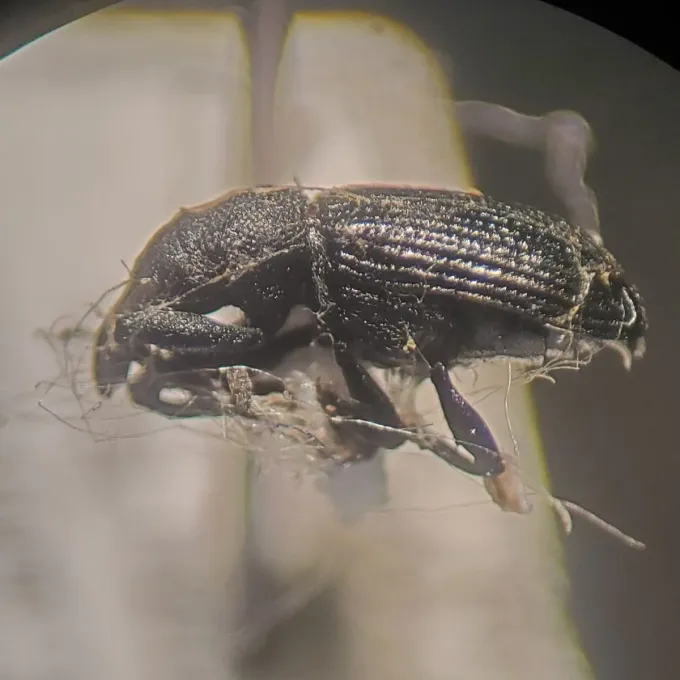
The Bronze apple weevil (Magdalis aenescens) is a small beetle belonging to the Curculionidae family. It typically measures between 3 and 5 millimeters in length and has a distinctive bronze-black coloration with a metallic sheen.
The body is elongated with a short, stout snout. The surface of the beetle is covered with fine punctures, giving it a somewhat matte appearance under magnification.
The larvae are legless, white, and curved, with a prominent brown head capsule. They are well-adapted to life beneath the bark, where they feed and develop undisturbed by many predators.
Pupation takes place beneath the bark as well, where the insect transitions into its adult form before emerging. The life cycle is tightly synchronized with the growth stages of apple and other fruit trees.
This beetle is a significant pest in many regions, especially where fruit production is intensive and proper orchard management is neglected.
What it damages
The primary hosts of this pest include apple, pear, cherry, and other fruit-bearing trees. Both larvae and adults contribute to the damage, though in different ways.
Adults feed on young buds, leaves, and tender bark. While this feeding can be damaging, it is generally secondary to the destruction caused by the larval stage.
Larvae feed under the bark, creating winding galleries that destroy the cambium layer. This disrupts the tree's vascular system, hindering the transport of water and nutrients.
In severe cases, the tree's health declines significantly, leading to branch dieback or even the death of young trees if the stem is girdled by larval tunnels.
Economic damage is often cumulative, as orchards with chronic infestations suffer from decreased vitality and reduced fruit yield over several seasons.
When it appears
Adult beetles typically emerge in late spring, usually May or June, as temperatures increase and tree sap begins to circulate. They feed on plant tissues to reach sexual maturity.
Females lay eggs in small, carefully excavated holes or cracks in the bark. A single female can produce a large number of offspring over her lifespan.
Larval development occurs throughout the summer months. The larvae spend their time excavating galleries and feeding, eventually overwintering under the bark or within the wood.
Pupation occurs early the following spring within specialized cells beneath the bark. After this process, the cycle repeats with the emergence of the new generation of adults.
There is typically one generation per year, though climatic variations can influence the exact timing of the beetle's life stages.
Signs of infestation
The most visible sign of an infestation is the presence of small, circular exit holes in the bark, indicating that adult beetles have recently emerged.
Branch dieback, particularly in summer, is a common symptom. When branches wither unexpectedly, it often points to disrupted vascular flow caused by larval tunnels underneath.
Frass (a mixture of excrement and wood shavings) near bark cracks is a clear indicator that larvae are actively feeding and tunneling within the tree's wood.
Loose or peeling bark on younger branches is often a sign of damage caused by larvae, as the destroyed cambium allows the bark to separate from the wood.
Stunted growth and a generally weak appearance of the tree are also indicators that an infestation has been present for a significant amount of time.
Control measures
Effective control relies on a combination of cultural practices and chemical interventions to maintain the health of the orchard.
Removing and destroying infested branches is essential to reduce the population. This practice must be done carefully to ensure that larvae inside the wood are also destroyed.
Applying systemic insecticides at the right time—specifically when adults emerge and begin supplemental feeding—can be highly effective in controlling the population.
Good orchard maintenance, such as proper pruning and ensuring the trees are not stressed by drought or malnutrition, helps trees resist and recover from pest attacks.
- Annual winter pruning to remove damaged or dead wood.
- Applying white wash or protective coatings to tree trunks.
- Using pheromone or visual traps to monitor beetle activity.
- Spraying with approved insecticides during the early spring emergence.
- Promoting natural predators in the orchard to manage pest numbers.
Taxonomy
- Latin name
- Magdalis aenescens
- Order
- Coleoptera (beetles)
- Family
- Curculionidae
- EPPO code
- MAGDAE
Discussion
No discussions yet — be the first.