
Round-eared sengi
Macroscelides proboscideus
Description
How to identify
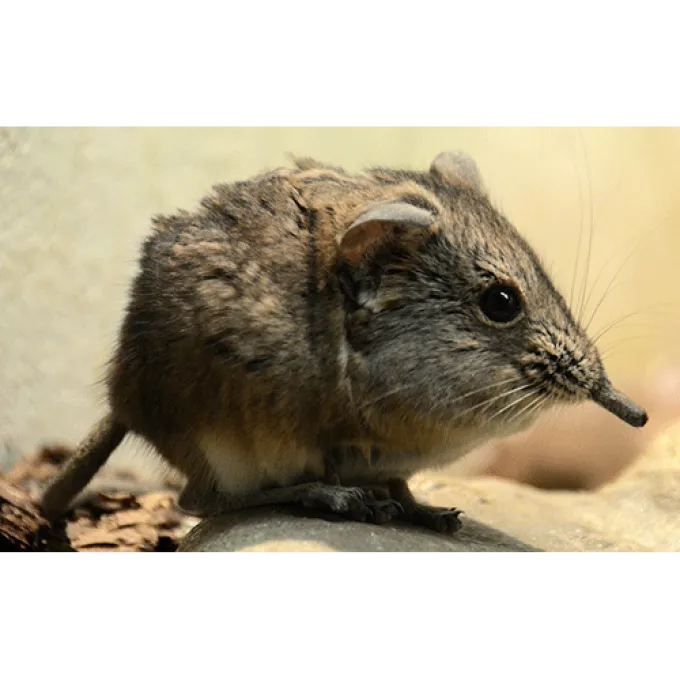
The round-eared sengi (Macroscelides proboscideus), also known as the round-eared elephant shrew, is a small insectivorous mammal belonging to the order Macroscelidea. It is characterized by its elongated snout, which it uses to forage for insects in leaf litter and sandy soil.
Physically, the sengi has long hind legs adapted for rapid hopping, a slender tail, and a brownish-grey fur pattern that provides excellent camouflage in arid habitats. Adults typically measure about 10–12 cm in length.
The name "round-eared" distinguishes it from other species within the family. These animals have large, expressive eyes, reflecting their need for acute vision to avoid predators while active during the day or twilight hours.
They are primarily solitary creatures that construct shallow burrows or take shelter in natural rocky crevices. They exhibit a high degree of alertness and are known to be quite shy when encountering larger animals or humans.
In an agricultural context, they are not typically considered major pests, as their diets are largely carnivorous. However, their physical presence on farmland can occasionally interfere with cultivation processes.
What it damages
The round-eared sengi is primarily an insectivore, consuming a high volume of ants, termites, and beetle larvae. This behavior often makes them beneficial to farmers by controlling populations of agricultural insect pests.
When natural food sources are scarce, they may supplement their diet by eating seeds, berries, or small plant sprouts. This can lead to minor damage to vegetable crops or newly sown grain seeds if they are accessible on the soil surface.
The main agricultural concern is the structural damage caused by their burrowing activities. The construction of complex tunnel networks under field crops can destabilize the root zones of seedlings, leading to reduced growth or plant loss.
Furthermore, their presence can create pathways through the soil, which might facilitate the movement of other, more destructive rodent species that are attracted to the same crops.
It is important to emphasize that their impact is usually localized and rarely results in significant economic losses for commercial-scale farming operations.
Signs of infestation
The most reliable indicators of their presence are the small, circular burrow openings, typically 3–5 cm in diameter, located near the edges of fields or rocky clearings.
Distinctive hopping tracks can often be observed in soft soil, where the impressions of the longer hind feet are more pronounced than those of the smaller forelimbs.
Evidence of plant damage is subtle and usually manifested as small, precise nibbling marks on the base of young stems or damaged seed coats on the soil surface.
Increased soil looseness or small mounds of dirt in garden rows may indicate recent excavation by sengi colonies seeking insects among the roots of crops.
Direct sightings are most common during early morning or late afternoon when the animals are most active while foraging in the vicinity of their burrows.
Control measures
Given that round-eared sengis are an essential part of the arid ecosystem and act as natural pest controllers, lethal control measures are generally discouraged and rarely necessary.
The most effective strategy is the use of non-lethal deterrents, such as ultrasonic devices that emit frequencies uncomfortable for small mammals, effectively encouraging them to move away from crop areas.
Physical barriers, such as densely planted thorny hedgerows or wire mesh fencing installed at the perimeter of the field, can be very effective at limiting the movement of sengi populations into cultivated plots.
Managing the area surrounding the fields by clearing debris and preventing dense shrubbery helps eliminate the cover needed by the sengi, naturally pushing them toward wilder areas.
Environmentally friendly repellent sprays, based on natural scents or essential oils, can be used sparingly around vulnerable crop beds to discourage foraging without harming the local wildlife population.
Taxonomy
- Latin name
- Macroscelides proboscideus
- Family
- Macroscelidae
- EPPO code
- MAKRPR
Discussion
No discussions yet — be the first.