
Macrocheles mites
Macrocheles
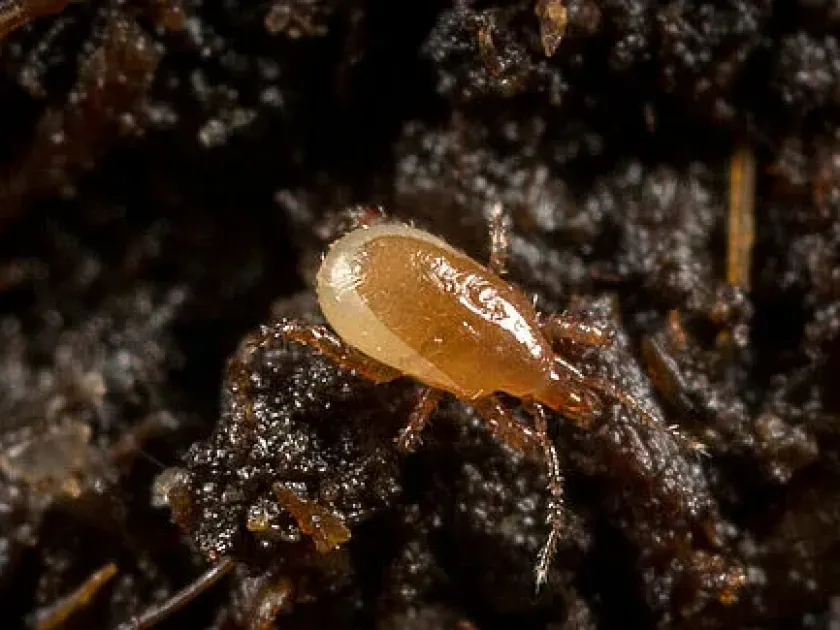
Description
How to identify
Macrocheles (genus Macrocheles) are predatory mites belonging to the order Mesostigmata and the family Macrochelidae. They are widely distributed across all continents.
These mites are typically small, measuring between 0.5 and 1 mm in length. Their bodies are flattened and brownish, which facilitates movement through soil and decomposing organic matter.
The defining morphological feature of this genus is the presence of robust chelicerae, specialized for grasping and consuming small invertebrates, particularly eggs and larvae of dipterans.
The life cycle encompasses egg, larva, protonymph, deutonymph, and adult stages. Under favorable conditions, they reach maturity very rapidly, allowing for quick population growth.
They are primarily dwellers of damp environments such as manure, compost, decaying leaves, and moist greenhouse soils, where they hunt their prey.
What it damages
While Macrocheles mites are technically beneficial predators in nature, they are often considered pests or nuisances in intensive horticultural production environments.
They do not cause primary tissue damage to healthy plant parts; however, they are mechanical vectors for various plant pathogens and fungal spores carried on their bodies.
Their presence in high densities can compromise the quality of agricultural produce, especially in sensitive indoor cropping systems like mushroom farming or hydroponics.
Macrocheles mites can interfere with integrated pest management (IPM) programs by competing with or preying upon other beneficial predatory mites introduced for biological control.
In some cases, their presence in potting media can stress young transplants or seedlings, hindering root system development and overall plant vigor.
When it appears
Macrocheles mites maintain year-round activity in climate-controlled greenhouse environments, provided that moisture levels remain consistently high.
Peak population growth occurs during warmer months when temperature and humidity levels are optimal for the rapid decomposition of organic substrates.
Humidity is the most critical environmental factor for their survival, as they require high levels of moisture to prevent desiccation during their development.
During colder periods, population activity declines, and the mites enter a state of reduced metabolic rate, surviving in protected moist micro-refugia.
Migration between crops occurs via phoresy, where the mites attach to the bodies of flying insects (like fungus gnats) to travel to new host sites.
Signs of infestation
The primary sign of a Macrocheles infestation is the observation of numerous tiny mites congregating on the moist surface of the soil or growing medium.
Monitoring traps for other pests, such as fungus gnats or shore flies, often reveals the presence of mites clinging to the wings or legs of the trapped insects.
Infested root zones may show signs of inhibited growth, particularly in young plants that are sensitive to changes in the soil microbiome.
- Visibility of tiny, active mites on damp soil or substrate surfaces.
- Mites observed attached to adult flies or other winged insects.
- Disturbed soil health or presence of predatory mites in laboratory soil samples.
- Unexplained decline in vigor of seedlings growing in non-sterile organic media.
Detection is often linked to the presence of other associated organic-waste-loving insects, which serve as transport vehicles for the mites.
Control measures
Effective management begins with strict sanitation practices, including the use of sterilized growing media and proper waste management in the greenhouse.
Reducing the moisture levels in the growing medium, if the crop permits, can significantly inhibit the population expansion of these mites.
Ensuring that all organic inputs, such as compost or manure, are fully processed and free from pest contamination is crucial for prevention.
Biological control using entomopathogenic fungi, such as Beauveria bassiana, can be effective in reducing mite numbers without harsh chemicals.
If chemical intervention is necessary, targeted acaricides should be used, carefully selecting products that do not harm the other beneficial organisms in the IPM system.
Taxonomy
- Latin name
- Macrocheles
- Order
- Mites
- Family
- Macrochelidae
- EPPO code
- MACHSP
Discussion
No discussions yet — be the first.