
Blue-winged blister beetle
Lytta cyanipennis
Description
How to identify
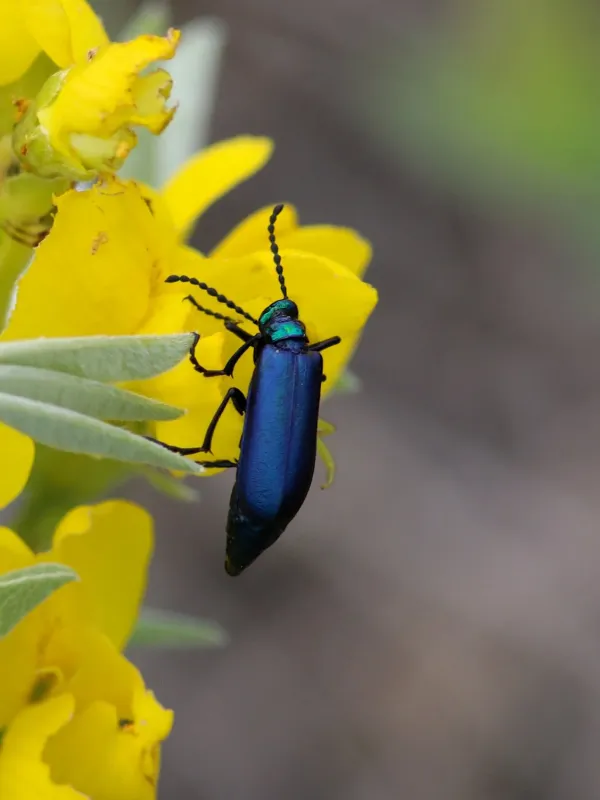
The blue-winged blister beetle (Lytta cyanipennis) is a member of the Meloidae family, belonging to the order Coleoptera. These beetles are characterized by their metallic blue or greenish elytra and elongated body shape.
Adult beetles typically measure 15–20 mm in length. They feature a prominent head and eleven-segmented antennae. A distinguishing feature of this family is the secretion of cantharidin, a toxic substance in their hemolymph that acts as a potent chemical defense against predators.
These insects are highly active during the day, thriving in sunny and open areas. They possess strong legs and wings, allowing for rapid movement and effective dispersal across agricultural landscapes in search of host plants.
Their life cycle is complex and involves hypermetamorphosis, where the larvae undergo several distinct developmental stages, each with significant physiological differences in anatomy and behavior.
The primary larvae, or triungulins, are highly mobile and equipped with well-developed legs to actively search for food sources, often targeting the nests of solitary bees or locust eggs in the soil.
What it damages
The blue-winged blister beetle is a polyphagous pest, meaning it feeds on a wide variety of plants. Adults are the primary cause of damage, as they engage in aggressive defoliation of cultivated crops.
They frequently target plants in the Solanaceae family, including tomatoes, potatoes, and eggplants. Leguminous crops such as beans, peas, and soybeans are also common food sources for this beetle.
Besides vegetables, the beetles can devastate flower gardens by consuming flower buds and petals, which ruins the ornamental value of the plants and disrupts the reproductive phase.
Damage is characterized by irregular holes in the leaves and the consumption of leaf margins. In severe cases, the beetles may skeletonize the leaves, leaving only the primary veins intact.
When high populations occur, these beetles can cause rapid and significant destruction of vegetation, potentially reducing the overall yield of the crop and weakening the plant's health.
When it appears
Adult blue-winged blister beetles are most active during the summer months, typically emerging between June and August, depending on the regional climate and temperature conditions.
Their appearance is closely tied to the onset of warm weather, which triggers the emergence of adults from the soil. Once active, they tend to cluster on host plants to feed and mate.
During hot, sunny days, these beetles are extremely active and spend most of their time feeding on exposed foliage. In contrast, they tend to hide within denser plant cover during cooler or overcast weather.
The developmental cycle is staggered, ensuring that beetles can be present in fields throughout much of the growing season, which necessitates long-term monitoring by farmers.
Overwintering occurs primarily in the larval stage, residing deep within the soil or in the nests of their insect hosts, providing them with protection against cold temperatures.
Signs of infestation
The most visible sign of an infestation is the sudden appearance of irregular, ragged holes in the leaves of host plants. The edges of the leaves may look as if they have been chewed by a large insect.
Significant loss of leaf tissue is another indicator. If left unchecked, the damage can progress from small holes to large portions of the plant being consumed, leading to severe defoliation.
Observation of the adult beetles themselves is a definitive sign. They are often seen feeding in groups, making them relatively easy to spot on flowers and the tops of leaves during the day.
Flower buds that fail to open or appear chewed and deformed are clear signs of feeding activity, as the beetles prioritize nutrient-rich parts of the plant during their reproductive cycle.
The presence of beetle excrement and small dark spots from their protective hemolymph secretion on the surface of the leaves can confirm the presence of these pests on the crop.
Control measures
Effective management requires an integrated approach that focuses on disrupting the beetle's life cycle and protecting the crop during its most vulnerable growth stages.
Cultural practices such as deep fall plowing are essential to disturb the soil, which can destroy the larvae's overwintering sites and expose them to unfavorable conditions.
Maintaining clean fields by removing weeds that serve as alternative food sources can help reduce the initial beetle population before they migrate to valuable cash crops.
For chemical control, insecticides effective against coleopteran pests should be applied if the economic threshold is exceeded, ensuring proper application timing for maximum impact.
- Monitor fields using light traps to detect adult beetle emergence early.
- Use protective gear (gloves) when hand-picking beetles to avoid contact with toxic hemolymph.
- Apply biological control agents, such as entomopathogenic fungi, to target beetle populations.
Taxonomy
- Latin name
- Lytta cyanipennis
- Order
- Coleoptera (beetles)
- Family
- Meloidae
- EPPO code
- LYTTCY
Discussion
No discussions yet — be the first.