
Lorryia
Lorryia
Description
How to identify
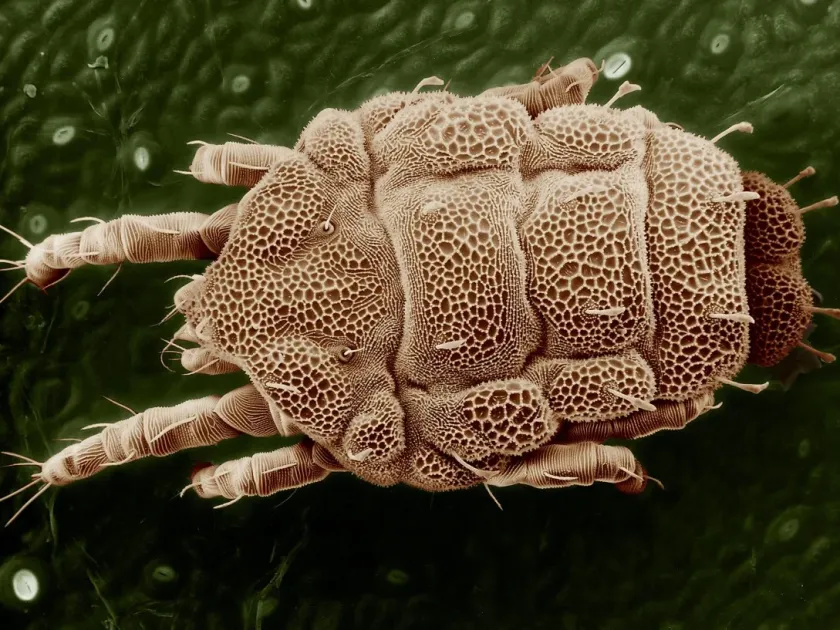
Lorryia belongs to the Tydeidae family, suborder Prostigmata. These are microscopic mites that often remain unnoticed by the naked eye due to their extremely small size and ability to move quickly across the leaf surface.
The body of the mite typically has an elongated or oval shape, with colors ranging from whitish to reddish or brown depending on the species and diet. They possess a characteristic mouthpart structure adapted both for sucking juices and consuming fungal mycelium.
The life cycle includes egg, larva, protonymph, deutonymph, and adult stages. Unlike many other plant-feeding mites, some Lorryia species are facultative predators or mycetophagous, which complicates their diagnosis.
The high reproduction rate under favorable conditions allows the population to quickly reach the economic injury level. In warm and humid conditions, the development cycle from egg to adult can take only a few days.
Identification is difficult due to similarities with other members of the Tydeidae family. For accurate species determination, laboratory microscopy with clearing agents is often required.
What it damages
Lorryia infests a wide range of agricultural crops, including fruit trees, berries, greenhouse vegetables, and ornamental plants. They are frequently found on grapes, citrus, and various decorative shrubs.
They pose a particular danger to young seedlings and plants with weakened immune systems. They are capable of colonizing both the upper and lower sides of the leaf blade, selecting areas along the veins.
Besides direct damage, some Lorryia species are vectors for various viral and fungal diseases. By compromising the epidermis, mites create entry points for secondary infections.
In greenhouses, damage from these pests is significantly higher due to the absence of natural enemies. They can massively colonize leaves, leading to premature leaf drop and shoot deformation.
Economic damage consists of reduced photosynthetic activity in plants, which inevitably leads to yield losses and decreased aesthetic quality of produce.
Signs of infestation
One of the first signs of infestation is the appearance of small light spots (chlorotic areas) on the leaf surface, which gradually merge into larger areas.
With heavy infestation, general growth inhibition, leaf curling, and the appearance of a characteristic "rusty" or grayish coating, consisting of excrement and mite shed skins, can be observed.
Unlike spider mites, Lorryia rarely forms noticeable webbing, which often misleads agronomists during diagnosis. Leaves may acquire a dusty appearance.
In early stages, signs are easily confused with micronutrient deficiencies, as damaged tissues lose chlorophyll. Careful inspection using a 20x magnifier allows for the detection of mobile individuals.
In cases of infestation by mycetophagous Lorryia species, patches of sooty mold may develop on the leaves, feeding on the pest's metabolic byproducts.
Control measures
The primary control method is the application of specific acaricides, whose efficacy should be verified for the specific region. It is important to rotate products to prevent the development of resistance.
Agronomic measures include regular greenhouse ventilation, maintaining optimal humidity levels, and timely removal of weed vegetation that serves as a reservoir for the pest.
Biological control involves the use of predatory mites from the Phytoseiidae family, which can naturally reduce Lorryia populations if the temperature regime is maintained.
When working in protected ground, preventive treatments based on sulfur or oils are recommended, as they act via contact and reduce the mobility of the individuals.
- Regular monitoring using yellow sticky traps.
- Thorough disinfection of tools after working with infested plants.
- Adherence to quarantine measures when importing new planting material.
- Use of high-quality, pre-treated planting material.
Taxonomy
- Latin name
- Lorryia
- Order
- Mites
- Family
- Tydeidae
- EPPO code
- LORRSP
Discussion
No discussions yet — be the first.